PART 3
The truth finally came out on a rainy afternoon. Aditi appeared at the door of Mr. Sharma and Meera’s home, soaked, without makeup, her eyes swollen from crying. Mr. Sharma didn’t want to open the gate, but Meera asked to hear her from behind it. “I came to tell you something before I leave the city,” Aditi said. Meera didn’t respond. “Raghav and I separated.” Mr. Sharma let out a bitter laugh. “How convenient. When he had money and status, you celebrated him. Now that he’s lost his job, he’s no longer useful to you.” Aditi lowered her gaze. “You’re right.” Meera shivered slightly. She hadn’t expected honesty. “I pushed him against you,” Aditi confessed. “Not because you were a bad mother. On the contrary. Because he loved you too much.” Meera felt a knot tighten in her throat. “That bothered you?” “It made me feel sick. My mother was never like you. In my home, no one hugged, no one asked if you’d eaten, no one saved your favorite dish. When I saw how Raghav spoke about you… how he still sought your approval… I felt I would always come second.” “So you decided to destroy him,” Mr. Sharma said.
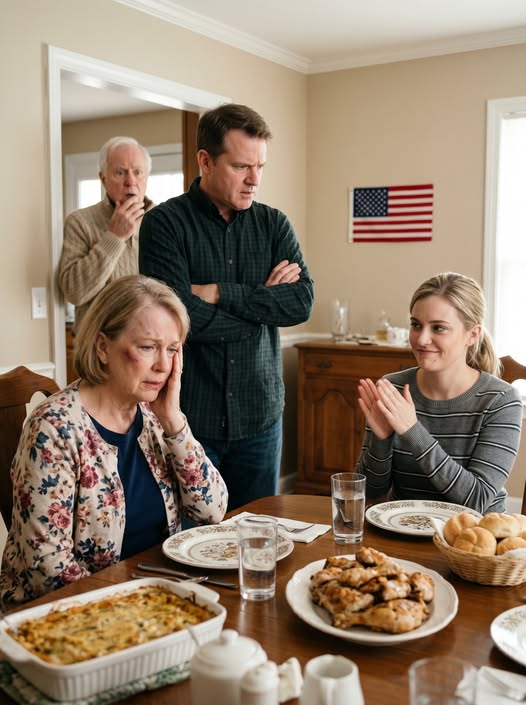
“I decided to separate him from you. First with comments. Then by mocking his calls. Then by telling him that a married man shouldn’t be so attached to his mother. He started believing it. And when he slapped her… I clapped because I thought I had won.” Meera cried silently. “And did you win?” she asked softly. Aditi shook her head. “No. I ended up with a man capable of hitting his mother. And a man who hits his mother will eventually destroy his wife too.” That day, Aditi left. No one stopped her. Raghav tried to return once more. He showed up thinner, his shirt wrinkled, his eyes hollow. He stood outside the gate like a punished child. “Mom… forgive me. I’ve lost everything.” Meera looked at him with a mixture of love and pain. “You’re not here because you’ve understood, Raghav. You’re here because you’re alone.” He cried. “I’m your son.” “Yes,” she said. “And I am your mother, not your doormat.” Raghav covered his face. “Give me another chance.” Mr. Sharma stepped closer to Meera, ready to support her if she wavered. But she didn’t. “A chance isn’t a door opened so you can hurt us again. If you truly change, it will be shown through actions, not tears. For now, this house needs peace.” Raghav stayed a few seconds longer. Then he walked away under the sun without turning back.
Months later, they learned he had moved to another city and was working a modest job in an auto parts shop. They didn’t know whether he was better or worse. And for the first time, that uncertainty no longer controlled their lives. Meera started therapy. Then she enrolled in an open schooling program she had abandoned in her youth. After that, she began volunteering at a local school, reading stories to children who needed support. She discovered she still had love to give—but now she understood something she hadn’t before: love without boundaries can become a cage. Mr. Sharma sold the dining table. “I don’t want to sit again where I saw you cry,” he said. They bought a smaller wooden table in Delhi’s local market—simple, light-colored, unadorned. Their first meal there was lentil soup, green chicken curry, and rose-flavored sherbet. Nothing fancy. But they ate in peace. “It feels different,” Meera said. “The food?” he asked. “Life.” They also adopted a mixed-breed dog named Chintu. Meera laughed because the dog followed her everywhere, wagging its tail as if she were the most important person in the world. “This little one appreciates me more for a bowl of food than Raghav did in all his years,” she said one afternoon. Mr. Sharma didn’t know whether to laugh or cry. Over time, shame stopped weighing on them. When neighbors asked about Raghav, Meera answered honestly. “My son assaulted me, and we had to set boundaries.” Some were shocked. Others lowered their voices and shared similar stories—sons who took money, daughters-in-law who disrespected, grandchildren used as leverage. Meera realized her pain wasn’t rare; what was rare was the courage to stop it. Two years later, Meera turned sixty-one. Mr. Sharma took her to the sea in Goa, somewhere she had never been. When she touched the sand barefoot, she cried like a child.
“We lost so many years,” she said. He took her hand. “But not the ones we still have.” That night, they ate fish by the shore. Meera sang off-key along with a small band passing by. Mr. Sharma recorded her on his phone. In the video, she didn’t look like a broken mother or a humiliated woman. She looked free. Sometimes, Meera still missed the boy Raghav had been—the one who ran to her with scraped knees, who asked for hot milk, who slept holding her sleeve. But she had learned not to confuse the child in memory with the man who chose to hurt her. And Mr. Sharma learned that being a father does not mean covering up a child’s mistakes until dignity disappears. It means teaching consequences, even when they hurt. It means protecting the one who has been harmed, even if the aggressor carries your blood. Because a family where one person must shrink themselves so others can feel comfortable is not a family. It is a prison. And sometimes, closing the door is not about stopping love. Sometimes, closing the door is the only way to start living again.