“No Man Has Ever Kissed Me,” She Whispered. The Co…
“No Man Has Ever Kissed Me,” She Whispered. The Cowboy Removed His Hat And Said, “Then We’ll Start Slow.” But Seconds Later, A Gunshot Shattered The Night.
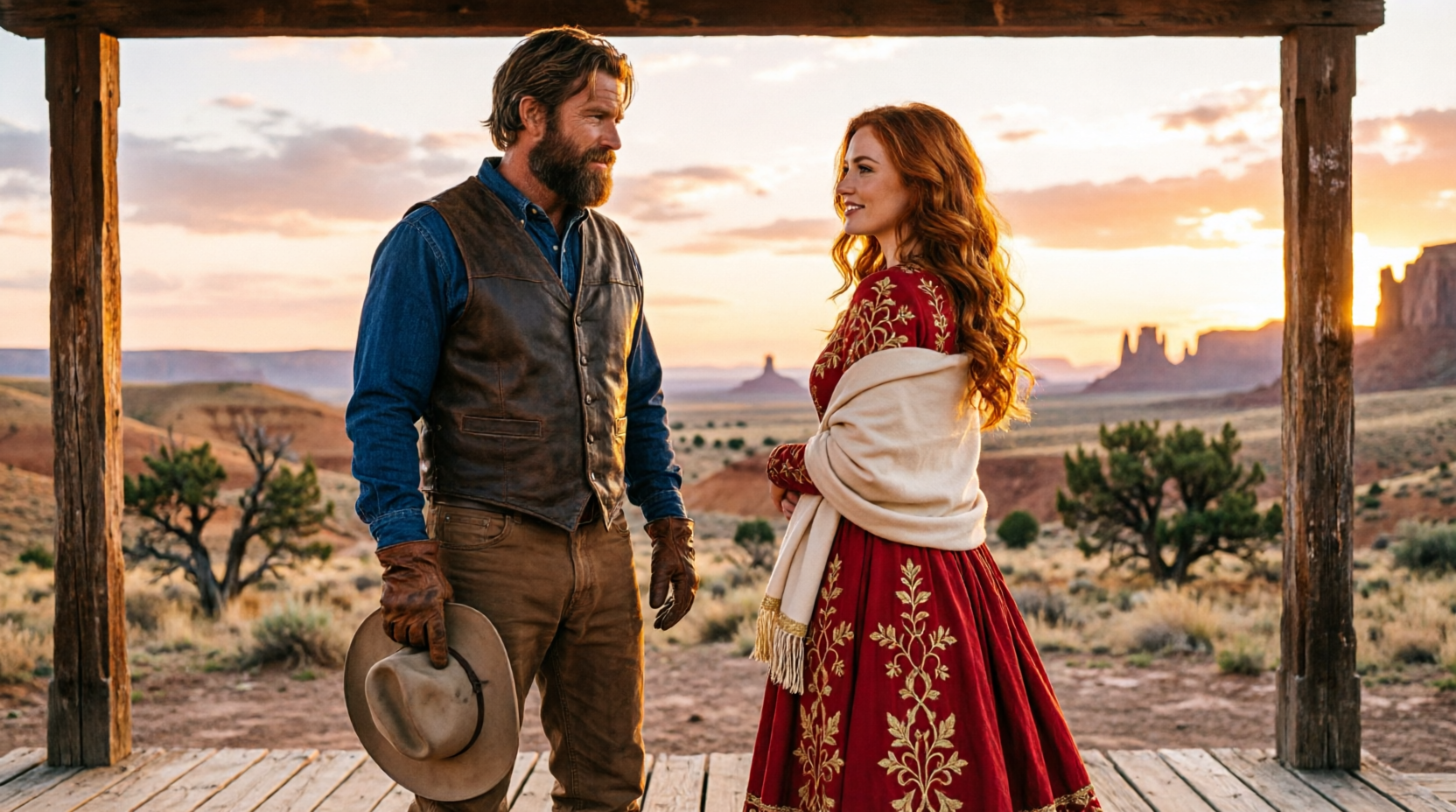 “It’s been a long time since I talked to anyone like this,” she murmured.
Juan turned slightly toward her.
“Same for me.”
She looked out at the darkening land and felt her heart begin to hammer against her ribs with a force that seemed absurd for a woman her age who had survived so much harsher things than conversation.
And before she could stop herself, before dignity or fear or habit could close over the impulse, she said the truest thing in her.
“No man has ever kissed me.”
The silence that followed was so complete it seemed the whole world had paused to listen.
Juan did not laugh.
He did not shift closer with sudden male certainty. He did not seize on the confession as though it were a door left unwisely unlatched. Instead he turned toward her slowly, took off his hat, and held it in both hands.
Then, with a gentleness that almost undid her, he said, “Then we’ll start slow.”
He did not move toward her.
He did not corner her.
He did not claim anything from the moment except honesty.
Leonor felt tears rise behind her eyes so fast it made her angry. She turned her face slightly away, embarrassed not by the tears themselves, but by how much the tenderness in his voice hurt her. There are people so starved of gentleness that the first true portion of it feels almost like pain.
That night, after the fire burned low and wind began worrying at the shutters, Juan came to the door to tell her he would check the west fence at first light. It was the kind of practical sentence their days had been built from all week. Yet both of them stood in the doorway longer than such a sentence required.
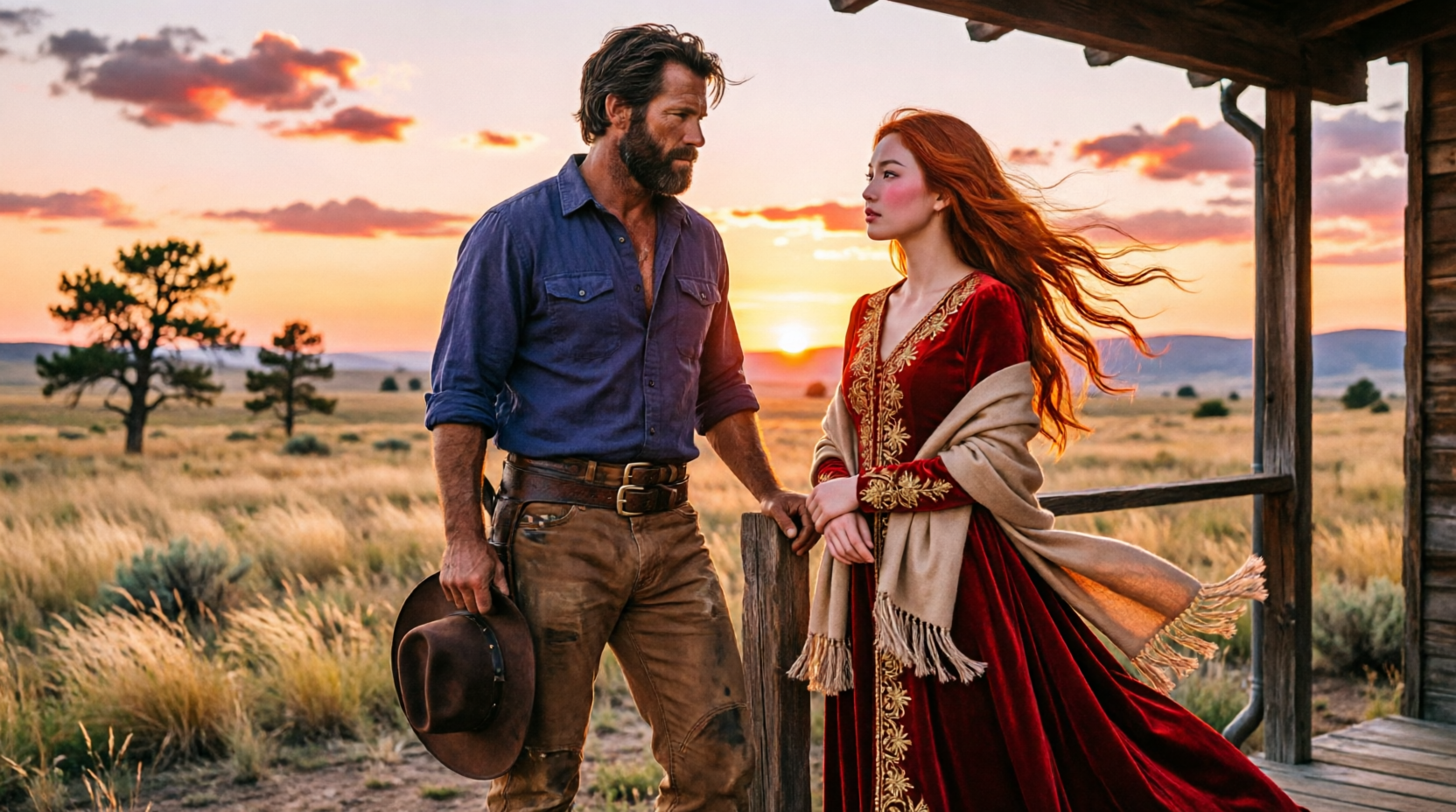
Darkness wrapped the porch.
The lamp inside the cabin glowed weakly behind her shoulder.
They stood close enough now that Leonor could see the fatigue carved around his eyes, the road and weather still in him, the patience. She no longer knew whether she was afraid of him or of how badly she wanted him to stay.
“Maybe,” she whispered, “maybe we both ought to start slow.”
A little smile touched his mouth.
“I’d like that.”
Leonor held out her hand.
He answered by offering his palm.
Their fingers had only just touched when the gunshot exploded from the dark.
The cabin window blew inward behind them in a shower of shattered glass. The horse screamed in the yard. Juan moved with shocking speed, catching Leonor hard around the waist and driving her down to the porch boards as another shot tore through the blackness beyond the yard.
A voice thundered from the direction of the river.
“SALAZAR! COME OUT RIGHT NOW OR I’LL BURN THE WHOLE PLACE DOWN!”
Leonor’s blood turned to ice.
Because whoever was out there had not stumbled onto the cabin or mistaken the place for some other target. He had come by name. For her.
And when she looked up at Juan, the expression that crossed his face was worse than fear.
Recognition.
He knew who was hiding in the dark.
Amazing Reading Part 2
For a moment Leonor could hear nothing but the ringing left behind by the shot and the violent pounding of her own heart.
Broken glass scattered over the floorboards around them. The horse in the yard kicked and snorted, pulling hard against its tether. Wind drove cold night air through the shattered window and into the cabin behind them. Somewhere near the riverbank, out beyond the black line of the cottonwoods, a second horse shifted weight with the faint jingle of tack.
Juan still had one arm around her shoulders, holding her low.
His body had gone hard with that particular tension that does not come from surprise, but from recognition of a danger one hoped had been left much farther away.
“Who is it?” Leonor whispered.
He did not answer at once.
Another voice from the dark. The same man, closer now or louder, or perhaps only drunk on the sound of himself.
“You hear me, girl? I know you’re there!”
Leonor swallowed and felt the old terror rise up through her, bitter and immediate.
There are threats a person fears because they might happen, and threats she fears because some part of her has always known they would. Living alone had taught her to imagine many endings. Men arriving in daylight. Men arriving after whiskey. Men deciding a woman without brothers or sons was simply land in another form. But this did not feel random enough to be that kind of danger. There was purpose in the voice. History. Claim.
And Juan knew it.
He lifted his head slightly, listening.
Then, very low, he said, “Get inside. Stay below the window.”
Leonor grabbed his sleeve.
“No. Tell me who—”
But a third shot cracked through the night and splintered the porch post just above them.
Juan swore under his breath.
“Inside,” he said again, more sharply this time.
She obeyed, though not because he ordered it. She obeyed because the porch had become a killing ground and because whatever questions burned in her could survive another minute unanswered if the alternative was dying with them still in her mouth.
They moved low and fast into the cabin.
The room looked suddenly strange under threat, every familiar object turned unstable by danger. Her table. The stove. The shelf of crockery. The bed in the corner. The small lamp guttering against the draft. Glass glittered across the floor from the broken window. Juan crossed to the far wall, pulled his revolver from beneath the coat he’d left draped over a chair, and checked the cylinder with a speed that suggested long practice.
Leonor felt a coldness take hold in her that had nothing to do with the night air.
“You’re armed,” she said.
Juan looked at her once.
His face in the half-light was no longer the face of the man who had chopped wood and fixed hinges and spoken softly about starting slow. That man was still there somewhere, but over him now lay another self entirely—more dangerous, older in ways that had nothing to do with age, and sharpened by whatever had just ridden out of the dark to find him here.
“Who is he?” she asked again.
Juan crossed to the window, staying low.
Then he said, “Tom Blevins.”
The name landed in her with no recognition at all.
It must have shown, because even in that moment Juan gave a quick, humorless shake of the head.
“You don’t know him,” he said. “Good. Keep it that way.”
Another shout came from outside.
“SALAZAR! DON’T MAKE ME COME GET YOU!”
This time Leonor knew the voice was wrong not only because it threatened her, but because it knew too much. Her name. Her cabin. Her presence alone. Someone had not simply found her. Someone had looked for her. Which meant one of 2 terrible things was true: either this man had come for her from some history she did not know she had, or he had come because Juan had brought his own history to her doorstep.
The realization hit her so cleanly she felt almost calm.
“This is not about me,” she said.
Juan did not deny it.
Outside, the horse stamped again.
Tom Blevins laughed once, harsh and carrying.
“I know you’re in there, Bravo!”
Leonor turned so fast her shoulder struck the table.
“Bravo?”
Juan shut his eyes for the briefest second.
Then opened them.
That was enough of an answer.
Everything in the room shifted.
The name he had given her—Juan Bravo—had been spoken by the man outside not as introduction, but as pursuit. Not the way you say the name of a stranger. The way you say the name of someone you’ve been hunting long enough to hate the sound of it.
“You lied to me.”
The accusation came out quieter than she intended, less angry than wounded.
Juan looked at her across the dark cabin.
“Yes,” he said.
He did not dress it in excuses. He did not tell her he’d meant to explain when the time was right. He did not reach for the easier evasions. In a strange way, that bare admission hurt less than any defense might have.
“About what?” she demanded.
The porch creaked.
He moved to the side of the window again, revolver steady in one hand.
“Enough to matter,” he said. “Not enough to change what I felt in this house.”
She stared at him.
There was no time to unravel the sentence. No time to decide whether it comforted or insulted her. Outside, a shape moved near the woodpile, little more than a heavier density in the dark. Tom Blevins had dismounted. He was coming closer.
Juan pointed toward the rifle leaning beside the bed.
“Can you still shoot as straight as you did when I rode in?”
She crossed the room in 2 steps and took it up.
The familiar weight in her hands steadied her more than any reassurance could have.
“Yes.”
“Good.”
A beat of silence.
Then, without looking at her, Juan said, “If he tries the door, you shoot him.”
There are moments in life when trust comes not as comfort, but as necessity. Leonor did not know whether she trusted Juan Bravo the man. She no longer knew if such a man existed in the simple form she had accepted all week. But she trusted the assessment in his voice. The immediate threat. The fact that fear had never yet made him foolish.
So she nodded once.
Outside, Tom called again.
“You think hiding in there changes anything? I’ve crossed 2 territories and half a season to find you.”
Juan muttered, not to her but to himself, “Should’ve known he’d never let it go.”
Leonor heard it.
“What did you do?”
For a second she thought he would refuse. Then perhaps some last instinct toward honesty, now that the lie had already cracked open, won out.
“I used to ride with him,” Juan said.
The words entered the room like another shot.
Leonor’s grip tightened on the rifle.
“Ride with him where?”
“Everywhere men like him go when there’s money in taking what isn’t theirs.”
She could hear the rest even before he said it.
Stage routes. Freight wagons. Isolated camps. The thin places between towns where the law arrived slowly and graves closed fast.
“I left,” he said. “He didn’t.”
“And he’s here because you left?”
Juan’s mouth hardened.
“He’s here because I took something with me.”
Outside, a boot thudded against the porch step.
Tom’s voice came from frighteningly near now.
“You know what I want, Bravo. Hand it over and I might leave the girl alive.”
Leonor’s heart lurched.
The girl.
Not even a woman with a name to him. Just a risk attached to the main business. Something disposable if the proper bargain could not be made.
Juan looked at the floorboards for half a second, then crossed to the shed-side wall where his bedroll still rested from the nights he had spent out there. He knelt and slid one hand under the folded blanket. When he brought it back out, he held a leather packet wrapped in oilcloth and tied with cord.
Leonor stared.
He had hidden it here. In her shed. On her land. Under her roof.
“What is that?”
Juan did not answer immediately.
The porch creaked again.
Tom was near the door now.
Instead of explaining, Juan untied the cord, stripped back the oilcloth, and handed Leonor the packet.
She hesitated only long enough to realize the thing was heavier than paper should have been. Inside were folded documents, a little metal key, and a ledger small enough to fit inside a coat.
Juan spoke quickly now, every word shaped by urgency.
“Land deeds. Payment records. Names. Routes. Account books. Enough to put 6 men in prison and ruin 3 more besides. Blevins’s operation. Freight theft, ranch extortion, protection payments, bribed deputies. Everything.”
Leonor looked up from the packet.
“You stole this?”
“I took it when I left.”
“Why?”
His eyes met hers then, and for the first time since the gunshot she saw not only the dangerous man but the exhausted one beneath him.
“Because I got tired of helping men like him bury decent people.”
The answer would have meant more had it come 1 hour earlier, 1 day earlier, any time before the shots in the dark and the false name and the horseman calling Bravo from the riverbank. Even so, something in it rang true enough that she could not dismiss it entirely.
Tom hammered the door with one fist.
The cabin shook.
“LAST CHANCE!”
Juan turned his head toward the sound, revolver raised.
Then he spoke to her in a tone so controlled it frightened her more than shouting would have.
“There’s a trapdoor under the bed. Root cellar. You get in there with the ledger and you don’t come up until it’s light or you hear my voice and no one else’s.”
Leonor stared at him.
“You think I’m leaving you here?”
“I think if Blevins gets that packet, every decent thing I’ve tried to do since leaving him dies with it.”
Another blow against the door.
The latch groaned.
“And if he gets you?” she asked.
Juan’s face changed then, only slightly, but enough.
“That was always more likely than I let you believe.”
He stepped toward her once, close enough that she could see the tiredness around his eyes again, the same tiredness she had seen the first afternoon he rode up and asked for a little kindness left in the world.
“I am sorry,” he said, and now the apology was for more than the false name. “About all of it.”
Leonor held his gaze.
Fear pressed at her from every direction. Fear of the man outside. Fear of the man in front of her. Fear of what it meant that tenderness and danger had entered the same week wearing the same face. But underneath the fear was something else she could not deny.
Juan had stayed.
He had fixed what was broken without asking ownership of the place.
He had never taken a thing from her body or house that she did not offer.
And now, with death on the porch, he was trying to give her the one thing his lies had endangered most.
A chance to live.
The latch snapped.
The door shuddered inward.
Juan moved instantly, firing once through the opening as Tom crashed against the threshold. The report inside the cabin was deafening. Smoke filled the air. Leonor flinched, stumbled, then obeyed at last, dropping to her knees beside the bed and shoving the packet beneath her blouse before wrenching up the trapdoor ring.
Cold earth smell rose from below.
Another shot from outside.
Wood splintered.
Juan shouted something she did not catch over the ringing in her ears.
She looked back once before climbing down.
He was in the center of the cabin, one shoulder turned, revolver lifted, body set between the broken door and the place she disappeared. Rain blew in through the shattered window behind him. Glass, smoke, wind, gunpowder, lamplight, all of it made the room look unreal—as though the week itself were burning up around its own center.
Then Leonor dropped into the cellar and pulled the trapdoor nearly shut above her.
Darkness closed around her with the smell of dirt, onions, and old potatoes.
She could hear everything.
The scrape of boots overhead.
A shot.
Another.
Juan’s voice, lower now and harsher.
Tom Blevins laughing from too near.
And beneath all of it, the awful, unmistakable knowledge that whatever secret Juan Bravo had carried into her life was no longer contained.
It was breaking open above her in gunfire and splintering wood.
And if he lost control of it now, the night would not end with only one man dead.
Keep Reading Amazing Part 3
The root cellar was barely large enough to stand in without stooping.
Leonor crouched on the packed earth, one hand pressed over her mouth, the other gripping the leather packet so hard her fingers hurt. The darkness below the cabin had its own cold, dense smell—soil, onions, old potatoes, lamp oil long spilled into wood. Around her, the little shelves her father had once built into the walls held half-empty jars and winter stores reduced by hard seasons. Above her, the cabin had become another creature entirely, all gunfire, crashing steps, shouted threats, and wood giving way under violence.
Another shot exploded overhead.
Dirt sifted down through the boards.
Leonor squeezed her eyes shut for a moment, not in fear exactly, but in effort. Effort to hear clearly. Effort to think. Effort not to let panic do what Tom Blevins could not yet do with bullets.
Voices. One of them Juan’s.
Lower than Tom’s, less frantic, less fueled by rage and whiskey and old grievance. Juan did not sound like a cornered man, not yet. He sounded like a man trying to measure distance, timing, and odds all at once.
Tom’s voice came louder, cracking under its own fury.
“You think stealing from me makes you righteous?”
A thud.
Something heavy overturned.
Juan answered, but Leonor could not make out the words.
Then Tom again, nearer the middle of the room now.
“She ain’t worth dying for.”
The words went through her cold as wire.
Leonor looked down at the packet in her hands.
A week ago she would have said no man on earth was worth dying for, not after what she had seen, not after the ways women got folded into male wars and called collateral once the shooting stopped. Even now, with Juan’s lies exposed and his true past laid bare in the space of a few brutal minutes, she could not say she trusted him in the clean, foolish way girls in stories trust men they want to kiss.
But she knew this much.
Tom Blevins had not come to bargain.
If he got the ledger, he would kill Juan and then come for her because witnesses were the kind of thing men like him called inconveniences before burying them.
Above, the floorboards groaned.
Then came a sound so close and sudden she almost cried out—a body slamming against the table, the scrape of boots, the grunt of a man taking or giving a blow. Leonor could picture the cabin without seeing it. The table shoved sideways. The chair splintering. The lamp in danger of going over. Juan moving backward or forward, she couldn’t tell which.
Then a shot cracked directly overhead and the boards answered with a shower of dust.
She heard Tom curse.
Then silence.
Not full silence. Rain still beat the roof and the broken window. The horse outside still fought its tether now and then. But the kind of silence that comes after violence pauses long enough to ask which man is still standing.
Leonor held her breath.
“Bravo,” Tom said, and his voice had changed. Less thunder now. More calculation. “You were always soft at the wrong time.”
A pause.
Then Juan, very quiet: “You never understood the difference between soft and done.”
Another blow.
A body hitting the wall.
Leonor’s fingers dug into the packet. The trapdoor above her sat half-set in place, enough to conceal but not to seal. If Tom won the room, he would find it. He would search. The ledger would not stay hidden long. And then whatever justice Juan imagined these papers might buy would rot in the same dark as her bones.
Fear and anger met inside her so fast they became one thing.
She did not know whether it was courage.
She only knew she was done crouching while men decided the terms of her night.
She reached beside the potato crate where her father, suspicious of every peaceable season, had once hidden a rusted hatchet for splitting roots or defending stores if the world turned mean. Her fingers found the worn wood handle almost at once.
Above, Tom laughed.
“Where is it?”
A dull impact, followed by the sound of something dropped to the floor.
Leonor knew then, with a certainty too clean to ignore, that Juan was losing.
She shoved the packet deeper into her dress, lifted the trapdoor with one hand, and climbed.
The cabin smelled of gunpowder, rain, blood, and lamp smoke.
The lamp itself had been knocked sideways but had not gone out. It cast a weak, trembling light over wreckage. The table lay on its side. One chair had been smashed. The door hung half-broken from one hinge. Rain and dark moved in through the gap. Near the stove, Juan was on one knee, one hand braced against the floorboards, blood dark down one sleeve. His revolver lay several feet away.
Tom Blevins stood between him and the door.
He was broader than Juan, heavier around the middle, wearing a long dark coat soaked through at the shoulders. His hat was gone. Wet hair clung to his temples. In one hand he held a pistol, low but certain. There was blood on his cheek that did not appear to be his own. He had the face of a man who had once been handsome enough to get away with things and then learned it was easier to get away with more through fear.
He had not seen Leonor rise.
Not yet.
He was looking at Juan.
“You should’ve stayed bought,” he said.
Juan spat blood onto the floorboards and gave a little laugh that contained no amusement at all.
“You never bought anything,” he said. “You just threatened the right men until they called it business.”
Tom’s mouth twisted.
“That ledger won’t save you.”
“No,” Juan said. “But it’ll finish you.”
Tom lifted the pistol.
Leonor moved.
She did not shout. She did not warn. She crossed the space in 2 quick steps and drove the hatchet handle down against Tom’s wrist with every ounce of force in her body. The pistol fired into the wall as it dropped from his hand. He roared, turning too late. Leonor swung again, not with the blade but the thick end of the handle, and caught him at the side of the head.
Tom staggered backward into the broken chair.
Juan lunged.
Pain must have been tearing through him, but he moved like a man whose body knew violence too well to hesitate now. He hit Tom low and hard, driving him into the floorboards. The 2 of them crashed against the table leg, sending the lamp guttering. Tom struck once with his good hand, a brutal blind punch. Juan answered with 2 fast blows to the ribs and jaw. Then they were on the floor in a tangle of wet coats, blood, and boots.
Leonor grabbed the fallen pistol.
She had never fired a pistol in her life. Rifle, yes. Shotgun once. This felt wrong in her hand—too small, too hot, too intimate. But she lifted it anyway and aimed at Tom as Juan finally got him flat beneath one forearm across the throat.
Tom saw her then.
Really saw her.
Not the voice behind the cabin wall. Not the woman he’d come to drag into his bargain with Bravo. A woman standing over him with his own pistol in both hands and rain blowing through the broken doorway behind her like judgment.
His expression changed.
Not into remorse. Men like Tom Blevins rarely spend their last free moments discovering conscience. But into surprise. The deep, contemptuous surprise of a man who has built his life assuming women freeze when it matters most.
Juan slammed his wrist into the floor once, twice, until Tom’s knife skidded free and disappeared beneath the stove.
“Shoot him if he moves,” Juan rasped.
Leonor said, with a steadiness she did not feel, “He won’t.”
Tom looked from one to the other and began to laugh, a rough wet sound made more of hate than humor.
“You think this ends it? There’s men beyond me.”
Juan’s forearm tightened against his throat.
“Let them read the ledger.”
The name ledger changed the room.
For the first time all night, Tom looked afraid.
Not of death exactly. Of exposure.
He twisted once more under Juan’s hold, but the fight had gone out of the movement. Leonor could see it. Blood from a cut near his scalp ran into one eye. His wounded wrist shook. The pistol felt steadier in her grip now.
No one spoke for several seconds.
Then, from outside, came the sound of another horse.
All 3 of them heard it.
Tom smiled through blood.
Leonor’s stomach dropped.
But Juan, even half-broken on the floor, went still in a different way.
“That’ll be Norris,” he said. “Told him if I didn’t reach his line by moonrise to come looking.”
As if in answer, a voice called from the yard.
“Bravo?”
Not Tom’s. Younger. Alert.
Juan closed his eyes once in brief relief.
“In here,” he called, his voice rough.
Within moments, a second man appeared at the ruined doorway, revolver already drawn and his face sharpening instantly as he took in the room. He was leaner than Juan, perhaps a little younger, rain running off the brim of his hat. His gaze went first to Tom on the floor, then to Leonor holding the pistol, then to Juan’s bleeding arm.
“Christ,” he said.
“Norris,” Juan managed. “Tie him.”
The newcomer moved without further question.
He pulled leather from his saddlebag and bound Tom’s hands with a competence that suggested none of this was unfamiliar to him either, though perhaps not in the same damned way. Tom cursed, threatened, spat. No one answered him. By the time Norris had him trussed and hauled upright against the wall, the cabin looked less like a home than a battlefield briefly mistaken for one.
Then the adrenaline left Leonor all at once.
Her knees threatened to fold.
Juan saw it before she did.
“Sit down,” he said.
She almost laughed at the absurdity.
The porch window was shattered. A man was tied against her wall. The door hung open to the storm. Half the room was wrecked. Juan himself looked half-dead from blood loss and bruising. Yet his first impulse after the danger turned was to tell her to sit.
Instead she crossed to the table, righted the least-damaged chair, and set the pistol down with deliberate care before her hands could start shaking in earnest.
Norris finished checking the yard and came back in.
“No one else.”
“Good,” Juan said.
Leonor looked at him then. Really looked.
Blood had soaked through his sleeve from shoulder to elbow. One side of his face was swelling already. His breathing had that controlled shallowness people use when deeper breaths hurt too much to allow. He was not merely bruised. He was badly hurt.
Without asking permission, she crossed to the shelf, took down the basin, and poured water into it with hands that finally betrayed their tremor.
“I told you to stay below,” Juan said.
“And let him kill you and then dig me out?” she replied.
Some ghost of a smile touched his mouth and vanished again.
She cleaned the cut at his shoulder while Norris stood guard over Tom and the storm dragged itself slowly past the cabin. No one spoke for a while. There was too much in the room already. Blood. Broken wood. The ledger hidden inside her dress. The truth hanging between her and Juan, larger now than the lie that preceded it.
At last Leonor said, “Start at the beginning.”
Juan sat on the edge of the bed, one hand braced behind him, and looked at the floorboards.
“The beginning is ugly,” he said.
“I am not asking for pretty.”
Norris gave a little grunt that might have been agreement.
Juan exhaled slowly.
He told her then.
Not every sin in full detail—not in that first telling, not with Tom tied against the wall and dawn still hours off—but enough. He had ridden with Blevins for 2 years. Freight theft. Protection rackets. Intimidation. Work that was easier to call transport or debt collection until you stripped the language off it and saw the theft underneath. He had told himself at first it was temporary. Necessary. Work for a man too good with horses and weapons and bad luck to remain hungry for long. Men always think they’ll leave before the worst part of themselves settles.
Then came a winter raid on a settler family outside Helena.
Blevins called it warning collection.
The family called it mercy when it ended.
A boy died.
Juan left 3 days later.
Not out of sudden virtue, he admitted. Out of finally seeing himself clearly enough to be sickened. He took the ledger because it was the only leverage Blevins truly feared. Names. payments. bought officials. blackmail records. routes. Enough to bury the operation if put in the right hands. He had been trying to get it to a U.S. marshal contact near Fort Benton when the storm threw him south and onto her land instead.
Leonor listened with her jaw set and her hands steady over the bandage.
“So you brought all that to my cabin.”
“Yes.”
“And never thought that mattered enough to tell me?”
He met her eyes then and did not look away.
“I thought if I left soon enough, maybe it wouldn’t.”
The answer was not clever, and that saved it from sounding false.
Outside, the rain began to ease.
Tom Blevins, tied and bleeding against the wall, had gone quiet at last. Whether from pain, exhaustion, or calculation, Leonor could not tell. Norris checked the knots again.
“We move at dawn,” he said. “Sheriff in Dry Creek owes me 2 favors and hates Blevins enough to make it a third.”
Juan nodded once.
Then the room settled into a waiting that felt almost stranger than the violence had. Leonor sat by the cold stove. Norris kept his watch. Juan’s head tipped back against the wall for a few seconds at a time, not sleeping but slipping near it.
And through all of it, the thing between Leonor and Juan remained alive and altered.
He had lied to her.
That could not be softened.
He had also stepped between her and a bullet without pausing to calculate whether his half-earned redemption deserved the cost.
That could not be denied either.
Toward morning, when the sky had just begun to gray the edges of the broken window, Juan looked at her and said, “I meant what I said on the porch.”
Leonor did not pretend not to know which part.
“We were supposed to start slow,” she said.
He gave a tired little nod.
“Seems the night had other ideas.”
She should have laughed. Instead she felt something ache low in her chest, an ache made of grief, anger, relief, and the dangerous fact that even now, with the truth laid open and the room still smelling of gunpowder, she had not stopped wanting him near.
At dawn they rode for Dry Creek.
Tom went bound across his own horse with Norris leading him. Juan, despite Leonor’s objections, rode upright and silent, pale from blood loss but steady in the saddle through what had to be awful pain. Leonor rode beside him with the ledger hidden under her coat and the rifle across her lap.
No one on that road mistook them for a courting pair now.
They looked like what they were: people coming out of a bad night carrying the evidence of worse things.
The sheriff in Dry Creek took one look at Tom Blevins and another at the ledger and said, “Well. Hell.”
By noon the papers were in official hands.
By evening, Blevins was in a cell.
By the following day, men from 3 counties and 2 territories had reason to start riding in directions they had long avoided.
The world beyond Leonor’s land shifted quickly then, not because justice had suddenly become clean, but because corruption hates daylight. The names in the ledger meant arrests, inquiries, frightened men riding early and burning records too late. Juan spent 2 days at the sheriff’s house under the doctor’s eye while Leonor returned to her cabin with Norris escorting her there and back until the road no longer felt raw with threat.
The cabin itself looked wounded.
The broken window was boarded. The door rehung. Blood scrubbed from the floorboards until only the dark ghost of it remained in the grain. Leonor moved through the repairs with a calm so deliberate it bordered on ritual. Sweep. Wash. Hammer. Patch. Boil water. Mend. Work, because work kept thoughts from taking their natural shape too fast.
Still, his absence was there.
In the yard. On the porch. In the silence at dawn where another pair of boots had recently been.
That was when she knew it had gone farther than gratitude or fear or the lonely tenderness of a shared week.
She missed him.
She hated that.
And she missed him anyway.
When Juan rode back 4 days later, slow and one-armed and still not fully healed, she was splitting kindling near the porch. She saw him before he called out. He stopped where he had stopped the first afternoon—horse between them, distance like a question.
“I thought I ought to ask permission again,” he said.
Leonor set the axe down carefully.
“For what?”
“To come closer.”
There were a hundred sensible things she might have said.
You should keep riding.
You brought danger to my door.
You lied and let me build trust on the wrong foundation.
Instead she looked at the man in the saddle—the bruising still yellowing at his face, the shoulder held too stiffly, the weariness, the honesty now stripped of disguise—and answered with the only truth left.
“You can water your horse,” she said.
Something like relief crossed his face so quickly it was almost boyish.
“And?” he asked.
Leonor looked at him for a long moment.
“And then we will see whether slow still means what it used to.”
He smiled then, not wide, not triumphantly, just enough.
“That seems fair.”
He dismounted.
This time when he came toward her, there were no lies between them unspoken. No false name. No hidden packet in the shed. No man in the dark waiting to step into the ruin of withheld truth. There was only what remained after all that had burned off.
A woman who had defended her own life.
A man who had finally chosen what side of himself he would live on.
A cabin patched after gunfire.
A spring morning in Montana Territory with mud in the road, clean light over the fields, and the air still carrying the smell of rain and powder and thawed earth.
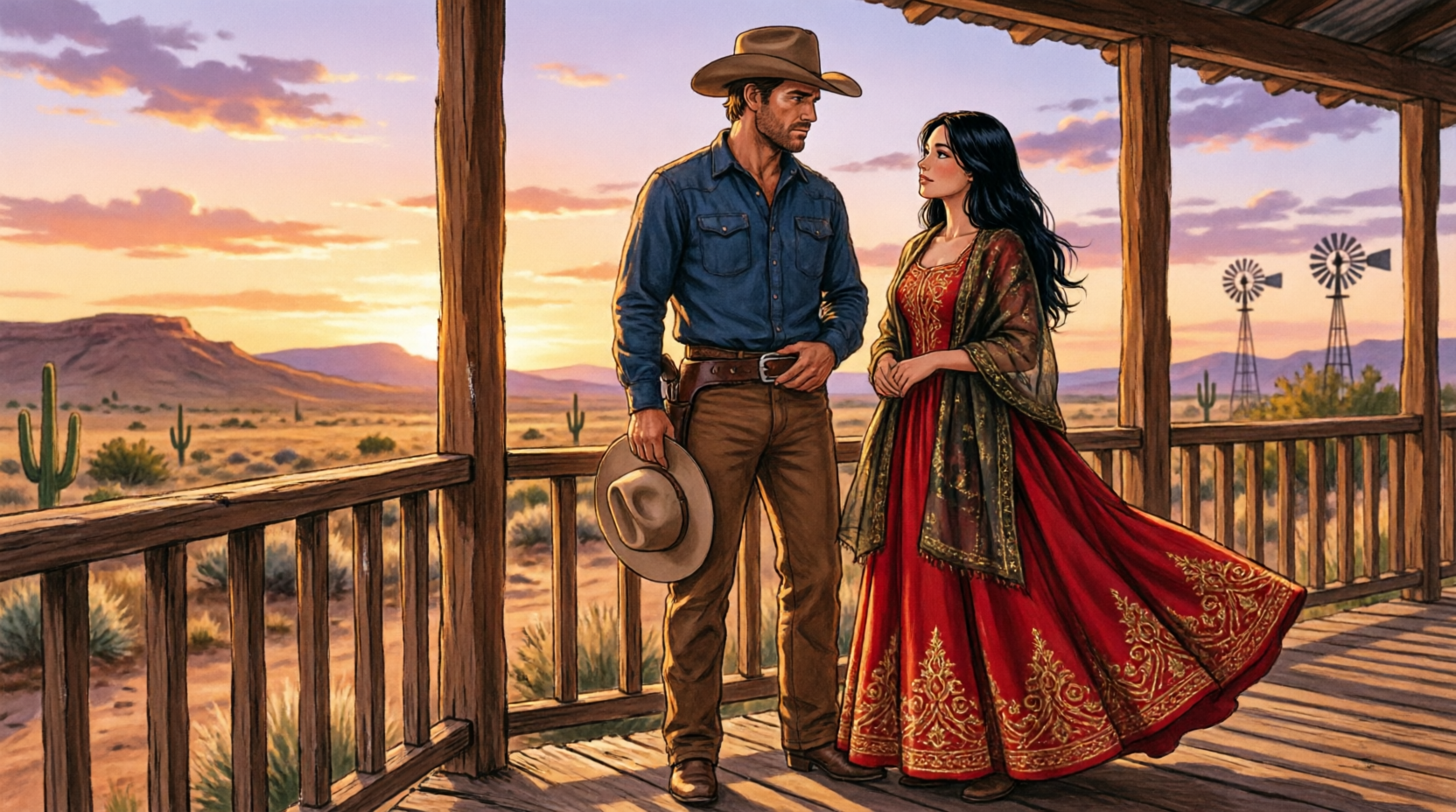
They stood close on the porch where the window had shattered and where, not many nights before, she had held out her hand believing the greatest risk in front of her was a first kiss.
Now she knew better.
Kisses were not the dangerous thing.
Trust was.
Juan took off his hat.
Leonor looked at him, then at the place beside him on the porch, then back again.
“No man has ever kissed me,” she said softly, reminding him and herself of the sentence that had split her life into before and after.
Juan’s expression gentled.
“Then we’ll still start slow,” he said.
This time when he reached for her hand, no gunshot shattered the morning.
She let her fingers rest in his.
And for now, for that one hard-earned moment on the porch of a cabin that had survived the night, slow was enough.