“He gave it away,” I said.
“To who?”
“Everyone,” I answered. “To people who needed dentures. To kids who needed books. To single moms whose cars broke down. To… anyone who was falling through the cracks.”
There was a long silence on the other end of the line.
“Wait,” Claire said finally. “He gave our money away? Without telling us?”
“It was his Social Security too,” I protested weakly. “It wasn’t just—”
“But your deposits are right there on the statement, aren’t they?” she pushed. “You said you’d been helping with ‘house repairs.’ He let us believe he was using that money to fix a roof while he sat here under a leak and… and played secret guardian angel for half the county?”
I heard the hurt before I heard the anger.
“Claire—”
“Do you realize,” she said, her voice starting to shake, “that I took on extra projects at work to cover those transfers? That I skipped a family trip to make sure we could afford to help him? Our kids thought Grandpa Jim couldn’t manage his bills. They felt guilty every time we said no to something because ‘we’re helping Grandpa right now.’”
I pressed my fingers into my eyes until I saw sparks.
“He wasn’t irresponsible,” I said. “He was—”
“Responsible for strangers more than his own family?” she snapped.
The words landed like a punch.
I didn’t answer. I couldn’t.
Because the awful truth was: if some consultant from Boston had sent me this story—that their dad gave away the money meant for his own roof—I would’ve said exactly what my wife just did.
I would’ve called it emotional manipulation.
I would’ve called it unfair.
Instead, it was my father, and now I was trapped between the ledger and the people whose names didn’t appear in it: my wife, my kids, my own life.
“Look,” Claire said, softer now. “I’m not saying what he did was all bad. Helping people is—of course it’s good. It’s just… you deserved to know. We deserved to know.”
“I know,” I whispered.
“What are you going to do?” she asked.
I looked around the kitchen. At the cheap linoleum curling at the edges. At the bucket catching water under the leak he’d never fixed. At the stack of unpaid property tax notices on the counter.
“I don’t know,” I said. “But I have to figure it out before I drive home.”
That afternoon, I did something I knew my father would’ve hated.
I went online.
I opened our town’s community page, where people usually complained about potholes and teenagers speeding. My hands hovered over the keyboard.
Then I started typing.
I wrote about Big Jim.
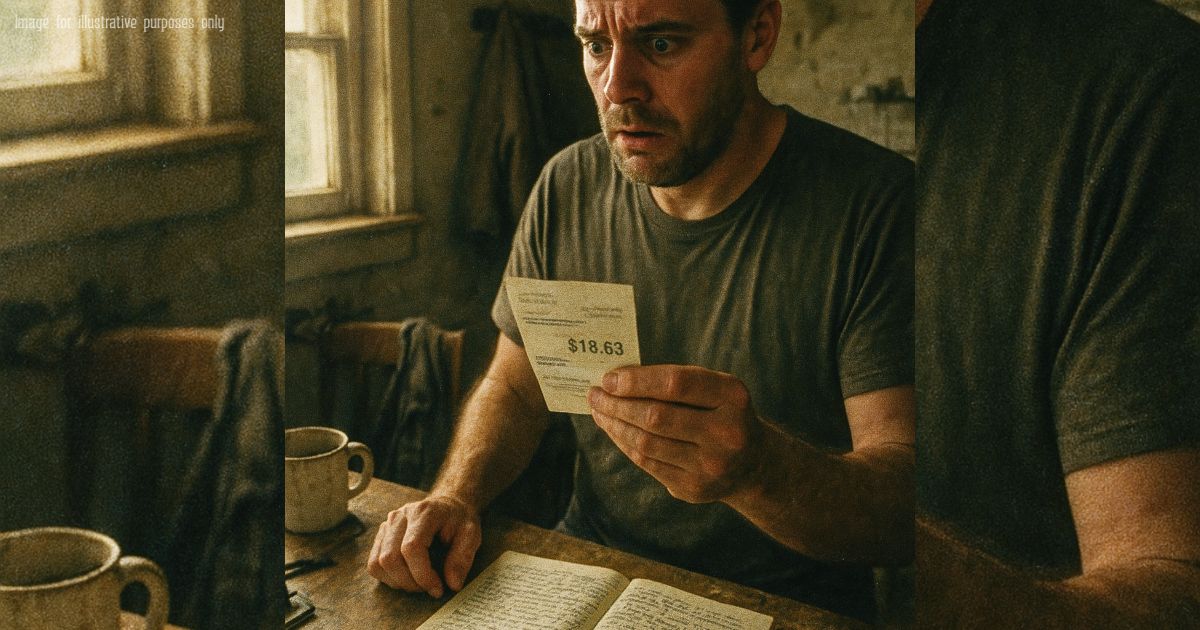
I wrote about the $18.63. About the receipts. About Leo. About the kids whose lunch balances magically disappeared. About the heating oil and the textbooks and the anonymous, gruff kindness that had quietly stitched our divided town together.
I didn’t post names. I didn’t out anyone he’d helped. But I told the truth: that the man everyone thought was just a grumpy old mechanic had been running his own private social safety net out of a checkbook and a coffee can.
And I added one thing I knew would light a match.
I wrote:
“For five years, I sent my father $500 a month for ‘house repairs.’ He spent it on everyone but himself. Part of me is proud. Part of me feels betrayed. I don’t know if what he did was heroic… or selfish… or both.”
Then I hit “post.”
It took about three minutes for the first notification to pop up.
Then ten.
Then fifty.
By evening, the comment section looked like a town hall meeting with no moderator.
“He was a saint,” one woman wrote. “Jim paid for my mom’s medication. If he hadn’t, she wouldn’t be here.”
“This makes me angry,” another person said. “Charity is great, but not when it comes from other people’s wallets. He should’ve asked his son.”
“He raised his kid with enough values that the son would’ve said yes,” someone else argued. “Maybe Big Jim just skipped the guilt-trip part and went straight to the helping.”
“You don’t get to decide for your grown children how their money is spent,” another fired back. “That’s not noble. That’s boundary-crossing.”
“I’d rather have a dad who gave away my money than a dad who hoarded it,” another wrote. “You can’t take it with you.”
It went on and on.
Some people told stories like the ones I heard at the graveside. Others called my dad reckless. A few called me ungrateful for even questioning him. A few more called him emotionally manipulative for never telling his family.
In a country where we can’t agree on much of anything anymore—how to vote, what to teach kids, what “being a good person” even means—the town suddenly had a new debate:
Who do you owe first?
Your family?
Or your community?
And was my father a hero for choosing the second… or did he fail the first?
My phone buzzed with private messages.
One from a woman I vaguely recognized from the grocery store.
“I never met your dad in person,” she wrote. “But he’s the reason my son is in college. An anonymous donor paid one semester when we were going to pull him out. Please don’t let the loud voices make you think he was wrong. He saved us.”
Another message, from a guy who’d bullied me in high school.
“Your old man once told me to stop feeling sorry for myself and get a job. Then he called his buddy and got me an interview at the plant. He didn’t slip me cash. He shoved me toward responsibility. There’s a difference. Don’t let people turn him into a martyr or a villain. He was just… complicated.”
Complicated.
That word stuck to my ribs.
That night, I found another notebook.
It was wedged behind the cereal boxes in a kitchen cabinet, wrapped in a plastic grocery bag like something half-forbidden.
On the front, in black marker:
“IF FOUND AFTER I’M GONE – FOR DAVID.”
My hands shook as I opened it.
Inside, there weren’t numbers.
There were letters.
Most were unsent drafts. Some were just half-pages that trailed off. They were addressed to me but never mailed.
One dated two years ago:
“Dave,
I know you send more than you ought to. I know Claire probably thinks I’m bleeding you dry. I don’t like taking it. Feels like begging. Feels like losing.
So I figured this way I could live with myself: I use what I earn on the house. I use what you send on other people. I figure you’d approve, seeing as you make that big-city money and talk about ‘impact’ all the time.
If I’m wrong, I reckon you’ll curse me out one day. But I’d rather be cursed for helping too much than praised for doing nothing.
– Dad”
Another, written in messier handwriting, maybe after a long day:
“Son,
You’ve got kids. I know that. I also know every month you send that check anyway. I keep thinking I should tell you what I’m doing. But then I picture you walking into the diner and seeing Sharon smile with a full set of teeth again. Or the Rodriguez boy, first in his family to buy books for a fancy college class.
Maybe I’m stealing your chance to be ‘the hero’ here. But honestly, I think you’ve got enough on your plate. Let an old fool be useful while he still can.
If you’re reading this, it means I ran out of time to explain in person. For what it’s worth, I never spent a dime of your money on beer. Just people.
You can hate me and keep helping. Or hate me and stop. That part’s up to you.
Love, even if I never said it right,
– Dad”
I sat there a long time with that notebook in my lap, feeling something burn behind my sternum.
The internet was busy voting on my father’s soul while I was just beginning to realize he’d trusted me all along.
He assumed I would have said yes.
He just couldn’t bring himself to ask.
The next day, before I left town, I met Leo at the diner.
He slid into the booth across from me, hands rough, eyes tired but clear.
“You stirred things up,” he said, nodding toward the window where someone’s phone was lit up with my post. “Half the town is fighting in the comments.”
“Yeah,” I said. “I noticed.”
“You okay with that?” he asked.
“I don’t know,” I admitted. “Part of me thinks I betrayed him by telling everyone. Part of me thinks people needed to know what he did. Maybe it’ll make them kinder. Or maybe it’ll just give them something new to argue about.”
Leo stirred his coffee.
“Here’s the thing,” he said. “Your dad didn’t ask what people thought about what he was doing. He just did it. You’re different. You grew up in a world where everything has to be shared and debated and ‘liked.’ Neither way is all right or all wrong. They’re just different.”
He leaned forward.
“But if you turn what he did into a brand or a hashtag, you’ll miss the point. He didn’t start a foundation. He just refused to walk past people when they were drowning.”
“I can’t do it like he did,” I said quietly. “I have a mortgage. Kids. College funds. Retirement accounts. I know that sounds selfish, but—”
“It sounds human,” Leo cut in. “He made his choices. You get to make yours. Don’t let him become an excuse either way.”
“Either way?” I frowned.
“Yeah,” Leo said. “Don’t say, ‘Well, my dad gave away everything so I don’t have to do anything.’ And don’t say, ‘My dad gave away everything so now I’m obligated to bankrupt myself too.’ Both of those miss the middle. The middle is: figure out what you can carry without dropping your own family.”
I sat back.
The middle.
In a world that loves extremes, the middle isn’t flashy. It doesn’t get a lot of clicks. But maybe that’s where the actual living happens.
“So what do I do?” I asked.
Leo smiled a little. “What would he do?”
“He’d tell me to stop whining and pick someone,” I said. “One person. One problem. And fix that, instead of trying to fix the whole world.”
“Sounds about right,” Leo said.
On my last night in town, I went back to the kitchen table with a fresh notebook.
On the first page, I wrote in my neat consultant handwriting:
“JAN 2025 – BIG JIM FUND – START.”
Underneath, I wrote:
“RULES:
- No social media posts about this. No pictures.
- Never use money my kids need. This comes from what’s left, not from what keeps them safe.
- Always preserve dignity. Jobs over handouts when possible.
- No guilt-tripping others into giving. This is an invitation, not a command.”
I took a picture of that page and sent it to Claire with a message:
“I’m not giving away college funds. I’m not giving away mortgages. I am setting aside a percentage of my bonus every year for this. If a kid needs a shot, or a vet needs a first paycheck, I’ll help—quietly. If you hate this, say so. We’ll revisit. But I can’t un-know what I know now about how far a few hundred dollars can go.”
Her reply came a few minutes later.
“I’m still angry he didn’t tell us,” she wrote. “I’m allowed to be. But I also can’t pretend those people at his funeral didn’t matter. So here’s my compromise: we do this together. A fixed amount. We decide the cases as a family. And we tell our kids why. That way we’re not just bleeding quietly in the dark. We’re teaching them on purpose.”
I exhaled a breath I didn’t know I’d been holding.
For the first time since he died, it felt like I wasn’t choosing between my father and my family.
Maybe I could honor both.
Before I left for Boston, I stopped by the cemetery.
The ground was still raw and uneven. The temporary marker stuck up from the dirt, just a laminated card in a little metal frame:
JAMES “BIG JIM” CARTER. 1949–2024.
I knelt down, feeling mud seep into my knees.
“So here’s the deal,” I said out loud. “You and the internet started a fight I’m never going to win. Half the people think you’re a hero. Half think you crossed a line. I think… you were a man who did the best he could with the tools he had. You loved people in the only language you knew: money and tough words.”
A crow called from a nearby tree, like it had an opinion too.
“I’m not you,” I said. “I’m softer in some places and harder in others. I talk about my feelings, for starters. But I’m going to try to do what you did, just… with more communication and less secrecy. And if that disappoints you, well, you’re not here to yell at me about it.”
I laid the notebook—the new one, not his—on top of the dirt for a second.
“People online are still arguing,” I said. “They’re asking: did you owe that money to me, or to them? I don’t know the answer. I’m starting to think maybe the question is wrong.”
I picked the notebook back up and brushed the dust off.
“Maybe it’s not either/or,” I said. “Maybe the real question is: what kind of town do we want to live in? One where everyone minds their own business and lets the cracks widen? Or one where crusty old men with bad backs and eighteen dollars to their name still look for ways to patch the holes?”
I stood.
“You chose your answer,” I said. “Now it’s my turn.”
As I walked back to the car, my phone buzzed again.
Another comment on the post.
Another stranger, weighing in on whether my father was a saint or a fool.
I smiled for the first time in days.
Let them argue.
In a world where most legacies are measured in followers and square footage and stock portfolios, my father left a different kind of inheritance:
An uncomfortable question about what we owe each other.
A messy ledger full of other people’s second chances.
And a son standing in the middle, trying to find the line between honoring his family and helping his neighbors.
I don’t know if we’ll ever agree on whether Big Jim was right.
But I know this:
The next time I see someone slipping through the cracks, I won’t walk past them and say, “Someone should really do something.”
I’ll hear my father’s gravelly voice in my head saying, “That someone’s you, dummy.”
And whether the internet approves or not, I’ll act.
Thank you so much for reading this story!