
I got married very young, just twenty-three. My husband was the eldest of three brothers, so after the wedding I moved in with my mother-in-law. That’s where my life as a daughter-in-law began: a journey that, fifteen years later, still weighs heavily on my heart every time I think about it.
I almost never had a moment’s respite. Every day I got up at five in the morning to prepare breakfast for the whole family, then I went to work and in the afternoon I rushed back to the market, cooked, washed, cleaned, and took care of my mother-in-law. She wasn’t rude, but she was always strict and harsh with me, while with my younger sister-in-law she was kind and patient.
My husband was often away for work and only came home a few days a month. My younger brother and his wife lived separately, but they came to visit us on weekends. My sister-in-law was a great chatterbox, making everyone laugh, and always bringing expensive gifts to my mother-in-law. I, on the other hand, was never good with sweet words; all I knew how to do was silently take care of her every meal and every medicine she took when she was sick.
There were nights when she had a fever, but she still made me prepare the atole or broth and boil the medicine, because she said:
“I don’t feel comfortable if there’s someone else in the kitchen.”
I endured it all in silence, thinking that as long as I gave it my all with all my heart, one day they would understand.
But it was only after my mother-in-law died that everything came to light.
The family gathering for the reading of the will took place in a serious and formal atmosphere. The three siblings and several relatives were present. Everyone believed that, after so many years of living with and caring for my mother-in-law, she would leave me something.
But when the lawyer started reading, I felt like someone had poured a bucket of cold water over me.
—“I will leave the three houses on the main avenue to my youngest daughter and my youngest daughter-in-law, Hanh, because they know how to run a business and are really careful.”
—“I will not leave any property to my eldest daughter-in-law, Lan, because I think she is adaptable, not a conflictual person, and not ambitious.”
I lowered my head. I didn’t protest. I didn’t cry. But inside I felt an immense emptiness. Fifteen years of loving care had boiled down to a single sentence: “She’s not ambitious.”
That same afternoon, I began quietly tidying up my mother-in-law’s room. In one corner of the kitchen, there was a lot of old things that, according to my sister-in-law, they were about to throw away. Looking inside, I saw a porcelain mug I’d bought her over ten years earlier: it had a rubber base to protect it from the heat, and I used it every day to make her milk or hot water in the evening.
The mug was yellowed; the rubber gasket on the bottom was worn and a little loose. Without thinking, I washed and cleaned it: I wanted to keep it as a souvenir. While drying it, I noticed that the rubber base was strangely raised. Out of curiosity, I carefully removed it with a small knife.
Inside was a small piece of paper wrapped in plastic, very carefully rolled up.
I opened it with shaking hands.
I immediately recognized my mother-in-law’s handwriting.
And what he said left me breathless…
My fingers trembled as I opened the sheet of paper. It was thin, slightly yellowed with age, but the writing was still clear. Every stroke felt familiar: firm and precise, just like her.
I took a deep breath before reading.
“Lan,
if you have this paper in your hands, it means my wish has been granted.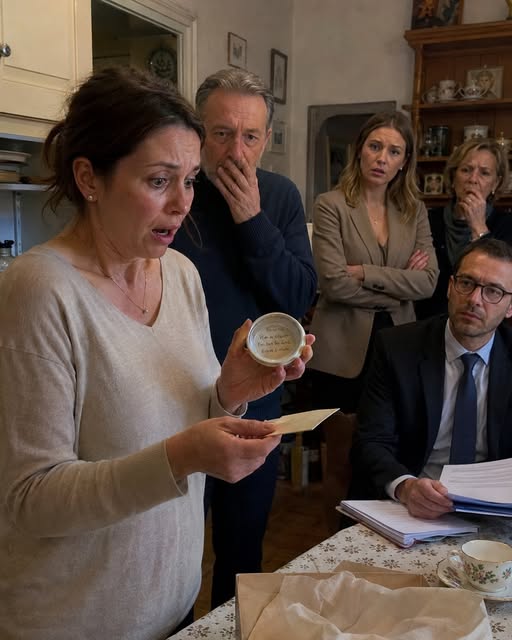
Don’t be surprised if your name isn’t in the will.
Truth be told, I never wrote down what was truly important there.”
I felt a knot in my chest.
“The three houses I left behind are there to be seen.
But I’ve hidden my true gratitude somewhere no one would ever think to look.”
I sat down on the floor.
“That cup was the first thing you bought me with your first salary as a daughter-in-law.
Every day I knew you were the one making me a drink, even when you were sick or tired.
I haven’t always been kind to you, but I’ve never been blind.”
Tears fell on the paper.
“Under the rubber seal of that glass lies the document that proves that you are the true heir to the property that the family built even before my children were born.”
I felt like the world had stopped.
“If anyone tries to throw the cup, let them.
For those who cannot recognize sacrifice do not deserve the reward.”
Below is a signature. Complete. Definitive.
Rose.
I don’t know how long I sat there. I only reacted when I heard footsteps outside.
—“Lan?” —it was my sister-in-law Hạnh’s voice. “What are you doing there? That bag will be thrown away.”
I stood up, still holding the cup in my hands.
—“Leave it to me,” I said calmly.
—“What’s the point?” —he frowned—. “It’s just garbage.”
I smiled.
—“There are things that seem like garbage… but inside they hold something precious.”
The next day, the lawyer returned to formally close the proceedings. The entire family was present: my husband, his siblings, and several relatives.
I sat silently to one side.
“Is there anything else pending?” asked the lawyer.
I stood up.
—”Yes,” I said. “There’s something I’d like to show you.”
They all looked at each other.
I took out the cup, clean and untouched, and placed it on the table.
—“And now what drama is this?” — whispered an aunt.
I smiled and took out the document that was hidden inside.
The lawyer was the first to remain silent.
“Wait a minute…” he said as he read. “This is… a deed of ownership.”
There was absolute silence in the room.
—“This property,” he continued, “is not included in the three houses mentioned in the will.”
—“Impossible!” Hanh shouted. “We know all my mother’s property!”