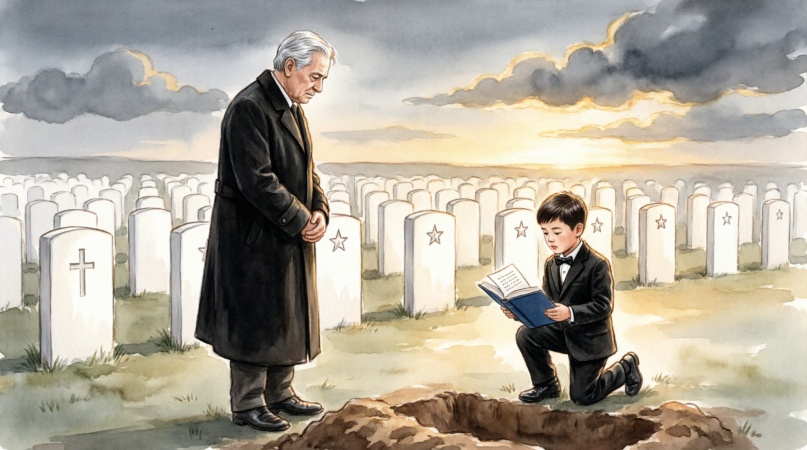
By the time Ellie got her front door open, rain had soaked through the shoulders of her black dress and turned the cemetery dirt along her hem to brown paste.
She was still carrying the wilted white rose from the graveside when she saw the child standing under her porch light.
For one impossible second, her mind refused to make sense of what her eyes were telling it.
Tyler was supposed to be in the ground.
She had watched the little white casket lower into wet Ohio soil less than an hour earlier.
But there he was.
Eight years old.
Thin shoulders trembling.
One shoe missing.
Blue jacket torn near the seam.
Dirt streaked across his cheeks and caked in the lines of his hands.
His hair was mashed flat on one side, and his lips were pale from cold.
“Grandma Ellie,” he whispered.
The rose fell from her hand.
She dropped to her knees so hard pain shot through them, but she barely felt it.
She caught his face between both palms.
His skin was freezing.
There was mud under her fingers.
His breath hitched in little bursts, and when he looked up at her, tears clung to his lashes.
“You’re here,” she said, except it came out as a broken breath.
Tyler gave one tiny nod
“Help me.”
That one word snapped her loose from shock.
Ellie dragged him inside, slammed the door, locked the chain, the knob, the deadbolt, then locked the deadbolt again because her hands needed something to do.
Tyler flinched at every click.
That flinch told her more than the dirt did.
He wasn’t confused.
He wasn’t sleepwalking.
He wasn’t dazed from some miracle she didn’t understand.
He was scared in the deepest way a child can be scared—like the grown-ups who were supposed to protect him had become the thing he needed protection from.
Ellie took him into the kitchen, sat him at the table, draped a dish towel over his shoulders, and lit the stove under a pot of tomato soup.
While it heated, she set out bread and poured apple juice into the blue glass Tyler always chose when he visited.
The motions were automatic, almost desperate.
If she kept moving, maybe the world would keep its shape for one more minute.
Tyler watched every step.
Not with ordinary hunger.
With vigilance.
She set the glass in front of him.
He seized it with both hands and drank too fast, apple juice spilling down his wrist.
Then he tore into the bread.
When headlights swept across the back window from a passing car, he froze so suddenly the crust remained halfway to his mouth.
“No one’s coming in here,” Ellie said.
She moved between him and the glass until the light was gone.
Only then did he breathe again.
Maplewood had always been the kind of town where people left doors unlocked during daylight and waved at each other in the grocery lot.
That night, every sound outside seemed sharpened.
Every engine felt like a warning.
Ellie set the soup in front of him and crouched by his chair.
“Tyler, I need you to look at me.”
He raised his eyes.
Fear was there, yes.
But so was exhaustion, and hunger, and something older than either of those.
A strain no
child should know.
“You’re safe here,” she said, forcing her voice steady.
“But I need the truth now.
Did someone hurt you?”
His jaw tightened.
The kitchen went so quiet Ellie could hear the little metal ping of the burner cooling beneath the pot.
At the funeral, Brian had stood bent over with grief while Michelle clung to his arm and cried into a black handkerchief.
Church women had squeezed Ellie’s shoulder and murmured that the Lord had a plan.
Michelle had kept saying she didn’t understand how this could happen to a good family.
Now Tyler sat at Ellie’s table with dirt behind his ears.
“Who did this?” Ellie asked.
Tyler put the spoon down very carefully.
“I was sleeping.”
The words landed in the room and stayed there.
Ellie waited.
“When I woke up, it was dark,” he said.
Ellie’s hand closed around the back of the nearest chair until her knuckles hurt.
“How dark?”
He swallowed.
“So dark I couldn’t see my hand.”
Her stomach turned so violently she thought for one sick second she might vomit right there on the kitchen floor.
Tyler pressed his palms to his knees, grounding himself the way frightened children do when they’re trying not to come apart.
“I called for you,” he said.
“But you weren’t there.”
Ellie sank into the chair across from him.
He kept going in short, careful breaths, as if he had decided his job was to say only what mattered.
“I pushed.
I kept pushing.
Something cracked.
Then dirt came in.
And rain.
I couldn’t breathe right.
I thought…” He stopped and looked at the table.
“I thought you weren’t going to find me.”
Ellie had stood at that grave less than an hour earlier.
She had watched the casket lower and the cemetery men back away because the weather was turning.
She remembered the thunder, the umbrellas, the wind shoving rain sideways under the tent.
The grave had not been filled yet.
In Maplewood, when storms rolled in hard, they sometimes finished after the family left.
Her grandson had clawed his way out of a coffin in the rain.
The thought nearly split her in half.
She reached across the table and took his hand.
His fingers clamped around hers with shocking strength.
“Why were you there, Tyler? What happened before you fell asleep?”
For a moment he didn’t answer.
Then he glanced toward the hallway as if even the walls might be listening.
“Michelle gave me medicine,” he whispered.
The name hit Ellie like a slap.
Michelle wasn’t Tyler’s mother.
Tyler’s mother, Leah, had died four years earlier when a truck slid through an icy intersection and crushed the passenger side of her car.
Leah had left behind an eight-year-old’s worth of bedtime songs, hair ribbons tucked in drawers, and a legal settlement that had been placed in trust for Tyler until adulthood.
Brian had remarried Michelle two years after the wreck.
Ellie had never liked how quickly Michelle learned where every paper was kept.
“What kind of medicine?” Ellie asked.
Tyler frowned, searching.
“Red.
Sweet.
She said it would help me sleep because I’d been crying.”
“When?”
“Yesterday afternoon.
Before everybody came over.
Before Dad got home.”
Ellie felt cold even standing next to the stove.
The day before, Michelle had called
saying Tyler had gone down for a nap and never woken up right.
By the time Ellie arrived, the volunteer EMTs were already there.
Michelle had been hysterical.
Brian had looked like a man who’d fallen through ice.
There had been no autopsy.
Michelle had said the county doctor believed it was a sudden seizure or hidden heart problem, one of those terrible things families never see coming until the worst has already happened.
Brian had signed the release for immediate burial because, through tears, Michelle had begged him not to let strangers cut into the boy’s body.
Ellie had thought grief was talking.
Now she wasn’t sure what had been talking at all.
“Did you see anything else?” Ellie asked.
Tyler licked dry lips.
“I heard them.”
“Who?”
“Michelle.
And Dad.”
The clock over the stove ticked once.
Twice.
“What did they say?”
Tyler’s eyes went glossy, but he kept speaking.
“Dad said, ‘This is wrong.’ He was whispering.
Michelle told him we were out of time.
She said once I was gone, the money would come through, and you wouldn’t be able to stop it.”
Ellie sat so still she could hear her own pulse.
Leah’s settlement.
A hundred and eighty thousand dollars, most of it protected in a trust with strict rules.
Brian could use some for Tyler’s education and care, but only with oversight.
Ellie had been named alternate trustee if anything happened or if there was ever cause for review.
Michelle had hated that from the day she learned it.
Three weeks earlier, Ellie had received a polite call from the attorney who handled the trust.
Michelle had been asking questions she had no authority to ask.
Ellie had confronted Brian gently over coffee, and Brian had looked embarrassed, then defensive, then angry in the way weak men do when shame gets too close.
He had insisted it was nothing.
Michelle was “just trying to understand the paperwork.”
Now Tyler was telling her Michelle had spoken about money while he lay half-drugged in the next room.
Ellie rose and went to the counter because sitting still felt impossible.
She kept one hand on the laminate edge until the shaking in her legs eased.
“Tyler, listen to me very carefully.
Are you saying Michelle put you to sleep on purpose?”
He nodded once.
“I heard her say if I told you what I saw, everything would be ruined.”
Ellie turned back.
“What did you see?”
Tyler looked ashamed, which broke her heart even further.
“I saw papers with my name on them in her purse.
A lot of them.
And I heard her yelling at Dad about the house money.
I told her I was gonna ask you what they meant.”
There it was.
Not a monster’s motive.
Something meaner and smaller and more believable.
Debt.
Panic.
Greed dressed up as survival.
Ellie reached for the phone mounted beside the fridge, then stopped.
Calling the house line felt absurd.
So did dialing 911 without another adult in the room who could see this with their own eyes.
In a small town, news traveled faster than sirens.
If Michelle was involved, Ellie wanted witnesses before she wanted noise.
She took out her cell and called Walt Kerr, the retired deputy who lived two streets over and had
known her family since Brian was twelve.
He answered on the second ring.
“Walt,” Ellie said, keeping her voice low, “come to my house right now.
Bring your phone.
Don’t call ahead.”
There was a beat of silence.
Then: “I’m on my way.”
When she hung up, Tyler was staring at the back door.
“Are they coming?” he asked.
Ellie didn’t lie.
“I don’t know.
But if they do, I won’t let anyone take you out of this house.”
He looked like he wanted to believe her so badly it hurt.
Then headlights swept over the kitchen wall again.
This time they didn’t move on.
Tyler’s chair scraped backward so fast it nearly toppled.
He stood, all the color draining from his face.
“That’s her.”
An engine cut off in the driveway.
Ellie’s heart slammed once against her ribs, hard enough to sting.
She took Tyler by the shoulders and steered him into the laundry room off the kitchen, the one with the narrow folding door and no window.
“Stay here.
Don’t make a sound unless I call your name.”
He gripped her wrist.
“Don’t let her touch me.”
“I won’t.”
A knock sounded at the front door.
Three brisk taps.
Then Michelle’s voice, pitched sweet and worried through the wood.
“Mrs.
Parker? Are you awake?”
Ellie crossed the dark living room on feet that suddenly felt twenty years younger and twenty years older at the same time.
She turned on nothing.
Through the sidelight she could make out Michelle’s neat coat, Brian’s broad shadow behind her, and the glow of their truck still washing across the wet gravel.
Ellie opened the door but left the chain latched.
Michelle’s mascara was perfect.
Her eyes were pink, but only around the edges.
Brian looked worse—gray, wrecked, rain-spotted, like he’d been dragged behind his own grief.
He kept staring past Ellie into the house.
“I’m sorry to bother you,” Michelle said, one hand pressed dramatically to her chest.
“The funeral home called.
There was…
some kind of disturbance at the cemetery.
They think boys from town may have vandalized the site.
We wanted to make sure you were all right.”
Ellie kept her face blank.
“Why would vandals send you here?”
Michelle gave a breathless little laugh.
“No reason.
It’s just…
after a day like today, I couldn’t stand the thought of you being alone.”
Behind her, Brian’s voice came out rough.
“Mom, did you see anyone on the road? Anyone walking?”
That was the first true thing either of them had said.
Ellie watched her son’s face.
He looked terrified—not of grief this time, but of discovery.
And suddenly she knew this wasn’t a clean line between innocent father and guilty wife.
Whatever had happened, Brian had walked some part of that road with her.
“No,” Ellie said.
Michelle leaned closer to the opening.
“Would you mind if we came in for a minute?”
“Yes,” Ellie said.
The answer seemed to surprise her.
Michelle recovered quickly
“I only thought—”
“I know what you thought.”
Brian rubbed a hand over his mouth.
“Mom, please.
If something happened at the grave…
if somebody took…” He couldn’t finish.
A floorboard creaked behind Ellie.
Michelle’s eyes flicked over Ellie’s shoulder.
For the first time, something hard flashed beneath the grief on her face.
Then another
set of headlights turned into the driveway.
Walt Kerr stepped out of his truck before it fully stopped, heavy coat unbuttoned, phone already in his hand.
He took in the scene in one glance.
“Evening,” he said, in the flat voice of a man who recognized danger on sight.
Michelle’s smile tightened.
“Walt.
What a relief.”
“That depends,” Walt said.
Brian looked from Walt to Ellie, and something in him sagged.
Then Tyler coughed.
It was small.
A dry little catch from the hallway.
But in that silence, it might as well have been a gunshot.
Brian made a sound Ellie had never heard from a grown man before—half sob, half moan.
He lurched toward the door.
Walt put out an arm and blocked him.
Michelle went white for one naked second.
Then she stepped forward so fast the chain rattled.
“Tyler?” she cried, too loud, too quickly.
“Baby, is that you?”
From the hallway, Tyler’s voice came thin and shaking.
“Don’t let her in.”
Everything broke open at once.
Ellie shut the door hard enough to rattle the glass and called 911 while Walt planted himself on the porch to keep Brian and Michelle outside.
Through the door she could hear Brian pleading, Michelle insisting Tyler was confused, Michelle then shouting, then Michelle dropping her voice again when she realized Walt was recording.
By the time the first deputy and the ambulance arrived, half the street had porch lights on.
Tyler came out of the laundry room only when Ellie called him.
He stood behind her at first, one hand twisted in the back of her dress.
The deputy took one look at him—mud, torn jacket, missing shoe, coffin-scratch marks along his wrists—and radioed for a state investigator.
Michelle’s performance shifted instantly.
She started crying harder, saying Tyler must have wandered in shock, that maybe he had never really died, that everyone had made a terrible mistake.
She said it so fast it sounded rehearsed.
Then Tyler looked straight at her and whispered, “You said once I was in the ground, Grandma couldn’t stop it.”
The deputy’s pen stopped moving.
Brian shut his eyes.
No one spoke for a beat.
Rain ticked from the porch roof.
Somewhere down the block, a dog barked and went silent.
Michelle laughed—one short, broken sound.
“He’s traumatized.
He doesn’t understand what he’s saying.”
But Tyler wasn’t looking at her anymore.
He was looking at his father.
“I heard you,” he said.
“You said it was wrong.”
Brian made that same terrible sound again and folded onto the porch step like his bones had gone out of him.
The state investigator arrived twenty minutes later, a woman named Denise Harper with tired eyes and a voice so calm it made Michelle visibly nervous.
She separated everyone.
Tyler went into the ambulance to get warm and be checked.
Ellie sat beside him while an EMT wrapped him in blankets and clipped a monitor to his finger.
He was dehydrated, scratched, badly bruised, and in shock.
But he was alive.
That word kept tearing through Ellie in waves.
Alive.
Inside the ambulance, Tyler gave Denise the same story he had given Ellie, only fuller now.
Michelle had brought him a paper cup of red liquid and told him it would help him rest.
He remembered feeling
heavy.
He remembered hearing Michelle and Brian argue in the hallway.
Brian had said, “He’s eight.” Michelle had answered, “And he’s the only thing standing between us and losing everything.” Tyler remembered trying to get up, falling asleep anyway, then waking in darkness so thick it felt like weight.
He described satin under his cheek.
Wood over his face.
Rain hitting above him.
He said he pushed until something cracked near his shoulder, dirt spilled in, and cold air finally followed.
He said he climbed toward the sliver of storm light until his hands bled and he left one shoe behind in the mud.
Even Denise had to stop writing for a second after that.
At the hospital, bloodwork found heavy sedatives in Tyler’s system.
Not enough to kill a healthy adult, but enough to knock down a child’s breathing and pulse until a panicked room could mistake stillness for death.
The emergency doctor who had first seen Tyler the day before had relied on the volunteer team’s field report and a chaotic handoff.
He had signed what he should not have signed.
The county doctor had approved what he should have questioned.
Fear and haste had done the rest.
But panic did not explain intent.
A search warrant on Brian and Michelle’s house did.
By dawn, investigators had found copies of trust documents spread across Michelle’s home office desk, emails she’d sent from Brian’s laptop asking how quickly funds could be released upon the beneficiary’s death, and a nearly empty bottle of prescription promethazine that had not been prescribed to anyone in the house.
They also found mortgage notices stamped FINAL and a stack of credit card bills tucked inside a cookie tin above the refrigerator.
The ugliest thing, though, came from Brian.
He broke before noon.
Denise interviewed him in a small room at the station while Michelle sat two doors down insisting it had been a misunderstanding.
Brian cried until he could barely breathe, then told the truth in pieces.
Michelle had been siphoning money from Tyler’s trust by routing reimbursements through Brian’s failing landscaping business.
Ellie had gotten close to noticing.
Tyler had made things worse, innocently worse, by telling Michelle he wanted Grandma to explain the papers with his name on them.
That morning, Michelle had panicked.
She gave Tyler sedatives to keep him asleep while she moved documents out of the house and tried to decide what to tell Brian.
When Brian came home, Tyler was barely breathing.
Brian wanted to call 911 again, wanted another hospital, another opinion, anything.
Michelle kept saying it was too late.
She said if toxicology got involved, the trust fraud would surface, the house would be lost, Brian would go to jail, and Tyler was “already gone anyway.” When the EMTs couldn’t find a pulse quickly, Michelle seized that uncertainty like a gift.
Brian admitted he signed the papers for immediate burial.
He admitted Michelle had pushed hard against an autopsy.
Then Denise asked him one more question.
Had he ever had reason to think Tyler might still be alive?
Brian put both hands over his face and nodded.
At the funeral home, before the service, he had heard a faint noise from the casket.
Just one knock.
Maybe a shift.
Maybe a trapped sound.
He had looked
at Michelle, and Michelle had said it was only the wood settling because of the damp.
Brian had wanted to believe her more than he had wanted to know.
That was the moment Ellie stopped thinking of weakness as something softer than cruelty.
Michelle was arrested before sunset.
Brian was arrested after he signed his statement.
Ellie was there when Denise came to the hospital room to tell her.
Tyler was asleep for the first time since climbing out of the grave, his lashes still dirty at the corners, one small hand curled around the blanket under his chin.
The monitor beside him drew green lines that looked almost holy.
“What happens now?” Ellie asked.
Denise glanced at the sleeping boy.
“Now he stays somewhere safe.”
Ellie had the emergency guardianship papers in motion by the next afternoon.
There was no dramatic speech, no cinematic moment where everyone suddenly became brave and good.
There were forms, and signatures, and a social worker with kind eyes, and Tyler waking from a nightmare so violent he tried to claw his own IV out until Ellie got both arms around him and told him, over and over, that there was no lid above him now.
The physical wounds healed faster than the rest.
The scratches on his hands scabbed.
The bruise along his shoulder faded from plum to yellow.
His appetite returned in bursts.
He began leaving his bedroom door open at night.
Then, weeks later, he let Ellie turn the lamp off as long as the hall light stayed on.
Some injuries lingered in stranger ways.
He couldn’t stand the smell of wet flowers.
He panicked when blankets were tucked too tightly around his feet.
For a long time, any knock on wood made him go still.
Maplewood tried to decide what story it wanted to tell itself about the whole thing.
Some people blamed the doctors first, then the funeral home, then the weather, as if a chain of terrible mistakes was easier to live beside than greed in a tidy kitchen two streets over.
Some insisted Michelle was the monster and Brian was only broken, only frightened, only trapped by debt and shock.
Others said a father who hears a sound from his son’s coffin and signs the burial papers anyway has crossed a line that doesn’t uncross.
Ellie never spent much time arguing with either side.
She had heard Brian weep at the funeral.
She had seen him crumple on her porch when Tyler spoke.
She knew he loved his son in whatever ruined, inadequate way he was capable of loving anyone.
She also knew love that folds under pressure and lets a child go into the ground is not the kind of love that keeps a house standing.
By the time the first frost silvered the edges of the yard, Tyler was back under her roof for good.
His backpack hung by the mudroom door.
His drawings covered the side of the refrigerator.
Some nights he still padded down the hall and stood in her doorway until she lifted the blanket beside her and made room.
She always did.
Once, late in November, he asked her why his father had cried so hard if he had still let it happen.
Ellie looked out at the dark yard for
a long time before answering.
“Because sometimes people know they’ve done the unforgivable,” she said.
“And crying is easier than stopping it.”
Tyler thought about that quietly, then leaned against her side and went back to sleep.
In town, the arguments never fully ended.
People still lowered their voices when Brian’s name came up, still divided themselves into camps over whether fear could hollow a man out enough to turn him into an accomplice, or whether that was just another lie adults told to make evil look smaller.
Ellie only knew what had stood on her porch that night: a child covered in mud, shivering under the light, asking for help after climbing out of a grave because the people entrusted with his life had chosen money, denial, and themselves.
Whatever name other people wanted to give that, she never found a gentler one.
I Came Home From My Grandson’s Funeral—And Found Him Standing on My Porch
Part 1
Coming home from my eight-year-old grandson’s funeral, I found him standing on my porch.
He was supposed to be in the ground.
Instead, Tyler stood under my porch light in torn clothes, soaked through from the rain, shaking so hard his teeth clicked.
“Grandma Ellie,” he whispered.
I had only just left Maplewood Cemetery.
Rain from the graveside still clung to my black dress, cold against my knees.
Mud had dried in dark half-moons along the hem.
My coat still carried the wet, sweet smell of church lilies pressed too close to grief.
And there he was.
Small.
Shivering.
One shoe missing.
Dirt streaked across his cheek like someone had dragged a thumb through it.
His blue school jacket was ripped at the shoulder.
His sock left a wet gray print on my porch boards.
For one long second, my hand stayed frozen on the deadbolt.
One part of me was still at the cemetery, watching a white casket sink toward Ohio earth.
The other part of me was staring at the same child on my porch, breathing.
“Grandma,” Tyler whispered again.
“Help me.”
That was when my body remembered it belonged to me.
I dropped to my knees and took his face in both hands.
His skin was cold.
Mud slid under my fingers.
His bottom lip shook so badly he could barely hold the words inside his mouth.
“You’re here,” I said.
But it came out like air leaving a wound.
He gave one tiny nod.
Behind me, the living room lamp burned yellow against the dark.
The clock over the mantel kept ticking like the world had not just split open.
As if less than an hour earlier I had not stood over his coffin with a white rose in my hand.
As if my son Brian had not been clutching his wife Michelle in front of half the town while they sobbed into each other’s shoulders.
I pulled Tyler inside and locked the door.
Chain lock.
Top lock.
Deadbolt.
He flinched at every click.
That flinch told me more than the mud did.
He was not confused.
He was not sleepwalking.
He was frightened in the way children get frightened when the adults around them have stopped being safe.
I took him into the kitchen, sat him at the table, draped a dish towel over his shoulders, and put tomato soup on the stove because my hands were shaking too hard to be useful unless I gave them work.
Bread on a plate.
Apple juice from the fridge.
A real glass, because Tyler had always hated juice boxes and said they made him feel like a baby.
For three years, he had spent every Friday after school in that kitchen.
He knew which drawer held the animal crackers.
He knew I kept his blue cup behind the mugs.
He knew I always cut his toast into triangles even when he told me he was too old for it.
That was the trust they had counted on.
He watched every single thing I did.
Not like a boy waiting to eat.
Like someone making sure I would not disappear.
I set the juice in front of him.
He grabbed the glass with both hands and drank too fast.
Juice ran down his wrist.
He did not even notice.
“How long since you ate?”
The embarrassed look on his face nearly broke me before the answer did.
“I don’t know.”
I pushed the bread closer.
“Eat.”
He did.
Fast.
Silent.
Shoulders rounded.
When a car rolled past outside at 7:46 p.m., its headlights skimmed across the yellow kitchen curtains and he froze with bread halfway to his mouth.
“No one is coming in here,” I said.
I stepped between him and the window until the light moved on.
Only then did he breathe again.
Maplewood is the kind of town where people wave from the ends of their driveways and leave pumpkins on porches until the cold caves them inward.
That night, every porch light on my street looked too bright.
Every engine sounded like danger.
I carried the soup over.
“Careful.
It’s hot.”
He wrapped his fingers around the spoon, but his hands were not steady.
I crouched beside his chair.
“Tyler.
Did someone hurt you?”
His jaw tightened.
That was not the look of a child inventing a story.
It was the look of a child deciding whether saying something out loud would make it real.
The kitchen went so quiet I could hear the burner ticking under the pot.
At the funeral, Brian had cried into Michelle’s shoulder while neighbors brought casseroles, church women squeezed my hand, and people said the Lord had a reason for everything.
Michelle kept dabbing at her eyes and whispering that she could not understand how this could happen to a good family.
Grief can make people holy in public.
Fear shows you what they are in private.
Now my grandson sat at my kitchen table with dirt still tucked behind his ears.
My voice went cold without asking my permission.
“Tyler.
Who did this?”
His spoon stopped in midair.
He set it down carefully, like even that much noise might punish him.
“I was sleeping,” he said.
The words slid into the room and stayed there.
I did not interrupt.
He pressed both palms against his knees and stared at the floor.
“When I woke up, it was dark.”
My fingers locked around the back of the chair beside me.
“How dark?”
He swallowed hard.
“So dark I couldn’t see my hand.”
The refrigerator motor kicked on.
The clock over the mantel kept ticking.
Somewhere outside, rainwater dripped steadily from the gutter onto the back step.
I thought of the funeral program still folded in my purse.
Tyler James Porter.
Age eight.
Maplewood First Methodist.
Service time: 3:00 p.m.
I thought of the burial receipt Brian had signed with a pen borrowed from the funeral director.
I thought of the white casket.
The sealed lid.
The rain beating softly against it.
Evidence has a sound when your heart finally understands it.
It is not a scream.
It is a click.
“I called for you,” Tyler said.
“But you weren’t there.”
I sat down so slowly the chair legs scraped across the tile.
He kept going in short little breaths.
“I pushed.
I kept pushing.
Something cracked.”
The room changed around me.
The stove.
The magnet calendar on the side door.
The yellow curtains over the sink.
Everything was still where it belonged, but none of it felt like it belonged to the same world anymore.
Tyler leaned closer.
Mud was drying stiff on his sleeve.
The soup sat untouched between us.
When he spoke again, his voice was barely more than air.
“Grandma,” he whispered, “I need to tell you why I was in that box.”
I reached across the table and took his hand.
His fingers were icy.
Before I could ask the next question, my phone buzzed inside the pocket of my black funeral coat.
Not a call.
A text.
It was from Brian
My son.
Timestamped 7:51 p.m.
Sent less than an hour after he had stood at a grave pretending to bury his child.
Mom, don’t open the door if Tyler comes there.
For a second, I could not understand the words.
Then I understood them all at once.
Across from me, Tyler saw my face change.
He covered his mouth with both hands, and the sound that came out of him was not crying.
It was something smaller.
Something learned.
Outside, someone stepped onto my porch.
The boards creaked exactly where Tyler had been standing minutes before.
Then came one soft knock.
Not urgent.
Not panicked.
Almost polite.
I looked from the text to my grandson, then toward the door.
Tyler finally said the sentence that made my blood go cold.
“It’s Michelle.”
When you say Part 2, I will continue.
Part 2
I did not open the door.
Not because I was afraid of Michelle.
Because Tyler was.
Fear in adults can lie.
Fear in children almost never does.
Another knock sounded through the house.
Three soft taps.
Polite.
Controlled.
Like someone pretending the world outside my kitchen had not just cracked open.
Tyler slid off the chair so quickly it scraped across the tile.
“Don’t let her see me,” he whispered.
I had heard fear before.
In hospitals.
At Leah’s funeral after the crash.
In Brian’s voice the night he admitted he could not sleep alone after his wife died.
But this was different.
This was survival fear.
The kind that teaches children to become quiet before anyone tells them to.
I took Tyler by the shoulders.
“Laundry room,” I said softly.
“Stay there until I call you.”
His fingers clamped around my wrist.
“She’ll say I’m confused.”
The sentence hit me like a punch.
Not because of what it meant now.
Because it sounded practiced.
Like something he had already heard adults say about him before tonight.
I crouched until we were eye level.
“No one decides what’s true in this house except me.
Do you understand?”
His chin trembled.
Then he nodded.
I moved him into the laundry room off the kitchen.
No windows.
Just shelves of detergent, old coats, canned soup, and the deep freezer Brian helped me carry in six winters ago.
The folding door shut with a soft click.
I crossed the dark living room toward the front entrance while my pulse hammered so hard it blurred the edges of my sight.
Another knock.
Then Michelle’s voice floated through the wood.
“Mrs. Parker?
Are you awake?”
Her tone was sweet.
Concerned.
Exactly the same voice she used at church potlucks and parent-teacher nights.
The same voice she used at the cemetery while she held tissues against perfectly untouched mascara.
I stopped at the door but did not unlock it.
Through the narrow sidelight window, I could see Michelle standing under the porch light in a cream coat with rain beading along the shoulders.
Brian stood behind her, broad and gray-faced, hands shoved into the pockets of his jacket.
He looked wrecked.
Not grieving.
Terrified.
That frightened me more than Michelle did.
I opened the door three inches with the chain still latched.
Michelle gave a tiny gasp of relief.
“Oh thank God.
We were worried about you.”
“Why?”
She blinked once.
Too quickly.
“The funeral home called.
There was some sort of issue at the cemetery.
A disturbance.”
“What kind of disturbance?”
Michelle gave a weak little laugh.
“You know teenagers.
Probably vandalism or something awful.”
Brian spoke for the first time.
“Mom… did you see anybody on the road?
Anyone walking?”
There it was.
The real question.
Not concern for me.
A search.
I looked at my son carefully.
Brian had always been soft-hearted as a child.
The kind of boy who cried over dead birds in the yard.
The kind who once hid an injured rabbit in my garage for three days because he could not bear the thought of something suffering alone.
Now his face looked like a man trying to outrun something already inside him.
“No,” I said.
Michelle leaned closer to the gap in the door.
“Could we come in for a minute?”
“No.”
Her expression flickered.
Only for a second.
Then the smile returned.
“Mrs. Parker, I really think after today maybe none of us should be alone.”
“I’m not alone.”
The words left my mouth before I could stop them.
Behind Michelle, Brian’s head jerked upward.
Michelle went still.
The porch light reflected in her eyes like two pale coins.
“Brian,” she said lightly, “did you hear that?”
My son stared at me.
“Mom…”
Then from the hallway behind me came the smallest sound in the world.
A cough.
Dry.
Child-sized.
Michelle’s face changed.
Not grief.
Not confusion.
Recognition.
Brian made a horrible choking sound deep in his throat.
“Tyler?” he whispered.
I moved before either of them could react.
I slammed the door shut.
Michelle shouted something outside.
The chain rattled.
I locked the deadbolt again anyway.
Then I grabbed my phone and dialed the only person in Maplewood I trusted to move before gossip got there first.
Walt Kerr.
Retired deputy.
Two streets over.
Widower.
Mean enough to be useful.
He answered on the second ring.
“Ellie?”
“Get over here right now.”
Silence.
Then his voice sharpened.
“What happened?”
“Bring your gun and your phone.”
Another beat.
“I’m coming.”
I hung up.
Outside, Michelle knocked harder now.
“Mrs. Parker!
Please open the door!”
Brian’s voice broke somewhere behind her.
“Mom, if Tyler’s in there—”
“Brian,” Michelle snapped.
One word.
Sharp as a whip.
Then instantly soft again.
“Baby, you’re upset.”
Baby.
She used that voice when she wanted to guide people back into weakness.
I had watched her do it to Brian for years.
At first, she had seemed helpful after Leah died.
Organized.
Efficient.
A woman who stepped in when grief left a man drowning.
Then slowly, little things changed.
Brian stopped visiting without calling first.
Tyler started asking whether it was okay to take extra food home.
Michelle always seemed to know exactly how much money Brian had.
And every conversation somehow ended with stress.
Bills.
Mortgage.
Repairs.
Bad luck.
Tyler had once whispered to me while helping wash dishes, “Michelle says grown-ups only love you if you stop costing them money.”
I should have listened harder then.
The laundry room door creaked open.
Tyler stood there clutching the dish towel around his shoulders.
“She knows I’m here,” he whispered.
I crossed the room fast and pulled him close.
His body was ice cold again.
“No one’s taking you.”
“She buried me.”
The sentence shattered something inside me.
Before I could answer, headlights turned sharply into my driveway.
Another vehicle.
Then a truck door slammed.
Walt Kerr strode through the rain in his old sheriff’s coat, gray hair soaked flat against his head.
He took one look at Michelle and Brian on the porch and understood enough.
Walt had spent thirty years pulling truth out of people who preferred lies.
He planted himself at the bottom of my porch steps.
Michelle forced a smile.
“Walt.
Thank goodness.”
“That depends,” Walt said flatly.
Brian stared past him toward the house.
“Mom,” he called hoarsely.
“Please.”
Then Tyler spoke from behind me.
One sentence.
Tiny.
Terrified.
“Don’t let Dad make me go back.”
Everything stopped.
Even the rain felt quieter.
Outside, Brian made a sound I had never heard from a grown man before.
Not grief.
Not shock.
Guilt.
Michelle turned white.
Then red.
Then furious.
She moved toward the door so suddenly Walt stepped directly in front of her.
“You move again,” he said calmly, “and I’ll put you face-down on Ellie Parker’s begonias.”
Michelle’s voice cracked.
“You don’t understand!”
“No,” Walt said.
“I think I do.”
I opened the door only enough for Walt to step inside.
Then I shut it again before Michelle could see Tyler clearly.
Walt looked down at the child beside me.
Mud.
Torn jacket.
One missing shoe.
Scratches along his wrists.
Walt’s jaw tightened.
“How long since he came here?”
“About twenty minutes.”
Walt nodded once.
Then he took out his phone.
“Calling this in.”
Michelle started crying outside.
Loud now.
Performative.
“I can explain!”
Tyler buried his face against my side.
Walt spoke quietly into dispatch.
“Possible attempted child homicide.
Immediate medical and law enforcement response requested.”
Brian shouted something outside.
Michelle shouted louder over him.
Then suddenly Brian yelled, “Stop talking!”
The porch went silent.
Walt’s eyes lifted toward the door.
Interesting, that look said.
Very interesting.
Sirens arrived seven minutes later.
Longest seven minutes of my life.
Deputies flooded the porch.
An ambulance rolled up behind them.
Neighbors’ porch lights snapped on one by one up the street.
Maplewood waking up around us like a body realizing it had been stabbed.
Deputy Carla Nguyen entered first.
Young.
Sharp-eyed.
No patience for hysteria.
She took one look at Tyler and immediately radioed for child protective services and a state investigator.
Michelle tried to push past another deputy.
“That’s my son!”
Tyler screamed.
Not cried.
Screamed.
“No!”
Every adult in that house froze.
Tyler backed against me so hard I nearly lost balance.
Deputy Nguyen’s expression changed instantly.
Not suspicion anymore.
Protection.
She stepped between Tyler and the door.
“No one goes near the child.”
Michelle’s mouth fell open.
Brian looked like he might collapse.
The EMTs wrapped Tyler in blankets and checked his pulse and pupils at my kitchen table while rain hammered the windows.
One paramedic lifted Tyler’s sleeve and revealed dark bruising near the elbow.
Finger marks.
Tyler watched every movement around him like a trapped animal trying to predict danger.
Deputy Nguyen crouched beside him.
“Tyler, can you tell me what happened?”
He looked at me first.
I nodded.
“You tell the truth.”
His breathing shook.
Then the words began spilling out in pieces.
The red medicine.
The nap.
Hearing Michelle and Brian argue.
Waking up in darkness.
Pushing upward.
Rain coming through broken wood.
Climbing.
Walking barefoot through the cemetery.
Coming to my house because “Grandma always tells the truth.”
When he finished, the kitchen had gone completely silent.
One of the EMTs quietly wiped tears from her cheek.
Deputy Nguyen stood slowly.
Then she asked the question none of us wanted answered.
“Tyler… did your father know you were alive?”
Tyler looked down.
For a moment I thought he would not answer.
Then he whispered, “I heard him.”
Brian made a strangled sound from the porch outside.
Tyler continued.
“He heard me knocking.”
The room tilted around me.
Outside, Brian started sobbing.
Not quietly.
Not with dignity.
Full-body sobs.
Michelle hissed something furious at him.
Deputy Nguyen opened the front door.
Rain blew inside immediately.
She looked straight at my son.
“Mr. Porter,” she said evenly.
“Did you hear your child inside the casket?”
Brian covered his face.
Michelle shouted, “Don’t answer that!”
Too late.
Because Brian whispered yes.
One tiny word.
Yes.
Michelle lunged toward him.
“You idiot!”
Every deputy on that porch moved at once.
Walt caught Michelle by the arm before she reached Brian.
Deputy Nguyen’s voice turned to steel.
“Michelle Porter, you are being detained pending investigation into attempted murder, fraud, child endangerment, and obstruction.”
Michelle stared at her like the words were in another language.
Then she laughed.
Actually laughed.
“This is insane.
He was supposed to be dead already.”
The porch went silent.
Even she realized too late what she had said.
Deputy Nguyen cuffed her right there in the rain.
Brian sank onto my porch step, shaking so violently he could barely breathe.
I should have hated him completely in that moment.
Part of me did.
But another part saw the little boy who once cried over an injured rabbit and realized something terrible.
Weak people do not always become monsters first.
Sometimes they become doors monsters walk through.
Tyler watched from the kitchen window as they took Michelle to the patrol car.
“Is she going to jail?” he whispered
“Yes.”
“Forever?”
I looked down at him.
His face looked so small wrapped in hospital blankets.
“I don’t know.”
He nodded slowly.
Then he asked the question that nearly destroyed me.
“Am I still dead?”
The room broke apart inside my chest.
I knelt in front of him and held his face in both hands.
“No.
Listen to me.
You are alive.
You hear me?
Alive.”
His eyes filled.
“But they buried me.”
I pulled him against me so tightly he squeaked.
“And you came back,” I whispered.
“You came back.”
Part 3
The cemetery workers found the broken coffin before sunrise.
By then, half of Maplewood already knew something terrible had happened.
By breakfast, people had chosen sides.
That is what small towns do best.
They bring casseroles with one hand and sharpen rumors with the other.
News vans arrived by noon.
Two satellite trucks parked outside the sheriff’s office.
Reporters stood in the rain talking about “the miracle boy” and “the funeral child.”
Nobody called it what it really was yet.
Attempted murder.
Because saying those words out loud makes people realize monsters do not always look monstrous.
Sometimes they bake cookies for school fundraisers.
Sometimes they marry your son.
Tyler slept most of the morning curled up in my bed while state police searched Brian’s house.
Every few minutes, he jerked awake gasping.
Once he screamed so hard I nearly fell trying to reach him.
“It’s dark!”
I pulled him against me immediately.
“You’re home.
You’re safe.”
His small body shook violently.
“I couldn’t breathe.”
My heart cracked a little more every time he said things no child should ever have to remember.
The doctors at Maplewood Regional said dehydration and lack of oxygen had exhausted him, but somehow he was alive because the coffin seal had not fully latched after the rain warped part of the wood during burial preparation.
A manufacturing defect.
That was the phrase.
As if survival had come down to one badly fitted piece of metal.
One inch between life and death.
By noon, investigators covered Brian’s driveway with yellow tape.
Walt drove me there himself because Deputy Nguyen wanted Tyler kept away from the scene.
“Probably for the best,” Walt muttered while turning onto Briar Lane.
The Porter house looked different in daylight.
Not cozy anymore.
Not suburban.
Wrong.
The front lawn still held sympathy flowers from church members.
A blue teddy bear sat soaked beside the porch steps.
Someone had tied white ribbons around the mailbox.
Mourning decorations for a child who had clawed his way out of a grave.
State investigators moved in and out carrying boxes.
Evidence.
Documents.
Medication bottles.
A camera crew waited across the street until officers forced them back.
The moment I stepped out of Walt’s truck, every lens turned toward me.
“Mrs. Parker!”
“Did your grandson really escape the coffin himself?”
“Did Brian Porter know the boy was alive?”
“Was the funeral staged for insurance money?”
Insurance money.
The words stopped me cold.
Walt immediately moved in front of me.
“No comment.”
But the damage was done.
Insurance.
I looked toward the house.
Toward the front window where Michelle once stood smiling beside Tyler during Halloween parties and Christmas dinners.
And suddenly I remembered something.
Three months earlier, Michelle had insisted Brian increase Tyler’s life insurance policy after “that awful playground accident” where Tyler broke his wrist.
I remembered Brian mentioning it awkwardly over Sunday dinner.
“Michelle says it’s responsible.”
Responsible.
My stomach turned.
Inside the house, Deputy Nguyen met us near the kitchen.
Her face looked harder than yesterday.
“Mrs. Parker.”
“What’s happening?”
She glanced toward the hallway before answering.
“We found sedatives in Tyler’s bloodstream.”
The room swayed slightly.
“What kind?”
“Prescription-grade.
Enough to keep him unconscious for several hours.”
Walt cursed under his breath.
I gripped the counter.
“And Brian?”
Nguyen’s mouth tightened.
“He admitted he heard Tyler banging.”
I closed my eyes.
The image came instantly.
Small fists inside darkness.
Tiny screams muffled under earth.
And my son standing above ground listening.
“Why?” I whispered.
Nguyen hesitated.
Then she said quietly, “Because Michelle convinced him Tyler would ruin everything.”
I opened my eyes slowly.
“What everything?”
Nguyen looked toward the dining room where investigators sorted papers across the table.
“Debt.
Foreclosure.
Gambling losses.
And a trust.”
“A trust?”
She nodded.
“Your late husband’s trust.”
Cold moved through my chest.
Harold’s trust.
My husband had set aside money for Tyler before he died.
College.
Future expenses.
Emergency access only through Tyler’s legal guardians until he turned twenty-five.
Michelle had always hated that arrangement.
She once called it “dead money sitting around while real people struggle.”
I had never forgotten the way she said real people.
As if Tyler’s future belonged to her already.
Nguyen continued carefully.
“If Tyler died before eighteen, the trust transferred to Brian as surviving parent.”
I stared at her.
“How much?”
“Just over two million.”
The kitchen fell silent except for the hum of the refrigerator.
Two million dollars.
Enough to save the house.
Enough to erase gambling debt.
Enough to turn desperation into murder.
“No,” I whispered automatically.
Because even after everything, some small animal part of my heart still wanted to believe my son could not cross that line.
Nguyen’s eyes softened slightly.
“We don’t think Brian planned it.”
“What does that mean?”
“We think Michelle did.
We think Brian froze.”
Froze.
Such a harmless word for standing above your child’s coffin while he begged to get out.
Walt spoke flatly.
“A freeze doesn’t explain the funeral.”
“No,” Nguyen admitted.
“It doesn’t.”
They found the pills in Michelle’s bedside drawer.
Crushed sedatives hidden inside children’s gummy vitamins.
Investigators also recovered deleted searches from her laptop.
How long can a child survive buried alive?
How much oxygen inside sealed coffin?
Child funeral insurance payout timing.
I sat down because my knees stopped working.
Nguyen crouched beside me.
“There’s more.”
I looked at her.
“We believe Michelle planned to report Tyler missing first.”
“What?”
“She told neighbors he wandered off after taking medicine for a fever.
She expected the weather and woods near Black Creek to support an accidental death narrative.”
“But there was a body.”
Nguyen’s face hardened.
“The casket was weighted.”
For one horrible second, I could not breathe.
Weighted.
Not occupied.
Weighted.
The funeral.
The church.
The prayers.
The cemetery.
All built around an empty box.
I thought I might vomit.
Instead, I laughed once.
A broken sound.
Because yesterday I had kissed my fingers and touched a coffin containing sandbags while my grandson suffocated somewhere underground.
Walt put a hand on my shoulder.
“Ellie.”
“My God,” I whispered.
Nguyen lowered her voice further.
“Mrs. Parker… there’s something else you need to know before you hear it from the media.”
Nothing about that sentence had ever brought good news into a room.
She handed me a printed document.
Bank statements.
Large withdrawals.
Casino transfers.
Loan notices.
And Brian’s signature beside all of them.
The earliest transfer dated back almost two years.
Long before Michelle.
Long before the fake funeral.
Long before Tyler’s “death.”
Brian had hidden debts from everyone.
Including me.
Walt read over my shoulder and swore again.
“How much?”
Nguyen answered quietly.
“Nearly four hundred thousand.”
I stared at my son’s signature.
The same hand that once drew me birthday cards with crooked footballs and smiling suns.
The same hand that signed Tyler’s burial paperwork yesterday.
Weak people do not always become monsters first.
Sometimes they become liars slowly enough that love keeps missing it.
Outside, reporters shouted questions as another patrol car arrived.
Brian stepped out wearing handcuffs.
For one suspended moment, our eyes met through the kitchen window.
He looked old.
Not older.
Old.
Like terror had finally stripped the softness from him.
He stopped walking when he saw me.
Then he started crying again.
I could not move.
This was my son.
My little boy.
My flesh.
And somewhere beneath that grief was another truth clawing upward:
He buried his child anyway.
Brian suddenly pulled against the deputies.
“Mom!”
Everyone turned.
“Mom, please!”
Deputies tightened their grip.
He kept staring through the glass at me.
“I tried to stop her!”
Nguyen’s jaw tightened.
Brian sobbed harder.
“She said he wouldn’t wake up!
She said it would look peaceful!”
The room spun.
Walt moved closer in case I fell.
Brian’s voice cracked completely.
“But then he started knocking.”
Silence swallowed the kitchen.
Even the investigators stopped moving.
Brian collapsed to his knees in the wet grass outside.
“I heard him,” he choked out.
“Oh God, I heard him.”
I covered my mouth.
The sound that escaped me was almost animal.
Not rage.
Not sorrow.
Something older.
The sound a mother makes when she realizes her child became the thing she once promised to protect him from.
Deputies lifted Brian back to his feet.
He kept looking toward the house.
Toward me.
Toward forgiveness he had not earned.
“I was scared,” he whispered.
Then they put him in the patrol car.
That sentence haunted me more than if he had screamed.
Not because fear excused him.
Because fear explained him.
Michelle had not married a monster.
She found weakness and taught it how to stay quiet.
That evening, I returned home to find Tyler sitting at my kitchen table coloring.
The sight nearly destroyed me.
Ordinary.
Alive.
A little boy pressing green crayon too hard into paper.
He looked up when I walked in.
“Grandma?”
I crossed the room and held him before I even took my coat off.
He smelled like soap and hospital disinfectant.
Safe smells.
Real smells.
He hugged me carefully.
“Did Daddy get arrested?”
I closed my eyes.
Children always know more than adults think.
“Yes.”
He nodded against my shoulder like he already expected the answer.
“Is Michelle gone too?”
“Yes.”
A long pause.
Then quietly:
“Okay.”
Not sadness.
Relief.
That hurt worst of all.
I pulled back enough to look at him.
“Tyler… why didn’t you tell me sooner if you were scared?”
His eyes dropped to the table.
“Daddy said Michelle was helping us.”
“And did you believe him?”
He thought about that.
Then shrugged weakly.
“Sometimes.”
Sometimes.
That was how children survive dangerous homes.
Not by believing fully.
Not by understanding fully.
By learning how to float between fear and hope without drowning in either.
I noticed his drawing then.
A house
Yellow windows.
Rain.
A tiny figure standing on a porch.
And beside the porch, a grave with a stick figure climbing out.
My chest tightened.
“What’s that?”
“That’s me.”
He pointed at the grave calmly.
“I thought if I got out fast enough maybe you didn’t leave yet.”
I sat down beside him because my legs stopped working again.
He kept coloring.
“I was yelling for Daddy first,” he added quietly.
The crayon snapped in his hand.
Neither of us spoke for a moment.
Then Tyler whispered the sentence that finally broke whatever was left inside me.
“But he picked Michelle.”
Part 4
The town turned against Michelle first.
Then against Brian.
Then, slowly and more painfully, against itself.
Because once people learned an eight-year-old boy had been buried alive in Maplewood, everyone began replaying old conversations in their heads.
Every strange bruise.
Every forced smile.
Every church hallway moment they ignored because it felt impolite to ask questions.
Truth spreads differently in small towns.
Not cleanly.
Not honestly.
It spreads like smoke through walls people pretend are solid.
Three days after the arrests, someone smashed the Porter house windows.
By morning, another person had spray-painted MONSTERS across the garage door in red paint.
The sheriff’s office covered it before reporters arrived, but everybody still saw the photos online.
Maplewood had become national news.
Comment sections called Michelle evil.
Called Brian spineless.
Called Tyler “the coffin boy.”
I hated that name immediately.
Children should not become headlines before they become teenagers.
Tyler stopped sleeping through the night.
Every evening he checked the locks himself.
Deadbolt.
Chain.
Back door.
Windows.
Then he checked under the bed before lying down.
The first time I saw him do it, I went into the bathroom and cried quietly with a towel over my mouth so he would not hear.
Trauma in children looks unbearably practical.
On Friday morning, Child Protective Services came for the formal placement interview.
A woman named Denise Harper sat at my kitchen table with files stacked in front of her while Tyler colored silently beside the window.
Rain tapped softly against the glass again.
Every storm made him tense now.
Denise spoke gently.
“Mrs. Parker, until the court hearing, Tyler will remain in emergency kinship placement under your care.”
I nodded.
Good.
The idea of anyone taking him somewhere unfamiliar made my skin crawl.
Denise lowered her voice.
“There’s another issue we need to prepare for.”
“What issue?”
“Michelle’s attorney is already building a defense.”
I stared at her.
Defense.
The word felt obscene.
“What defense?”
Denise hesitated.
Then:
“They may claim Brian acted alone.”
The room went very still.
Across the kitchen, Tyler kept coloring without looking up.
But his crayon stopped moving.
He was listening.
Children always listen when adults think they are protecting them.
I folded my hands tightly together.
“She buried him.”
“Yes.”
“They found searches on her computer.”
“Yes.”
“They found sedatives.”
“Yes.”
Denise inhaled slowly.
“But juries can be unpredictable when a woman presents herself as frightened or manipulated.”
My stomach turned.
Michelle frightened?
Michelle manipulated?
No.
Michelle had never followed storms.
She had created them.
Tyler suddenly spoke from the table.
“She smiled.”
Denise looked over gently.
“What do you mean, sweetheart?”
He kept his eyes on the paper.
“When they put me in the box.”
The crayon snapped again.
Tiny hands.
Too much pressure.
“She smiled and said everything would be quiet after.”
No one in the room moved.
Tyler whispered the next part so softly I almost missed it.
“She said Grandma Ellie cries too much anyway.”
Something inside me went cold and sharp.
Not hot.
Not rage.
Ice.
Because cruelty toward me was not the important part.
It was what the sentence revealed.
Michelle had talked about me to Tyler while preparing to bury him alive.
Like this was all inconvenience management.
Like my grandson was paperwork standing between her and money.
Denise quietly closed her folder.
“I’ll document that statement.”
Tyler finally looked up.
“Will Daddy come here?”
The question shattered the room again.
Denise answered carefully.
“Not right now.”
“But later?”
I opened my mouth.
Nothing came out.
Because I did not know.
Brian’s attorney had already filed for psychiatric evaluation instead of immediate arraignment.
Exhaustion.
Coercive control.
Emotional manipulation.
Gambling addiction.
Fear.
The papers used so many words trying to explain why a father heard his child knocking from inside a coffin and still walked away.
None of the words mattered to Tyler.
Only one thing mattered.
Daddy picked Michelle.
That sentence stayed in the house like another person.
That afternoon, Walt installed new locks.
Then motion lights.
Then cameras.
“I know Michelle’s locked up,” he muttered while drilling into the porch frame, “but crazy doesn’t always stay alone.”
I stood beside him holding screws.
“You think somebody else helped?”
Walt wiped sweat from his forehead.
“I think two idiots don’t pull off a fake death, fake funeral, fake body weight, forged paperwork, cemetery timing, and insurance setup without somebody noticing.”
The thought made me sick.
Because he was right.
Funeral homes.
Doctors.
Death certificates.
Transportation paperwork.
Someone else had looked away.
Or been paid.
Or simply chosen not to ask enough questions.
Maplewood suddenly felt rotten beneath the paint.
That evening, Deputy Nguyen arrived with another officer and two cardboard evidence boxes.
“We recovered Tyler’s belongings from the Porter house,” she explained.
Tyler sat cross-legged on the living room rug while they unpacked items carefully.
His backpack.
His dinosaur pajamas.
A pair of muddy sneakers.
Schoolbooks.
A stuffed fox with one button eye missing.
The second he saw the fox, he grabbed it so tightly his knuckles turned white.
“He thought you were dead too,” Tyler whispered to it.
Nguyen turned away briefly.
Probably so Tyler would not see her crying.
Then she opened the second box.
My breath caught.
Folders.
Bank files.
Insurance documents.
Trust paperwork.
And on top, a spiral notebook labeled in Michelle’s handwriting:
FUTURE PLANS.
Walt looked at Nguyen.
“Jesus.”
She nodded grimly.
“We haven’t gone through all of it yet.”
I opened the notebook slowly.
Inside were pages of calculations.
Trust amounts.
Mortgage balances.
Estimated life insurance payouts.
Projected expenses after funeral.
Then one sentence highlighted in yellow:
Once Tyler passes, Brian will finally stop worrying and we can start over somewhere warm.
Passes.
Not dies.
Passes.
Like she was planning a weather change.
My hands started shaking so badly the notebook rattled.
Tyler looked up from the rug.
“What is it?”
I closed the notebook immediately.
“Nothing you need to see.”
But children notice everything.
Especially hidden horror.
That night, after Tyler fell asleep, I sat alone in the kitchen rereading Michelle’s notebook while rain hammered the windows.
One page near the back stopped me cold.
It was a checklist.
MEDICATION.
COFFIN ORDER.
TRUST TRANSFER.
MOVE MONEY.
SELL HOUSE.
LEAVE OHIO.
Underneath, in different handwriting, someone had written:
What about Ellie?
Brian’s handwriting.
Michelle’s answer sat beneath it in red ink.
She’ll break eventually.
I stared at the sentence for a long time.
Not because it surprised me.
Because of how accurately she understood grief.
Grief does break people.
Slowly.
Quietly.
By making survival feel disrespectful.
Michelle expected me to become another old woman swallowed by loss.
Crying at cemeteries.
Talking to framed photographs.
Too tired to ask hard questions.
She counted on that.
Instead, Tyler came home alive.
And now every ugly little secret was crawling into daylight behind him.
At 1:14 a.m., my phone rang.
Unknown number.
I almost ignored it.
Then something cold moved through me.
I answered quietly.
“Hello?”
Breathing.
That was all.
Slow breathing.
Then a woman’s voice.
“You should’ve let him stay buried.”
The line went dead.
I froze.
Every hair along my arms lifted.
Then I moved fast.
Bedroom first.
Tyler asleep.
Still breathing.
I checked the windows.
The locks.
The porch camera feed Walt installed.
Empty street.
Rain.
Nothing else.
But someone had called.
Someone knew.
Someone angry enough to threaten a child who had already clawed himself out of a grave.
I called Nguyen immediately.
She arrived twenty minutes later with two deputies.
After tracing attempts, they discovered the call came from a prepaid phone near the county line.
Disposable.
Untraceable for now.
Nguyen looked exhausted.
“You need to understand something, Mrs. Parker.”
“What?”
“The more financial records we uncover, the more likely this expands.”
“Expands how?”
“Other people may lose money if Tyler survived.”
The room seemed to tilt.
“What are you saying?”
“We found unusual transfers connected to Michelle’s accounts.
Not huge.
But enough to suggest outside involvement.”
Walt swore quietly under his breath.
Nguyen continued:
“If someone helped arrange documents or expected payment after the trust transfer, Tyler being alive becomes a problem.”
I looked toward the hallway where my grandson slept.
Eight years old.
One missing shoe.
Tiny fists clawing through burial dirt.
And somewhere out there, another person wished he had died.
I sat down slowly.
“Tell me the truth,” I whispered.
Nguyen hesitated.
Then:
“We don’t think Michelle was the smartest person in this plan.”
Silence.
Rain.
Clock ticking.
The old familiar sounds of my house suddenly felt fragile.
Like safety could crack any second.
Walt leaned against the counter.
“You got somebody in mind?”
Nguyen’s jaw tightened.
“There’s one name coming up too often.”
“Who?”
She looked directly at me.
“Dr. Leonard Graves.”
The name hit me instantly.
Maplewood Family Medical.
Town physician.
Signed Tyler’s death paperwork.
Church elder.
Golf partner to half the county officials.
The same doctor who told us Tyler “passed peacefully” after a severe allergic reaction.
I felt sick.
“He certified the death.”
“Yes.”
“But there was no body.”
Nguyen nodded once.
“That’s why we’re here.”
I remembered Dr. Graves hugging Michelle after the funeral service.
I remembered him telling Brian to “focus on healing.”
I remembered him placing one calm hand on my shoulder and saying Tyler was “at peace now.”
Peace.
The word nearly made me scream.
Nguyen lowered her voice.
“We searched his office tonight.”
“And?”
“We found shredded financial documents in a burn bin.”
My stomach dropped.
“How bad is this?”
She looked toward Tyler’s dark hallway.
“Potential conspiracy to commit homicide bad.”
The house fell silent again.
Then, from the hallway, Tyler’s sleepy voice drifted out softly:
“Grandma?”
I was moving before he finished the word.
He stood wrapped in blankets, hair messy, fox tucked under one arm.
His eyes moved from me to the deputies to Nguyen.
“Did I do something wrong?”
That question nearly killed every adult in the room.
I crossed the hallway and pulled him into my arms.
“No,” I whispered fiercely.
“No, baby.
You survived.
That’s never wrong.”
Part 5
The arrest of Dr. Leonard Graves split Maplewood straight down the middle.
Half the town called it impossible.
The other half suddenly remembered things they had spent years explaining away.
Wrong prescriptions.
Cash-only favors.
Death certificates signed too quickly.
Quiet little “clerical errors” no one questioned because Leonard Graves had delivered half the babies in town and attended the same church for thirty years.
Good reputations are the strongest camouflage.
Especially in places where people mistake familiarity for goodness.
State investigators raided Graves Medical Clinic at 6:10 a.m. on a Tuesday.
By 7:00, every diner, barber shop, church parking lot, and grocery aisle in Maplewood was buzzing with the same question:
How deep does this go?
Tyler heard it too.
Children always do.
Even when adults whisper.
Especially when adults whisper.
That morning, I found him sitting on the back porch wrapped in my old quilt, staring at the woods behind the house while rainwater dripped from the trees.
He looked older somehow.
Not physically.
Spiritually.
Like survival had forced him to skip forward into places children should never reach.
“You’re cold,” I said gently.
He shrugged.
I sat beside him.
For a while, neither of us spoke.
Then he asked, “Did the doctor know I wasn’t dead?”
The question settled heavily between us.
I answered honestly.
“We think he did.”
Tyler nodded slowly, like another terrible piece had clicked into place.
“He smelled weird.”
I turned toward him.
“What do you mean?”
“Like smoke and peppermints.”
My chest tightened.
Dr. Graves always carried peppermint lozenges in his coat pocket.
Every child in Maplewood knew it.
Tyler pulled the quilt tighter.
“He touched my face.”
The porch suddenly felt too small.
“What happened?”
Tyler stared at the wet grass.
“When I woke up the first time, before the dark part, Michelle and Daddy were arguing.”
His voice had gone flat in the way traumatized children sometimes speak when memory becomes too heavy.
“She kept saying the medicine should’ve lasted longer.”
I kept my face still.
Inside, I was breaking apart.
“Then the doctor came.”
“Here?”
“At home.”
Tyler nodded.
“He said I was still groggy.
He checked my eyes with a flashlight.”
Exactly like a body.
Not a child.
A body.
Tyler rubbed his fingers together nervously.
“Then he said, ‘Once the burial happens, everything settles down.’”
I closed my eyes briefly.
Everything settles down.
The casualness of evil always wounds deepest later.
Tyler continued softly:
“I thought they meant my fever.”
A long silence followed.
Then:
“Grandma?”
“Yes?”
“Was Daddy waiting for me to stop knocking?”
I nearly lost my breath.
There are questions no child should ever ask.
Questions that split generations open.
Questions that turn parenthood itself into something frightening.
I took his hand carefully.
“I don’t know exactly what Daddy was thinking.”
Tyler’s eyes stayed on the woods.
“I do.”
I waited.
“He was scared of Michelle.”
The certainty in his voice terrified me more than tears would have.
Because children learn power dynamics long before adults admit they exist.
Inside the house, the phone rang.
Again.
It had not stopped much since the story broke.
Reporters.
Lawyers.
Church members.
People pretending concern while hunting details.
I ignored it.
Tyler suddenly leaned closer.
“I didn’t tell the police everything.”
Cold moved through me immediately.
“What didn’t you tell them?”
He hesitated.
Then:
“There was another person at the cemetery.”
Every nerve in my body went tight.
“What person?”
“A lady.”
“What lady?”
“She wore a red scarf.”
For one impossible second, I thought my exhausted brain had misunderstood him.
“A red scarf?”
Tyler nodded.
“She was near the trees when they buried me.”
My heart started hammering.
“Did you see her face?”
“Not good.
It was raining.”
“What was she doing?”
“She kept looking at Daddy.”
I forced myself to stay calm.
“Did Daddy see her?”
“Yes.”
“What happened?”
Tyler frowned hard, trying to remember.
“He got really mad.
Michelle too.”
The porch suddenly felt colder.
“Did you hear anything they said?”
“A little.”
Tyler looked up at me now.
“She said, ‘You promised nobody would get hurt.’”
I stopped breathing for a second.
Nobody would get hurt.
Not no one would die.
Not this is wrong.
Nobody would get hurt.
Whoever the woman was, she already knew enough.
“Then what?” I asked carefully.
“Michelle told her to leave.
The lady started crying.”
Tyler’s face tightened with concentration.
“She said, ‘This wasn’t the deal.’”
Deal.
The word echoed through me.
Not family tragedy.
Not panic.
A deal.
Before I could ask another question, Walt’s truck pulled sharply into the driveway.
He climbed out fast, carrying a folded newspaper under one arm and fury all over his face.
“That son of a bitch,” he muttered before he even reached the porch.
“What happened?” I asked.
He slapped the newspaper down on the outdoor table.
Front page.
DR. GRAVES LINKED TO MULTIPLE SUSPICIOUS CHILD DEATHS.
I stared at the headline.
Below it were photographs.
Dr. Graves.
The clinic.
Three children from surrounding counties.
Different years.
Different causes of death.
Same doctor signing paperwork.
My stomach turned violently.
“No.”
Walt pointed at the article.
“State investigators found altered medical records going back twelve years.”
Tyler shrank closer against me.
Walt noticed instantly and lowered his voice.
“Sorry, buddy.”
But Tyler was staring at the newspaper photo of Dr. Graves.
“He came into my room before.”
I looked at him sharply.
“When?”
“At the hospital after I broke my arm.”
Walt and I exchanged a glance.
Tyler continued quietly:
“He asked Michelle if I remembered stuff.”
A horrible silence followed.
Not remembered pain.
Not remembered medicine.
Stuff.
Patterns were beginning to emerge.
And every new pattern made Maplewood uglier.
That afternoon, state investigators requested another interview with Tyler.
This time they came to my house instead of bringing him to the station.
Smart.
After coffins and funerals, children need familiar walls.
Detective Serena Vale led the interview.
State major crimes.
Sharp suit.
Sharp eyes.
The kind of woman who noticed every twitch in a room.
She sat at the kitchen table with Tyler while I stayed nearby making grilled cheese sandwiches nobody touched.
Vale kept her tone gentle.
“Tyler, can you tell me more about the woman in the red scarf?”
He nodded slowly.
“She looked scared.”
“Did she talk to you?”
“No.”
“Did she touch you?”
“No.”
“What did Daddy call her?”
Tyler frowned hard.
Then his eyes widened slightly.
“Rachel.”
Vale immediately looked up.
“Are you sure?”
“I think so.”
Walt swore quietly from the hallway.
Vale stayed calm, but I saw the change in her posture instantly.
A lead.
A real one.
“Did Rachel talk to Michelle?”
Tyler nodded.
“They fought.”
“About what?”
“She kept saying this wasn’t what she agreed to.”
Again.
Agreed.
Vale wrote something down.
Then asked the question carefully:
“Tyler, did Rachel try to help you?”
He thought for a long moment.
Then:
“She looked at me.”
“That’s all?”
“She looked like she wanted to.”
Wanted to.
Couldn’t.
Or didn’t.
Detective Vale closed her notebook slowly.
After Tyler went upstairs to rest, she remained in the kitchen with me and Walt.
“Rachel Mercer,” she said quietly.
I recognized the name immediately.
Local funeral assistant.
Worked part-time with Maplewood Memorial Chapel.
Young.
Quiet.
Always polite.
I remembered her standing near the casket at Tyler’s funeral holding extra programs in trembling hands.
“She helped prepare the service,” I whispered.
Vale nodded grimly.
“We found transfers from Michelle’s account into Rachel Mercer’s checking account.”
“How much?”
“Twenty thousand.”
Walt cursed again.
“Payment for what?”
Vale looked toward the ceiling where Tyler’s footsteps moved faintly above us.
“We think Rachel helped alter the coffin inspection paperwork.”
The room seemed to shrink around me.
“Does she know Tyler survived?”
“We don’t know.”
“But she was at the cemetery.”
“Yes.”
“And she cried.”
Vale’s eyes narrowed thoughtfully.
“Which means she may not have realized Michelle intended to bury him alive.”
Walt folded his arms.
“Or she realized too late.”
Exactly.
That was the problem with evil.
Most people do not join it all at once.
They join pieces.
One form.
One favor.
One silence.
Then suddenly a child is in a coffin and everybody is claiming they never meant for it to go that far.
That night, another storm rolled into Maplewood.
Wind rattled the windows hard enough to wake Tyler again.
I found him standing in the hallway clutching the stuffed fox under one arm.
“Can I sleep in your room?”
“Always.”
He crawled into bed beside me quietly.
Too quietly.
Children who fear being inconvenient become careful in heartbreaking ways.
Around midnight, while Tyler finally slept against my shoulder, motion lights flared outside the house.
I froze.
Then came the sound.
Crunching gravel.
Someone in the driveway.
Walt’s cameras beeped softly downstairs.
I eased out of bed carefully and looked through the curtains.
A woman stood beside the mailbox in the rain.
Red scarf.
My blood went cold.
She lifted both hands slowly when she saw movement upstairs.
Not threatening.
Pleading.
Then she held up a white envelope.
I stared down at her while thunder rolled across Maplewood.
Tyler shifted behind me in his sleep.
The woman in the red scarf looked up toward my window and mouthed four words I could somehow understand even through the rain.
“He’s not the only one.”
Then headlights appeared at the end of the street.
The woman panicked instantly.
She dropped the envelope into my mailbox and ran toward a dark sedan parked half a block away.
The car sped off before I could see the plate.
Seconds later, another vehicle turned onto my street
Police cruiser.
Detective Vale stepped out.
She had probably been monitoring the house after the threats.
I ran downstairs and opened the door before she reached the porch.
“There was a woman here.”
Vale’s hand immediately moved toward her radio.
“Who?”
“Red scarf.
I think Rachel.”
Vale looked toward the empty street.
“Where?”
“She left something.”
I pulled the envelope from the mailbox with shaking hands.
Rain had soaked one corner.
Inside was a flash drive.
And a handwritten note.
Only one sentence.
Michelle wasn’t planning one funeral.
Part 6
I did not sleep after the note.
Neither did Detective Vale.
By 2:00 a.m., my kitchen looked like a war room.
Coffee cups.
Evidence bags.
Rainwater drying across the tile.
The flash drive sat in the middle of the table beside Rachel Mercer’s handwritten warning:
Michelle wasn’t planning one funeral.
Vale read the sentence three times.
Then once more silently.
Walt stood near the sink with both hands braced against the counter.
“No,” he muttered.
“No damn way.”
But all of us knew there was a way.
Because three weeks earlier, none of us would have believed a mother could bury her stepson alive for money either.
Tyler slept upstairs under three blankets with the stuffed fox tucked under his chin.
I kept listening for his breathing between every sentence downstairs.
That is what fear does after almost losing a child.
It turns silence into danger.
Vale finally picked up the flash drive carefully.
“We’re not opening this on your computer.”
Twenty minutes later, state tech investigators arrived with a laptop shielded from external networks.
The entire kitchen held its breath while they loaded the drive.
Folders appeared on-screen.
Photos.
Scanned documents.
Audio files.
And one folder labeled:
PROJECT AFTERMATH.
My stomach tightened instantly.
The investigator opened it.
Inside were funeral home invoices.
Insurance projections.
Trust paperwork.
And another file labeled:
NEXT STEPS.
Vale clicked it open.
The room went silent.
There were names.
Children’s names.
Six of them.
Boys and girls from three surrounding counties.
Next to each name were notes.
Family debt.
Custody complications.
Medical history.
Insurance potential.
Vulnerability score.
I stared at the screen without breathing.
Not random.
Not panic.
Selection.
Michelle had been choosing children like someone shopping for opportunities.
Walt whispered, “Sweet Jesus.”
Vale’s face hardened into something colder than anger.
Professional horror.
One highlighted name sat at the top.
Tyler Porter.
Status: Completed.
I thought I might black out.
Completed.
That was what my grandson had become to them.
A finished task.
Below Tyler’s name sat another.
Emily Harrow.
Age nine.
Status: Delayed.
I grabbed the edge of the table.
“Who is Emily?”
One investigator typed quickly.
Then looked up sharply.
“Missing child from Franklin County.”
The room froze.
Missing.
Not dead.
Missing.
Vale immediately picked up her phone.
“Get Franklin County on the line now.”
Everything accelerated after that.
Phones ringing.
Officers moving.
Names being checked against missing persons databases.
The flash drive kept revealing more.
Rachel Mercer had copied everything.
Messages between Michelle and Dr. Graves.
Payment records.
Funeral arrangements.
Insurance manipulation.
And one horrifying truth:
Tyler was never supposed to be the first child.
He was the first successful burial.
I sat down hard in the kitchen chair because my knees stopped holding me.
Not because Michelle was evil.
I already knew that.
Because she had been building toward this.
Practicing toward this.
And somewhere out there another child might still be alive.
Vale ended the call and turned toward us.
“Franklin County’s reopening the Emily Harrow case immediately.”
“How long has she been missing?”
“Eight months.”
Eight months.
My eyes burned.
Eight months of posters.
Search parties.
Parents unable to sleep.
While people like Michelle sat at dinner tables pretending to be human.
One of the investigators opened an audio recording from the drive.
Rachel’s voice filled the kitchen speakers.
Shaking.
Terrified.
“I didn’t know about the child.
Michelle told me the coffin would be empty for insurance fraud only.
I thought the boy was hidden somewhere else.”
The recording crackled.
Rachel cried softly before continuing.
“I tried to stop it at the cemetery, but Brian kept saying it was already too late.”
Brian.
Even now his name hurt in ways I could not explain.
Because monsters are easier than weak men.
Weak men still look like people you love.
Rachel’s voice continued:
“Dr. Graves said once the burial happened, everyone would calm down and the trust transfer would process before questions started.”
Then another voice entered the recording.
Michelle.
Cold.
Sharp.
Controlled.
“If you panic now, you go down with us.”
The audio ended.
Walt looked physically sick.
Vale turned toward me carefully.
“Mrs. Parker… I think Rachel came tonight because she’s running.”
“From who?”
Vale’s eyes moved to the names list on-screen.
“Maybe whoever helped Michelle choose the children.”
A chill moved through the room.
Because suddenly the conspiracy looked bigger again.
Not just Michelle.
Not just Brian.
Not just Dr. Graves.
Selection lists.
Vulnerability scores.
Patterns across counties.
This was no longer one broken family.
This was organized.
Upstairs, a floorboard creaked.
Tyler.
I moved immediately.
I found him standing in the hallway rubbing his eyes.
“Grandma?”
I crossed to him fast.
“You should be sleeping.”
“Why are police here again?”
Children deserve honesty.
But not all of it at once.
I crouched in front of him.
“They’re trying to make sure nobody else gets hurt.”
He nodded slowly.
Then asked the question I dreaded.
“Did Michelle hurt other kids?”
I could not lie.
“I think she helped bad people.”
Tyler looked toward the stairs.
“You think Daddy knew?”
My throat closed.
The truth sat like broken glass inside me.
Brian had known enough.
Not everything maybe.
But enough.
Enough to bury his son anyway.
“I don’t know exactly what Daddy knew,” I said softly.
Tyler stared at the floor.
“I do.”
There it was again.
That terrible certainty children sometimes carry after surviving adults.
He looked up at me with exhausted eyes.
“He knew when he stopped helping.”
I pulled him into my arms immediately because no child should understand betrayal that clearly.
Downstairs, Vale suddenly shouted:
“Pause that.”
I turned.
One investigator had opened a photo file.
The image on the screen made every adult in the kitchen go silent.
A little girl.
Dark curls.
Pink raincoat.
Alive.
Terrified.
Timestamped three months earlier.
Emily Harrow.
There were more photos.
A basement room.
Children’s drawings taped to concrete walls.
A mattress.
Canned food.
One tiny sneaker beside a bucket.
I felt Tyler cling harder against me.
Vale immediately started issuing orders.
“We need state warrants.
Every property connected to Graves, Michelle, and Mercer.
Now.”
Chaos exploded downstairs.
Officers leaving.
Phones ringing.
Maps opening across laptops.
And in the middle of it all, Tyler whispered against my shoulder:
“That room smells bad.”
I froze.
Slowly, I pulled back enough to look at him.
“What room?”
“The basement.”
Every nerve in my body went tight.
“You’ve been there?”
Tyler nodded once.
My voice nearly failed.
“Where?”
“At the lake house.”
The room downstairs seemed to vanish around me.
“What lake house?”
Tyler blinked slowly.
“The one Michelle took me to before I got sick.”
I stared at him.
There had been another property.
Not the cabin.
Another place.
A holding place.
Vale climbed the stairs fast the second she saw my face.
“What happened?”
I could barely get the words out.
“He knows the room.”
Vale immediately crouched beside Tyler.
“Tyler, sweetheart, can you tell me where the lake house is?”
He looked frightened now.
“I don’t know.”
“That’s okay.”
“It had ducks.”
Vale stayed calm.
“What else?”
“A green boat.”
“Anything else?”
Tyler thought hard.
Then:
“There was a church bell.”
Vale and I exchanged a look instantly.
Maplewood Lake sat near St. Agnes Chapel.
Old vacation properties lined the shore.
Dozens of them.
But only three had private docks.
And only one belonged to Dr. Graves.
Vale was already reaching for her radio.
At 4:12 a.m., state police descended on Graves’s lake property.
The wait nearly killed me.
I sat in the kitchen holding Tyler while rain battered the windows and dawn slowly turned the sky gray.
Nobody spoke much.
Because all of us feared the same thing.
That we were too late.
At 5:03 a.m., Vale’s radio crackled.
The entire kitchen froze.
Then came the words:
“We found a child alive.”
Everything inside me collapsed at once.
Not Tyler this time
Another one.
Emily.
Alive.
Starving.
Terrified.
But alive.
I started crying before I even realized I was crying.
Walt covered his face with one hand.
One of the investigators whispered, “Thank God.”
But the radio was not finished.
Another voice cut in.
“Detective… you need to see this.”
Vale straightened immediately.
“What is it?”
Silence.
Then:
“There are more rooms.”
Part 7
There were four rooms beneath Dr. Graves’s lake house.
Four.
State police found them hidden behind a false storage wall in the basement.
Concrete.
No windows.
Heavy locks mounted outside the doors.
The kind used for containment.
Not protection.
Containment.
I learned the details slowly over the next twelve hours because Detective Vale tried to shield me from the worst of it.
But horror travels anyway.
Through overheard conversations.
Through reporters whispering into cameras outside your street.
Through the faces of exhausted officers who stop looking surprised because shock has become routine.
Emily Harrow was alive.
So were two other children.
A ten-year-old boy from Dayton listed missing for eleven months.
And a little girl from Kentucky whose disappearance never even made national news because her mother struggled with addiction and police originally assumed she had wandered away.
Three children.
Alive under a doctor’s lake house.
While Maplewood held bake sales and Christmas drives and trusted him with babies.
The fourth room was empty.
That room frightened investigators most.
Because empty rooms imply movement.
Or plans.
Or previous occupants.
At 8:40 that morning, national media trucks lined Main Street all the way past the courthouse.
Helicopters circled low enough to rattle windows.
Reporters camped outside my yard despite police barriers.
One anchor called Maplewood “America’s house of buried secrets.”
I hated how dramatic people became around suffering that did not belong to them.
Inside my house, Tyler sat cross-legged on the living room floor building a puzzle while armed state troopers stood watch outside.
A puzzle.
Children always return to ordinary things when terror becomes too large.
It is how they survive.
I carried him grilled cheese triangles and apple slices at noon.
He took one bite.
Then asked quietly:
“Did they find Emily?”
I sat beside him carefully.
“Yes.”
“Is she okay?”
“She’s alive.”
Tyler nodded.
Then he whispered:
“I told her not to cry.”
I turned toward him slowly.
“What?”
His small fingers pressed puzzle pieces together too hard.
“At the lake house.”
Cold moved through my chest.
“You met her?”
He nodded.
“When?”
“Before Michelle gave me the medicine.”
Every sound in the room disappeared for a second.
I kept my voice steady with effort.
“Tyler… what happened at the lake house?”
His face went pale instantly.
Too pale.
I almost stopped.
But children carry poison when adults refuse to hear them.
And Tyler had already carried enough alone.
“She was in the room downstairs,” he whispered.
“She cried at night.”
I felt physically sick.
“What did Michelle tell you?”
“That Emily was bad.”
His hands started shaking.
“She said bad kids had to stay hidden until they learned how to behave.”
I closed my eyes briefly.
Control.
Punishment.
Isolation.
Michelle had turned imprisonment into discipline.
The language of abusers is always terrifyingly ordinary.
Tyler stared at the puzzle without seeing it anymore.
“She told me if I didn’t stop making things harder for Daddy, I’d stay there too.”
The room tilted around me.
“What things?”
He looked ashamed suddenly.
“I told my teacher Daddy cried after Michelle yelled at him.”
That was it.
That tiny.
That human.
A child noticing fear.
A child speaking honestly.
And somewhere after that, Michelle began deciding Tyler was dangerous to her plans.
I took the puzzle from his hands gently.
“Look at me.”
He did.
“You didn’t do anything wrong.”
Tears filled his eyes instantly.
“She said I ruin everything.”
“No.”
I held his face carefully.
“She ruined everything.”
He started crying then.
Not loud.
Not dramatic.
The exhausted crying of a child who had spent too long trying not to become inconvenient.
I pulled him against me and held him while cameras flashed outside my curtains like distant lightning.
That afternoon, Detective Vale returned with information that made the entire case even darker.
Rachel Mercer was missing.
Her apartment emptied.
Car abandoned near a bus station forty miles away.
No confirmed sightings.
But before disappearing, she left another package at the sheriff’s office addressed specifically to me.
Vale placed it carefully on my kitchen table.
Inside was a small stack of photographs.
Most showed Michelle with Dr. Graves.
Fundraisers.
Church events.
Lake parties.
Smiling pictures.
Normal pictures.
Then came the final photo.
And my blood turned to ice.
Brian.
Standing beside Dr. Graves outside the lake house.
Holding a shovel.
The timestamp was six months old.
“No,” I whispered automatically.
Vale stayed quiet.
Because there was nothing left to soften.
My son had been there.
At the house.
Near those rooms.
Near those children.
Walt sat heavily in the kitchen chair.
“Jesus Christ.”
I kept staring at the photograph.
Brian looked thinner.
Worn down.
Exhausted.
But not confused.
Not unaware.
Present.
Complicit.
Tyler walked quietly into the kitchen before I could hide the photo.
His eyes landed on it immediately.
Then he looked away fast.
Too fast.
Children recognize danger before adults admit it exists.
“Buddy,” Vale said gently, “did Daddy take you to that house?”
Tyler nodded once.
“How many times?”
His lips trembled.
“A lot.”
I could barely breathe.
“What happened there?”
Tyler swallowed hard.
“Michelle said it was our special place.”
The room fell silent again.
Then he added the sentence that finally broke whatever denial still lived inside me:
“Daddy stopped talking normal there.”
Not evil.
Not violent.
Children rarely describe monsters dramatically.
They describe changes.
“He stopped talking normal.”
Vale crouched carefully beside him.
“What do you mean?”
Tyler’s face tightened with concentration.
“He talked quiet.
Like Michelle.”
A copy.
That was what Brian became there.
Not leader.
Follower.
Michelle had hollowed him out slowly until fear and obedience wore his face.
But the result was still the same.
Children locked underground.
An empty coffin.
A burial.
At 4:17 p.m., news broke nationally that investigators believed Graves and Michelle may have operated a trafficking ring disguised through medical manipulation, custody fraud, and falsified death records.
The entire country exploded.
Maplewood became cursed overnight.
People screamed outside the courthouse.
Church members tore down Dr. Graves’s nameplate themselves.
One woman fainted during a live interview after learning her niece’s old “accidental drowning” case was being reopened.
And through all of it, Tyler remained mostly quiet.
That frightened me more than crying would have.
Traumatized children often become very calm before the real collapse arrives.
That evening, while I made spaghetti neither of us touched, Tyler suddenly asked:
“Can dead people come back angry?”
The spoon slipped from my hand into the sink.
“Why would you ask that?”
He stared toward the dark kitchen window.
“Michelle said Emily’s parents stopped looking because people forget dead kids after a while.”
My stomach twisted violently.
Tyler continued softly:
“She said if people came back, everyone would hate them for ruining things.”
I walked to him immediately and knelt beside his chair.
“Listen to me carefully.”
He looked at me.
“The people who hurt children are the ones who ruin things.
Not the children who survive.”
His eyes filled slowly.
“Even if they make everybody sad?”
I thought about Brian.
About funerals.
About cameras.
About Maplewood collapsing under truths nobody wanted.
Then I answered honestly.
“Sometimes truth makes people sad before it makes them free.”
He leaned against me quietly.
And for the first time since he climbed out of that grave, he fell asleep before checking the locks.
That should have comforted me.
Instead, it terrified me.
Because exhausted children stop checking doors only when their bodies finally lose the strength to stay afraid.
Around midnight, my phone rang again.
Detective Vale.
Her voice sounded tight.
“We found Rachel Mercer.”
Relief hit me instantly.
“Is she okay?”
A pause.
“No.”
Everything inside me went cold.
“She’s alive?”
“Yes.”
Another pause.
“But barely.”
My grip tightened around the phone.
“What happened?”
“She was found outside Columbus near an abandoned motel.
Beaten.
Drugged.
Dumped in a drainage ditch.”
I sat down slowly.
“Did she say who did it?”
Vale inhaled carefully.
“She said one thing before losing consciousness.”
I waited.
Then Vale spoke quietly:
“She said Michelle didn’t start this.”
The room seemed to shrink around me
“What?”
“She kept repeating the same sentence.”
Silence stretched.
Then:
“‘Find the pastor before Sunday.’”
Every nerve in my body locked.
Pastor.
Maplewood First Methodist.
The same church where Tyler’s fake funeral happened.
The same church where Dr. Graves served as elder.
The same church where Michelle cried in the front pew while my grandson suffocated underground.
Outside my kitchen window, thunder rolled across Maplewood again.
And for the first time since Tyler came home alive, I realized something even worse than evil hiding in town.
Evil had been praying beside us the entire time.
Part 8
Maplewood First Methodist canceled Sunday service for the first time in thirty-two years.
That alone terrified people more than the news helicopters.
Churches in towns like ours do not close unless death itself walks through the doors.
By Friday morning, state police surrounded the building with barricades while investigators carried out boxes of records under white evidence tarps.
Pastor Daniel Mercer disappeared before dawn.
Gone.
No goodbye.
No statement.
No explanation.
Just an empty parsonage behind the church and a half-drunk cup of coffee still sitting on the kitchen counter.
Rachel Mercer’s father.
The same Rachel who helped alter Tyler’s funeral paperwork.
The same Rachel who was beaten nearly to death after trying to warn us.
Everything connected.
Every road in Maplewood suddenly led back to that church.
I stood in my kitchen staring at television footage while Tyler quietly fed cereal pieces to the stuffed fox beside his bowl.
He had started doing that three mornings ago.
One piece for him.
One piece for the fox.
Children invent rituals when life becomes uncontrollable.
The news anchor spoke in a grave voice:
“Authorities now believe Maplewood First Methodist may have been used to identify vulnerable families through counseling programs and charitable outreach databases.”
My stomach turned.
Not random children.
Selected children.
Families in debt.
Parents overwhelmed.
Custody battles.
Addiction.
Isolation.
People who would struggle to fight back if something happened.
Tyler looked up from his cereal.
“Grandma?”
I muted the television immediately.
“Yes?”
“Are we bad people?”
The spoon nearly slipped from my hand.
“No.”
“But Michelle said only bad families get chosen.”
I crossed the kitchen instantly and knelt beside him.
“Listen carefully to me.”
He looked frightened already.
“Bad people choose victims.
That’s different.”
His eyes searched mine desperately.
“Then why did they pick me?”
There it was.
The question underneath every nightmare.
Why me?
No child should carry that question.
No adult really survives it either.
I touched his cheek gently.
“Because they thought they could control your father.”
Tyler stared down at the cereal bowl.
“They did.”
Truth hurts differently when it comes from children.
At 10:12 a.m., Detective Vale arrived with two federal agents.
Federal.
The word alone changed the air inside my house.
This was no longer county crime.
No longer state crime.
Bigger now.
One of the agents introduced himself as Noah Beck from the FBI Crimes Against Children Task Force.
Just hearing the name made my chest tighten.
Task force.
Like there were enough horrors in the world to require entire departments.
Vale placed a thick folder on my dining table.
“We found Pastor Mercer’s financial records.”
Walt, sitting nearby with black coffee in his hand, muttered:
“This keeps getting worse.”
Vale nodded once.
“It does.”
She opened the folder.
Inside were photographs.
Church youth retreats.
Adoption fundraisers.
Community outreach lists.
And spreadsheets.
Hundreds of names.
Children.
Families.
Notes beside them.
Financial stress.
Single parent.
Insurance coverage.
Behavior concerns.
No support network.
I felt physically ill.
The church had become a catalog.
A hunting ground disguised as ministry.
Agent Beck spoke quietly:
“We believe Mercer identified vulnerable families, Graves handled medical documentation, and Michelle recruited through emotional manipulation.”
“Recruited?” I whispered.
“For access.”
My stomach turned again.
“Brian?”
Beck’s face stayed carefully neutral.
“We think Brian began as a financial target.
Then became compromised.”
Weak men.
Again.
Weak men opening doors monsters walk through.
Vale slid another photograph toward me.
I froze.
It showed Michelle standing beside Pastor Mercer in the church fellowship hall six months earlier.
Tyler stood nearby coloring at a folding table.
Michelle was smiling.
Mercer’s hand rested lightly on Tyler’s shoulder.
Predatory people always look ordinary in photographs.
That is how they survive long enough to become dangerous.
Tyler suddenly stood from the kitchen table and backed away from the photo.
His face had gone white.
“He smells like dirt.”
Every adult in the room turned toward him.
Vale crouched carefully.
“Tyler?”
Tyler pointed shakily at Pastor Mercer’s picture.
“He came to the lake house.”
My blood turned cold.
Agent Beck immediately leaned forward.
“When?”
“After Emily cried too loud.”
The room stopped breathing.
Tyler hugged himself tightly.
“He prayed.”
No one spoke.
Because somehow that detail was worst of all.
Not the basement.
Not the lists.
Prayer.
Tyler continued softly:
“He told Michelle God sends difficult children to difficult people for a reason.”
I felt rage rise so sharply it almost blurred my vision.
Religion twisted into permission.
Cruelty wrapped in scripture.
Walt slammed his coffee mug onto the counter hard enough to spill it.
“Son of a bitch.”
Agent Beck spoke carefully.
“Tyler… did Pastor Mercer ever hurt you?”
Tyler shook his head immediately.
“No.”
“Did he hurt the other children?”
A long silence.
Then Tyler whispered:
“He watched.”
The room went dead quiet.
Watched.
Not helped.
Not stopped.
Watched.
My stomach rolled violently.
Vale closed her eyes briefly.
Even Agent Beck looked shaken now.
Tyler’s hands trembled harder.
“He said some children are meant to disappear so better families can survive.”
That sentence sat in my house like poison.
Because people always imagine evil sounds dramatic.
It doesn’t.
Sometimes it sounds reasonable.
Practical.
Moral even.
That is why it spreads.
One of the federal agents stepped outside immediately to make calls.
The investigation exploded again after Tyler’s statement.
By afternoon, search warrants expanded across three counties.
Church records seized.
Medical files reopened.
Foster placements reviewed.
And everywhere, the same names kept surfacing:
Graves.
Mercer.
Michelle.
Donors.
Counselors.
“Support coordinators.”
A network hiding behind charity and grief.
That evening, the news broke something else.
Pastor Mercer’s wife had been dead for nine years.
Officially:
Suicide.
Now investigators were reopening her case too.
Nothing in Maplewood stayed buried anymore.
Around sunset, Tyler asked to visit the cemetery.
Every adult in the room tried to hide their reaction.
“Why?” I asked gently.
He stared toward the window.
“I left my shoe.”
My chest hurt instantly.
One shoe.
The muddy footprint on my porch.
The tiny sock.
He had climbed out of his own grave missing a shoe.
I should have realized sooner why he kept glancing at children’s sneakers in stores and television commercials.
Trauma hides in ridiculous little details.
We went just before dark with two patrol cars following behind.
Maplewood Cemetery looked different now.
Floodlights.
Police tape.
News vans outside the gates.
The burial site remained partially excavated for evidence processing.
Tyler held my hand tightly while we walked through damp grass.
Then he stopped.
The open grave sat ahead of us.
The coffin removed.
The earth torn apart by investigators.
Tyler stared silently for a long time.
Then he whispered:
“It was louder than I remembered.”
I knelt beside him carefully.
“What was?”
“The dirt.”
No child should know what burial sounds like from underneath.
Tyler pointed toward a muddy patch near the headstone.
“My shoe.”
One tiny sneaker still lay half-buried in the mud.
An officer retrieved it gently and handed it to him.
Tyler held it against his chest like something sacred.
Then he asked quietly:
“Can we leave now?”
We turned back toward the gate.
That was when headlights flashed suddenly near the cemetery entrance.
A black SUV.
Fast.
Too fast.
Federal agents immediately shouted.
One grabbed Tyler and pulled him behind a patrol car.
The SUV slammed through the temporary barrier tape and sped directly toward the cemetery road.
For one terrifying second, I thought they were trying to reach Tyler.
Then the passenger door opened.
Something rolled out onto the gravel.
A body.
The SUV sped away before officers could fire.
Chaos exploded.
Federal agents drew weapons.
Sirens screamed.
Someone tackled me to the ground while officers surrounded the motionless figure near the gate.
Then Detective Vale shouted:
“She’s alive!”
The body moved weakly.
Red scarf.
Rachel Mercer.
Barely conscious.
Covered in bruises.
Blood soaking through one sleeve.
She tried to speak while paramedics rushed toward her.
Vale knelt beside her.
“Rachel.
Who did this?”
Rachel’s lips trembled.
Her eyes moved wildly until they found Tyler behind the patrol car.
Then she started crying.
“I tried to stop it,” she whispered.
Vale leaned closer.
“Who?”
Rachel coughed hard.
“Mercer… and Graves… but Michelle…” Her voice broke.
“She liked it.”
Silence swallowed the cemetery.
Rain began falling softly again.
Rachel grabbed Vale’s sleeve desperately.
“There’s another child.”
Every adult froze.
Vale’s voice sharpened instantly.
“Where?”
Rachel’s breathing turned ragged.
“The church.”
My blood turned to ice.
“The tunnels.”
Agent Beck stepped forward immediately.
“What tunnels?”
Rachel looked terrified now.
“Under the church.”
Vale grabbed her shoulder carefully.
“How many children?”
Rachel shook violently.
“I don’t know anymore.”
Part 9
The tunnels beneath Maplewood First Methodist stretched farther than anyone imagined.
Old coal passages from the 1920s.
Half-collapsed storage corridors.
Hidden rooms sealed behind maintenance walls.
Places forgotten by the town above them.
Perfect places for secrets.
At 11:42 p.m., federal agents descended under the church armed with flashlights, rifles, medical kits, and maps pulled from county archives.
Above ground, rain hammered the stained-glass windows while television helicopters circled like vultures over the parking lot.
Below ground, they found another child alive.
Seven-year-old Lucas Bennett.
Missing for four months.
Curled beneath church blankets inside a locked room hidden behind old hymn storage shelves.
Alive.
Drugged.
Terrified.
When they carried him out through the church basement doors, half the officers outside started crying openly.
Even hardened agents looked shaken.
One little boy wrapped in emergency blankets under church lights became the image that broke the country.
Not because America suddenly discovered evil existed.
Because people realized evil had been singing hymns beside them every Sunday.
Pastor Mercer was arrested at 2:13 a.m. hiding in a hunting cabin near the county line.
Dr. Graves was transferred into federal custody after evidence tied him to multiple disappearances across three states.
Rachel Mercer survived emergency surgery.
Barely.
Michelle Porter?
Michelle tried to run.
Federal marshals found her six hours later at a bus terminal outside Indianapolis wearing dyed hair, fake glasses, and carrying cash inside a diaper bag.
The moment officers grabbed her, she screamed one sentence over and over:
“Brian promised he could handle the boy!”
Not Tyler.
Not my grandson.
The boy.
Even at the end, she refused to see children as human.
Brian broke first.
Three days after the tunnel rescue, he requested a full confession interview.
I did not attend.
I could not.
Some betrayals become too large to witness directly.
But Detective Vale later told me everything.
Brian admitted Michelle targeted him after his gambling debts spiraled out of control.
She introduced him to Dr. Graves through church counseling.
At first, it was small.
Prescription fraud.
Insurance tricks.
Signing papers without asking questions.
Then debts grew.
Pressure grew.
Fear grew.
And every time Brian hesitated, Michelle reminded him of foreclosure, prison, losing Tyler, losing everything.
Weakness became obedience.
Obedience became complicity.
Then came the lake house.
Then the children.
Then Tyler.
Vale told me Brian cried hardest when describing the cemetery.
Not because Tyler knocked.
Because Tyler called him Daddy while knocking.
That detail haunted him most.
Good.
It should.
At trial, prosecutors called the network “a system of organized child exploitation hidden behind medicine, religion, and family trust.”
The country called it the Maplewood Horror Case.
I hated that name too.
Because horror makes evil sound supernatural.
It wasn’t supernatural.
It was human.
That was worse.
The trials lasted nearly eleven months.
Every week brought new victims.
New records.
New missing-child investigations reopened.
Some families got miracles.
Children found alive.
Others got only truth.
And truth is a brutal thing when it arrives too late.
Michelle never cried in court.
Not once.
She wore soft colors.
Held tissues.
Spoke quietly.
Exactly the same performance she gave at Tyler’s funeral.
But this time the whole world saw beneath it.
The spreadsheets.
The trust plans.
The vulnerability scores.
The recordings.
The tunnels.
And finally, Tyler’s testimony.
I fought against letting him testify.
Every protective instinct inside me screamed no.
But trauma experts explained something important:
Children sometimes heal by reclaiming their voices where adults once stole them.
So Tyler testified by closed-circuit video from a private room with therapists nearby.
He wore a blue sweater I bought him after the cemetery.
He held the stuffed fox the entire time.
The courtroom watched in silence while my grandson described waking up underground.
The knocking.
The dirt.
The dark.
Then the worst part.
He described calling for his father.
No one in that courtroom breathed normally after that.
When prosecutors asked why he climbed out and came to my house, Tyler answered with simple honesty:
“Because Grandma Ellie always believes me.”
I broke down crying in the second row.
Not because I was strong.
Because I realized trust had saved his life.
Nothing heroic.
Nothing dramatic.
A child simply knew one adult who would open the door.
That was enough.
Michelle received six life sentences without parole.
Dr. Graves died in prison before his second trial began.
Officially:
Heart failure.
Nobody in Maplewood mourned him.
Pastor Mercer received multiple federal convictions tied to trafficking, conspiracy, unlawful imprisonment, fraud, and abuse.
Brian accepted a plea agreement in exchange for full cooperation.
Twenty-two years.
Some people thought it was too light.
Others thought prison would destroy him anyway because unlike Michelle, Brian still possessed a conscience.
I honestly did not know which punishment was worse.
The hardest part came six months after sentencing.
Tyler asked to see his father.
Every adult around me disagreed.
Therapists.
Agents.
Lawyers.
Even Walt.
But Tyler insisted quietly for weeks.
Finally, one counselor told me:
“Children sometimes need to see whether monsters still look human.”
So I took him.
The prison smelled like bleach, metal, and old regret.
Brian looked thinner than I had ever seen him.
Gray already touching his hair.
When Tyler entered the visitation room, Brian started crying immediately.
Tyler did not.
That nearly destroyed me.
Children who stop expecting comfort become frighteningly calm.
Brian whispered:
“I’m sorry.”
Tyler sat across from him silently.
Then asked the question that mattered most.
“Why didn’t you help me?”
The room died around us.
Brian covered his face.
“I was scared.”
Tyler nodded slowly.
“I know.”
Not anger.
Not screaming.
Just devastating understanding.
Then Tyler asked:
“Did you love me?”
Brian looked up instantly.
“With everything I had.”
Tyler’s eyes filled for the first time.
“Then why was Michelle louder?”
I will never forget my son’s face after hearing that sentence.
Because Tyler had unknowingly spoken the entire truth of the case.
Evil did not win because it was stronger than love.
It won because too many weak people let fear speak louder than love.
Brian sobbed so hard guards nearly ended the visit.
Tyler simply stood.
Then he walked to his father and hugged him once.
Short.
Small.
Merciful.
Not forgiveness.
Goodbye.
We never went back.
Years passed slowly after Maplewood.
The church was demolished.
Not abandoned.
Demolished.
People wanted the ground itself gone.
The cemetery removed Tyler’s headstone privately at our request.
For a long time he could not wear dress shoes because they reminded him of funerals.
Rainstorms triggered panic attacks.
Dark closets made him shake.
And every night for almost two years, he checked the locks before bed.
Healing is not beautiful.
Movies lie about that.
Healing is repetitive.
Exhausting.
Quiet.
It happens in tiny ordinary moments.
A child laughing unexpectedly after months of silence.
A full night’s sleep without nightmares.
The first time Tyler walked into church again by choice.
The first time he stopped hiding food under his mattress.
The first time he believed adults could protect instead of bury.
When Tyler turned sixteen, he asked me to drive him somewhere.
No explanation.
Just directions.
We ended up at Maplewood Cemetery.
The rain had finally stopped after three straight days of storms.
Tyler walked silently through wet grass until we reached the old burial site.
No stone now.
Just earth.
He stood there for a long time with his hands in his pockets.
Then he said quietly:
“I don’t think I’m dead there anymore.”
I felt tears rise immediately.
“What do you mean?”
He looked out across the cemetery.
“For a while it felt like part of me stayed underground.”
His voice stayed calm.
“But I think it came back.”
I took his hand.
He squeezed mine once.
Then he smiled a little.
Not the frightened smile from after the coffin.
A real one.
Teenage.
Alive.
On the drive home, Tyler asked if we could stop for burgers.
Halfway through eating fries in the truck, he suddenly laughed at something stupid on the radio.
I stared at him for a second too long.
He noticed immediately.
“What?”
I smiled through tears.
“Nothing.”
But it wasn’t nothing.
It was everything.
Because years earlier, I came home from my grandson’s funeral and found him standing on my porch in torn clothes, soaked from rain, shaking with grave dirt still under his nails.
The world called it a miracle.
They were wrong.
The miracle was not that Tyler survived the coffin.
The miracle was that after everything buried on top of him — fear, betrayal, darkness, grief, silence, evil — he still grew into someone gentle enough to laugh.
And every time I hear that laugh now, I remember something the monsters never understood:
Children are not weak because they cry.
Children are strong because they keep learning how to love after adults give them every reason not to.