…..And I had to call them to ruin their lives again.
PART 3
Miguel Mendoza’s voice sounded dry when he answered.
-Well?
—Mr. Mendoza, my name is Santiago Rivas. I need to talk to you about your mother, Teresa Mendoza.
There was a long silence.
—My mother died more than forty years ago.
—I know. And I know who was driving the car.
I heard his breathing change.
-Who are you?
It was hard for me to say it.
—The son of the man who ran her over.
We met a week later at a coffee shop in Puebla. Miguel arrived with his sister Lucía. He was a mechanic, with thick hands and a hard gaze. She had tired eyes and an old sadness, the kind that doesn’t go away even when you smile.
I didn’t bring any speeches. Just the box.
I showed them the clippings, the photos, the receipts, the letters. Lucía wept silently. Miguel read my father’s confession three times, gripping the paper so tightly I thought he would tear it.
—All our lives we thought that nobody knew anything—Lucía said. —My dad died waiting for an answer.
Miguel looked up.
—Is your father still alive?
I nodded.
-Yeah.
His jaw trembled.
—My mom went out to get medicine for me. I had a fever. For years I thought that if I hadn’t gotten sick, she wouldn’t have gone out.
Lucia took his hand.
I felt a shame that I didn’t know where to put.
“I’m sorry,” I said. “I know it’s not enough. I know I can’t undo what my father did. But you deserved the truth.”
“Why are you looking for us?” Lucia asked. “You could have burned everything down and gone on with your life.”
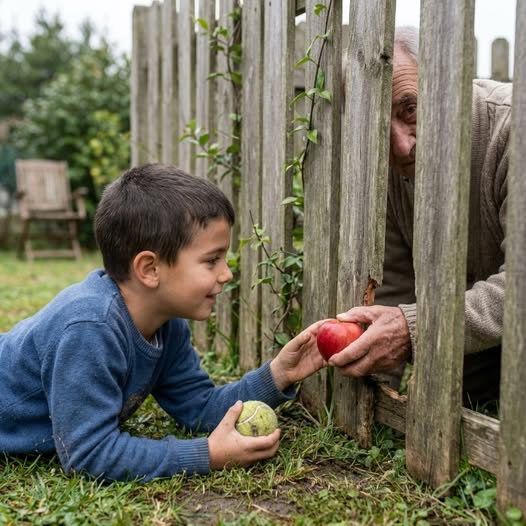
I thought of Don Ernesto. Of his wrinkled hands passing candy through a hole in the fence. Of the birthday cards I found later, stored in a drawer, all addressed to “my grandson Santiago,” all unmailed.
“Because my grandfather lost his son for trying to do the right thing,” I replied. “And because I don’t want to be another man in that family who chooses silence.”
The story didn’t end in jail. The law could no longer punish my father as he deserved. Too much time had passed for many things. But Miguel and Lucía went to the press. They filed a civil lawsuit. They told the whole story: the mother run over, the hit-and-run driver, the name change, the grandfather silenced for four decades.
Ricardo Rivas’ perfect life crumbled in a matter of weeks.
The neighbors who used to greet him stopped doing so. His former colleagues blocked him. My mother went to live with a cousin in Morelos, unable to keep up the charade. My father ended up alone, in a huge house full of family photos that now seemed like evidence of a deception.
He wrote me a letter.
“I don’t expect you to forgive me. I just want you to understand that I was afraid.”
I didn’t answer him.
Perhaps one day I’ll understand how a man can carry guilt for years and still choose to protect himself. But not yet. It still hurts too much to remember how he turned Don Ernesto into a monster to hide the monster within.
I moved into my grandfather’s house.
The first week I tore down the fence.
I didn’t hire anyone. I knocked it down myself, blow by blow, until my hands were covered in blisters. Each plank that fell seemed to release something: my childhood, my questions, Don Ernesto’s voice calling me “boy” from the other side.
When finally nothing was left, the two houses were joined by a patch of open grass. I sat on the ground and cried like I hadn’t cried at the funeral.
Then I found more boxes.
Albums with photos of me taken from afar: my first day of elementary school, my birthdays, my graduations. Journals where Don Ernesto wrote down our conversations. “Today Santiago told me he wants to be a teacher.” “Today he cried because his parents fought again.” “Today he hugged me for the first time. I can die in peace, but I still want to see him live.”
I also found wrapped gifts that he never dared to give me.
A watch. A fountain pen. A letter for my wedding. Another one for the day I had a child, although that never happened.
Don Ernesto had been like family to me all those years. Not just by blood, but by his presence. By his patience. By his unconditional love.
Now I visit her grave every Sunday. I bring her marigolds when they’re in season and tell her about my students, Miguel and Lucía, about how little by little we’ve formed a strange but sincere relationship. They tell me about Teresa: how she sang while she cooked, how she made tortillas by hand, how she wanted to study nursing when her children grew up. I tell them about Ernesto: the man who couldn’t save her, but who never stopped carrying her name like a debt.
My father lives far away now. Alone. He says he’s sorry.
Perhaps it is.
But repentance doesn’t bring Teresa back to life. It doesn’t bring back Miguel and Lucía’s childhood. It doesn’t give Don Ernesto back the forty years he spent watching his grandson from behind a fence.
History, I tell my students, isn’t just about dates. It’s about decisions. One person chooses to flee, and that cowardice destroys generations. Another person chooses to stay, and that silent love also changes a life.
My father chose to lie.
My grandfather chose to wait for me.
I choose to tell the truth.
Because walls aren’t just built with cement and wood. They’re also built with fear, with secrets, with families who prefer to keep up appearances rather than ask for forgiveness.
And when a wall falls, it hurts.
But at last we can see who was really on the other side.