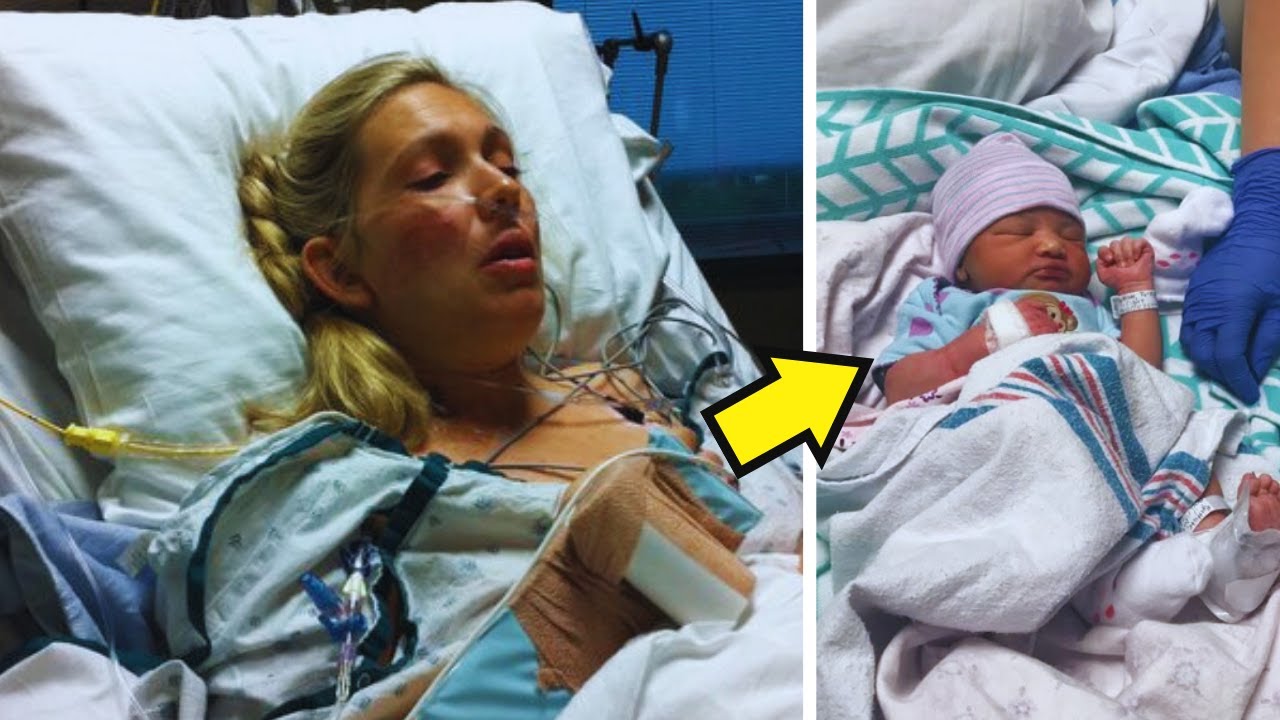
Santiago hated his daughter’s crying because in every scream he heard the death of the woman he had loved.For six weeks, the house in the Santa Tere neighborhood of Guadalajara was filled with diapers, votive candles, plates of mole that neighbors left at the door, and useless phrases like “God knows why He does things.” Santiago knew nothing about God. He only knew that Lucía had entered the hospital with a round belly, a braid over her shoulder, and the promise to return with Abril in her arms… and that she had left in a white coffin, while the baby was still alive.From then on, he didn’t say “my daughter.” He said “the girl.”
The crib stood by the window, decorated with clouds hand-painted by Lucía. She had painted them one rainy afternoon, perched on a chair, laughing because Santiago was begging her to get down. Don’t exaggerate, Santi. I’m pregnant, not made of glass. Now those clouds seemed to be mocking him. That morning, at 3:12, Abril began to cry a small, desperate sound, as if the world had abandoned her. Santiago opened his eyes in the armchair, exhausted, his shirt stained with milk and his beard growing long. He felt anger before tenderness. He felt shame before love. He got up furious. “That’s enough,” she murmured, gritting her teeth. “I can’t take it anymore.” He went into the room intending to let her cry until she was exhausted. But then he saw her. Abril’s fist wasn’t closed as usual. Her wrist was raised, and a little red bracelet with a tiny medal of the Virgin of Guadalupe gleamed on it. Santiago was frozen. He hadn’t put it on. The baby stopped crying for a second, as if she too were waiting for an explanation. Santiago approached, trembling, and saw something else: under the little pillow, hidden between the white case and a yellow blanket, was Lucía’s cell phone. Turned on. His heart leaped into his throat. That phone had been put away since the funeral. Or so he thought. No one should touch it. No one should open it. No one should bring Lucia’s voice back into that house where he was barely surviving. The screen lit up on its own. Audio began to play. Lucia’s voice came out low, hoarse, tired, but alive. Santi… don’t be mad at my mom. He stepped back as if he had been hit.
“No,” she whispered. I asked her not to tell you anything until the time came. I knew that the day they buried me, you wouldn’t listen to me. You would hate the world. You would hate yourself. And, though it pains me to say it, you would also hate Abril. Santiago covered his mouth with his hand. Doña Carmen, his mother-in-law, had come every afternoon with her black shawl, her rosary, and her eyes swollen with blood. He let her in because he didn’t have the strength to throw her out. He never imagined that she had entered the room, put on the bracelet, and hidden the phone. Listen to me completely—Lucía continued—. Don’t pause. Don’t throw your phone. Don’t run away like you do every time something breaks you inside. Santiago sat down next to the crib. Abril wiggled her feet inside her onesie. Our daughter didn’t kill me, Santi. April didn’t take my life. I was already in danger before. The fourth one seemed to tilt. At 32 weeks, the doctors told me my blood pressure was bad, that there were risks, that everything could get complicated. I didn’t tell you because that same day I saw you crying in the kitchen while you were assembling the crib. You wiped your face with your sleeve and said that for the first time you felt like God was giving you something clean. Santiago closed his eyes. He remembered. The screwdriver in his hand. The open box of screws. The shame of crying silently. “I was a coward,” Lucía said, “but I was also a mother. I signed a paper. I asked that, if anything went wrong, Abril be saved first.” A harsh sound came from Santiago’s chest. It wasn’t crying. It was something more broken. “I didn’t do it to leave you alone. I did it because I already loved her. Because you loved her too, even if you can’t feel it right now. Every night you talked to my belly and it moved as if it already knew who you were.”
April opened her mouth, but she didn’t cry. She barely sighed. I bought the little red bracelet in San Juan de Los Lagos, remember? You made fun of me because I said it was against the evil eye. But that night you kissed it when you thought I wasn’t looking. Santiago wept silently. He remembered the craft stall, the smell of gorditas, candle wax, and rain on the quarry stone. Lucía held the bracelet as if it were a treasure. “I asked my mother to wait six weeks,” the voice said. “Because at six weeks, babies begin to recognize a voice, a shadow, a presence better. And because at six weeks, people stop coming. The condolences, the potlucks, the hugs all end. That’s when true loneliness begins.” Santiago looked at Abril. His daughter. So small. So alive. So innocent. Then Lucia’s voice lowered even more. There’s another video in the gallery. But before you watch it, promise me something: when this audio ends, don’t put her back in the crib. Hold her. Even if you’re scared. Even if it hurts. Even if you cry over her. Babies don’t break from their parents’ tears, Santi. They break from abandonment. The audio ended with a kiss. And in the darkness, just as Santiago stretched out his arms towards Abril, his cell phone vibrated again with a new file that he had never seen before.
Part 2.
Santiago carried Abril with a clumsiness that was both endearing and embarrassing. The baby was warm, smelled of baby soap and milk, and when she fell against his chest, she stopped trembling. That devastated him more than any scream, because he understood that for six weeks she hadn’t asked for punishment, she had asked to be held. In the kitchen, he prepared a bottle with trembling hands. He spilled water, measured the formula incorrectly, and started again. On the wall still hung a photo of Lucía in a yellow dress, laughing at the Tonalá market, with an ear of corn in her hand and her lips covered in chili powder. For the first time since the hospital, Santiago didn’t look away. He gave Abril the bottle and watched her drink desperately. He looked at her long fingers, the almost invisible mark next to her ear, her light eyelashes. He saw Lucía in her forehead and saw himself in her hands. At dawn, Doña Carmen opened the door with a bag of conchas and bolillos. She froze when she saw him sitting in the living room, Abril asleep on his chest, the red bracelet on his wrist. No shouting was necessary. Guilt filled the room before words could be spoken. Santiago showed her the bracelet. Doña Carmen broke down. She confessed that Lucía had made her swear before the Virgin Mary that she wouldn’t hand over the phone until he was on the verge of dying, because only someone broken could listen without defending themselves. Santiago wanted to confront her, but his anger choked when he saw her old, hunched over, carrying a pain that was also his. When he allowed her to hold Abril, the woman kissed the baby’s forehead and prayed silently, like grandmothers do when they no longer ask for great miracles, only that the child breathe, eat, and not get sick. Then Santiago went into the room and opened the video. The video showed Lucía sitting on the bed, pale, with a huge belly and a loose braid. She was talking to Abril. She told him she had been wanted, that her father pretended to be tough but bought three identical pairs of socks because he didn’t know which color she would like. Then she said that Santiago hadn’t been born knowing how to love, that sometimes he shut himself off like an old door, but inside he was like sweet bread soaked in coffee. Santiago couldn’t go on. He fell to his knees beside the bed and wept for every night he’d let Abril cry for a few more minutes just to punish someone who was innocent. At that moment, from the living room, the baby began to cry. His first impulse was to run away. The second was to breathe. He walked toward her and, without thinking, said he was coming. Daughter. The word came out on its own. And instead of breaking him, he held him.
Part 3
The following days didn’t turn Santiago into a perfect father. That would have been a cheap novel lie. He learned to change diapers with fear, to bathe Abril without worrying she’d slip, to distinguish between cries of hunger, cries of sleepiness, and the cries that simply said, “Don’t let go of me.” Doña Carmen continued to visit, but no longer as a mourner, but as a grandmother. She made atole, scolded Santiago for not eating, and told Abril about Lucía: how she danced even to the sound of the blender, how she put salsa on everything even if she ended up crying, how she said Santiago had the face of a grumpy old man but the heart of a rescued dog. One afternoon, when Abril turned three months old, Santiago took her to San Juan de los Lagos. He walked with her close to his chest, wrapped in a yellow blanket. Everything hurt: the stalls, the votive candles, the smell of cajeta, the sound of the bells. At the same stall where Lucía had bought the bracelet, an elderly woman with white braids looked at the baby’s wrist and said she remembered a pregnant woman who cried when she bought it. Santiago replied that she was his wife and that the baby was Abril. The old woman touched the small medal and smiled sadly. She explained that these bracelets weren’t meant to ward off death, because no one could sell something like that; they were meant to help love find its way back. Santiago bought another red bracelet for himself. The old woman tied it with three knots: one for the one who had left, one for the one who had arrived, and one for the man who could still be saved. Months later, the house no longer resembled a mausoleum. Santiago kept some of Lucía’s things, but not all of them. He left her yellow dress behind the door, not to mourn her every day, but to remember that they had truly been happy. He painted crooked clouds in Abril’s room and stuck photos on the wall: Lucía pregnant, Lucía laughing with her mouth full of bread, Abril as a newborn, Abril squeezing his finger. Underneath, he wrote that she had arrived with a storm, but had stayed like Abril. On the girl’s first birthday, they filled the living room with yellow balloons. Abril stuck her hand into the cake with the seriousness of a judge, and everyone laughed. Later that night, when the house was quiet, Santiago turned on Lucía’s cell phone. The battery was barely holding on, but he opened the last video. Abril crawled toward the screen. When she saw her mother, she froze and touched the glass with her shoe polish-covered fingers. She babbled a word that could have been a coincidence, a miracle, or a memory: Mama. Santiago hugged her, crying, not with despair, but with gratitude. That morning, at 3:12, the cell phone lit up again on the nightstand. There was no new audio. Only one photo surfaced, one Santiago had never seen before: Lucía in the hospital, pale, exhausted, smiling with newborn Abril in her arms. The caption, written by her, said that she hadn’t left losing herself, she had left loving. Santiago kissed his daughter’s red bracelet and, for the first time since that operating room,The sound of Abril breathing didn’t seem unfair to him. It seemed like a miracle. From then on, every time Abril cried in the early morning, he would go in barefoot, tired, with dark circles under his eyes and fear, but he went in as a father. He would straighten her blanket, check her bracelet, and whisper what he should have told her from her first cry: that he was there, that Daddy was there.