he first thing I heard was Sophia crying behind a locked door. The second thing I heard was her teacher’s voice, calm and cold, telling my eight-year-old that children like her only understood punishment. I have sat through federal sentencing hearings where grown men looked less afraid than my daughter looked through that narrow storage room window. My name is Valerie Montgomery, and for three years, St. Aurelia Academy knew me as Mrs. Montgomery. Just Mrs. Montgomery. A widow. A reduced-tuition parent. A quiet woman who arrived in an old SUV, signed forms neatly, thanked receptionists, and never asked for special treatment. They did not know I was a federal judge.
That was not an accident. I never wanted Sophia to be treated kindly because of my title. I wanted her teachers to be patient because she was a child. I wanted administrators to protect her because that was their job. I wanted to know what happened when no one in that building believed there would be consequences. For a long time, I thought I was being careful. Now I know I was being shown the truth slowly. Sophia was the kind of child who carried worms off sidewalks after rain and whispered apologies to furniture after bumping into it. She loved library day, pancakes with too much syrup, and drawing little suns in the margins of her spelling worksheets. She was not loud. She was not defiant. She was simply sensitive in a room full of adults who seemed to treat sensitivity as misbehavior. Mrs. Robins started with small words. “Distracted.” “Overwhelmed.” “Dramatic.” Then the words became heavier. “Needs firm boundaries.” “Struggles with correction.”
“Emotionally manipulative.” Every phrase came dressed like professional concern. Every phrase left Sophia smaller. At home, I saw the damage before I understood the source. She stopped singing in the car. She stopped telling me what happened at recess. She started checking my face before she asked for anything, as if love was a resource she might use up. One Thursday night, while I folded laundry, she held one of her school shirts to her chest and asked if her father would still have loved her if she cried too much. My husband, Daniel, had died in a car accident when Sophia was three. She had only a few soft memories of him. The way he danced badly in the kitchen. The way he called her peanut.
The way his old sweatshirt still lived in the bottom drawer because I could not make myself give it away. I sat on the laundry room floor that night and pulled her into my lap. “Yes,” I told her. “Your dad loved every part of you.” She nodded, but she did not look convinced. That frightened me more than any disciplinary note in a backpack ever could. Cruel adults do not always leave bruises first. Sometimes they teach a child to apologize for needing comfort. The first real warning came from Rosa Miller. Rosa was not dramatic. She was a practical mother with grocery bags in one hand, keys in the other, and the permanently tired eyes of someone who worked before pickup and after dinner. Her son, Ethan, was in Sophia’s class. She stopped me outside St. Aurelia on a gray afternoon while parents moved around us with paper coffee cups and half-listened phone calls. “Valerie,” she said quietly, “Ethan told me something.” I could tell from her face that she had rehearsed the sentence. “He says Mrs. Robins made Sophia stand facing the wall during science class.” My stomach dropped. “Did he say why?” Rosa looked toward the front entrance. A security guard stood by the glass doors, pretending not to watch the parents too closely.
“He said Sophia cried after Diego pushed her. He said Mrs. Robins told her she was making a scene.” I did not speak. Rosa’s voice got smaller. “He also said there’s a storage room by the old gym. Ethan says they put kids in there sometimes.” I remember the wind moving a wrapper along the curb. I remember a yellow school bus hissing at the far end of the pickup lane. I remember thinking that schools like St. Aurelia survived because everything ugly happened behind clean doors. I started documenting after that. Not loudly. Not emotionally. Methodically. I saved every email. I photographed every note that came home. I wrote down dates and times after every strange change in Sophia’s behavior. On Monday, I requested a conference. The front desk told me Mrs. Robins was unavailable. On Tuesday morning, I emailed the school office again and asked for any written discipline records involving Sophia. No answer. At 2:14 p.m. that same Tuesday, while I sat in chambers reviewing a municipal corruption file, my phone lit up. Rosa had texted me. “Come now. Old gym hallway. I hear Sophia crying.” There are moments when the body moves before the mind asks permission. I closed the file. My clerk looked up. “Judge?” “Cancel my next call,” I said, already reaching for my coat. “Is everything all right?” “My daughter needs me.” I drove to St. Aurelia with both hands tight on the wheel. The school sat behind manicured hedges and a little American flag near the front walkway. From the outside, it looked safe.
Inside, the receptionist tried to stop me. “Mrs. Montgomery, dismissal is not for another forty minutes.” “I’m not here for dismissal.” She stood as if her body could become policy. “Parents are not allowed past the front desk without approval.” I kept walking. The hallway by the old gym smelled like bleach and damp towels. The fluorescent lights buzzed. Then I heard Sophia. Not a tantrum. Not an outburst. A trapped child trying not to sob too loudly. Mrs. Robins stood outside a storage room door. Her body was angled toward the narrow window, and her voice was low enough that she probably thought no one else would hear. I took out my phone and started recording. Through the glass, I saw Sophia sitting on the floor. Her knees were pulled to her chest. Her hair had come loose from the braid I had done that morning. A red mark crossed one side of her face. Mrs. Robins spoke through the door like she was correcting handwriting. “You are not special because your mother reads to you,” she said. Sophia shook her head. “You are not gifted. You are exhausting.” “Please don’t tell the class,” Sophia cried. “I don’t have to,” Mrs. Robins said. “They already know. That’s why they laugh.” My hand shook. I forced it still. I had learned a long time ago that anger feels righteous while it ruins evidence. So I kept recording. Then Mrs. Robins said, “Maybe your father left this world early because he knew you were too hard to love.” Something in me went silent. Not calm. Not peaceful. Still in the way a courtroom goes still when the truth finally has nowhere left to hide. I stopped recording and pushed open the storage room door so hard the handle struck the wall. Mrs. Robins spun around. For half a second, she looked afraid. Then she remembered who she thought I was.
“Mrs. Montgomery,” she snapped. “You cannot enter a restricted staff area.” I walked past her and dropped to my knees in front of Sophia. “Mommy,” Sophia whispered. “I’m sorry.” I held her face between my hands. The red mark looked like fingers. “You do not apologize for being hurt,” I said. Her whole body folded into me. Mrs. Robins started talking behind us. “Sophia had an outburst. I separated her for safety reasons.” I looked up slowly. “She hit me first,” Mrs. Robins said. Sophia cried harder. “That’s not true. Diego pushed me, and I spilled the paint.” “Sophia,” Mrs. Robins barked. I stood with my daughter against me. “Do not speak to my daughter again.” That was when Principal Harold Sellers arrived with two private security guards. His smile was practiced. It had probably worked on nervous parents for years. “Do we have a problem here?” he asked. “Yes,” I said. “My daughter was locked in a storage room.” “That is a very dramatic description.”
Rosa appeared behind him, breathless. When she saw Sophia’s face, one hand went to her mouth. Principal Sellers turned slightly, blocking her view. “Let’s discuss this privately in my office.” “I am taking my daughter home.” “I’m afraid that will not be possible until we complete an incident report.” He said it smoothly. Then he made his mistake. “If you refuse to cooperate, we may have to document unstable parental behavior and contact Child Protective Services.” Sophia gripped my coat. Her fear moved through me like electricity. “Are you threatening to report me because I found my child locked in a storage room?” “I am following protocol.” “No,” I said. “You are making a threat in front of witnesses.” His smile tightened. “Five minutes in my office, Mrs. Montgomery. Then you may leave.” I could have walked out. I should have walked out, some people might say. But men like Harold Sellers reveal more when they believe the room belongs to them. I handed Sophia to Rosa. “Stay with her.” Rosa nodded, crying now. The principal’s office smelled like expensive coffee and leather chairs. A framed school award hung behind his desk.
A small American flag stood near a shelf of binders.
Mrs. Robins closed the door as if that gave her power.
Principal Sellers extended his hand.
“Show me the video.”
I played it.
Sophia’s crying filled the room.
Mrs. Robins’ words followed.
Then the sentence about Daniel.
Nobody spoke when the recording ended.
For one second, I thought some human part of them might surface.
Then Principal Sellers said, “Delete it.”
I looked at him.
“Excuse me?”
“Delete the video,” he repeated. “We can handle this internally.”
Mrs. Robins crossed her arms.
“She is a difficult child,” she said.
Principal Sellers did not correct her.
“If you choose to make this difficult,” he continued, “Sophia’s record may become complicated.”
I glanced at the framed award behind him.
Excellence in Character.
That was almost funny.
Almost.
Mrs. Robins looked me over, from my plain coat to my worn bag.
“And honestly,” she said, “who do you think people will believe? A bitter widow with a difficult child, or an institution like this?”
That was his first mistake.
He let her say it.
Then she made his second.
“Your daughter is too slow to understand normal discipline,” Mrs. Robins said. “This is how I deal with students like her.”
What neither of them knew was that I had started recording again the moment we entered the office.
The phone sat inside my open purse with the microphone facing up.
Every word was clear.
I put my hand on the edge of the chair and stood.
“You are right about one thing,” I said.
Principal Sellers gave me that thin smile.
“And what is that?”
“You truly have no idea who you just threatened.”
The smile disappeared.
Not faded.
Disappeared.
I opened the office door.
Rosa stood in the hallway with Sophia tucked under her arm.
Sophia’s face was blotchy from crying.
One of the guards would not meet my eyes.
I took my phone from my purse and saved the second recording.
Then I called my clerk.
“Judge?” he answered.
The room changed around that one word.
Principal Sellers stared at me.
Mrs. Robins went pale.
I kept my voice even.
“I need you to preserve the message I sent you at 2:14 p.m., note my current location, and prepare a memorandum of what I am about to report.”
His tone sharpened.
“Yes, Judge.”
I ended the call.
Mrs. Robins whispered, “Judge?”
I looked at her.
“My name is Valerie Montgomery.”
Principal Sellers sat down without meaning to.
I did not raise my voice.
I did not threaten them.
I did not need to.
I told them the video would not be deleted.
I told them Sophia was leaving with me.
I told them any attempt to alter her record after that moment would be documented.
Then I walked out with my daughter.
At the front desk, the receptionist opened her mouth and closed it again.
Rosa followed us to the parking lot.
Sophia did not let go of my hand once.
The afternoon sun was too bright, and the flag near the walkway kept tapping softly against its pole in the wind.
I buckled Sophia into the back seat myself.
She looked at me in the mirror.
“Am I bad?”
I turned around so fast the seat belt cut into my shoulder.
“No,” I said. “You are not bad.”
Her chin trembled.
“She said Daddy left because of me.”
I had spoken to liars for a living.
I had listened to people twist facts, hide money, blame victims, and dress cruelty in technical language.
Nothing had prepared me for answering that sentence.
“Your father loved you,” I said. “He would have crossed fire to get to you.”
Sophia looked down at her lap.
I reached back and held her hand until she squeezed mine.
That evening, I created a timeline.
2:14 p.m., Rosa’s text.
2:31 p.m., arrival at school.
2:36 p.m., first video recorded outside storage room.
2:41 p.m., hallway confrontation.
2:48 p.m., principal’s office recording.
I saved the videos in three places.
I wrote down the names of everyone present.
I requested Sophia’s complete school file in writing.
I sent a preservation notice to St. Aurelia Academy requiring them to keep hallway footage, access logs, incident reports, discipline notes, emails, and any communication about Sophia.
I also took Sophia to be medically evaluated and documented the red mark on her cheek.
The next morning, I filed a police report.
I did not do it for revenge.
I did it because powerful institutions love informal solutions when formal accountability would reveal the pattern.
By noon, Harold Sellers had sent a carefully worded email.
He called the situation “a misunderstanding.”
He called the storage room “a temporary supervised separation space.”
He called Mrs. Robins “a valued educator.”
He did not mention the video.
He did not mention the threat to call Child Protective Services.
He did not mention my daughter’s father.
I forwarded the email to counsel.
By Friday, parents were talking.
Rosa was not the only one.
Another mother came forward about her son.
Then a father whose daughter had started refusing school.
Then a former aide who said she had complained about the old gym hallway two years earlier and had been told she was “not a team fit.”
That is how rot works.
It hides inside everyone’s fear of being the first person to speak.
St. Aurelia placed Mrs. Robins on leave.
They did not do it because they suddenly cared.
They did it because silence was no longer useful.
Principal Sellers resigned before the board meeting.
His resignation letter mentioned family reasons.
It did not mention the recording.
It did not mention the incident report draft found in Sophia’s file, already worded to make me look unstable before anyone had asked my daughter what happened.
That was the part that made Rosa sit down when she heard it.
“They were ready,” she whispered.
“Yes,” I said. “They were.”
Sophia did not return to St. Aurelia.
I enrolled her in a smaller school where the principal met her at the front door on the first day, crouched to her level, and asked what book she liked best.
Sophia looked at me before answering.
I nodded.
She whispered, “Charlotte’s Web.”
The principal smiled.
“That is a good one.”
It took months before Sophia stopped apologizing for every small thing.
It took longer before she sang in the car again.
The first time she did, it was barely above a hum.
I kept both hands on the wheel and pretended not to notice because I did not want to scare the song away.
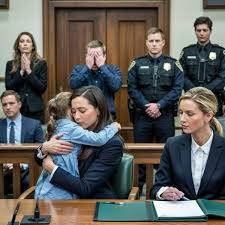
Later, at a hearing connected to the school’s internal records, I sat in a plain chair, not on a bench, not in a robe, just as Sophia’s mother.
The video played.
Mrs. Robins stared at the table.
When her own voice said my husband had left this world because my child was too hard to love, someone in the room gasped.
I did not look away from Sophia.
She sat beside me holding a little notebook.
On the cover, she had drawn a sun.
When the recording ended, she leaned into my side.
I remembered that storage room.
I remembered her whispering, “I’m sorry.”
And I whispered back the sentence I had needed her to hear then, and every day after.
“You do not apologize for being hurt.”
This time, she nodded like she believed me.
Not all at once.
Not perfectly.
But enough.
And sometimes enough is where healing start