 Part 2 — The Day the Clip Escaped the Hospital Walls
By the time the elevators carried us back up to the floor, my sneaker had stopped feeling wet.
Not because it was clean.
Because you get used to anything when you have no choice.
Zoe walked beside me with her badge swinging like a tiny pendulum, her eyes too wide, like she’d just stepped off a cliff and was still waiting to hit the ground.
Behind us, the line of bodies kept coming—nurses, therapists, a few doctors—quiet, stubborn, exhausted people who had just done the most dangerous thing in a modern workplace:
They chose a human being over a spreadsheet.
And I knew, deep in my bones, that the building was going to punish us for it.
Hospitals don’t like rebellion.
They like “compliance.”
They like smiling staff photos on the website and silence in the hallways.
They like a world where the only screams are behind closed doors, and the only questions are asked in training modules you click through at 2:00 AM.
I pushed open the double doors to Trauma and the smell hit me—bleach, sweat, plastic, old fear.
A young man was vomiting into a bag in Bay Two, his mother rubbing his back with the kind of frantic tenderness you only see when someone is helpless.
A respiratory therapist was jogging past with a tank, already late.
A monitor in the corner screamed like a smoke alarm.
And the moment I stepped into it, the conference room disappeared.
Because this—the mess, the noise, the need—this was the real presentation.
No laser pointer required.
Zoe swallowed hard. “Are we… are we in trouble?”
“Of course we are,” I said.
I didn’t mean it cruelly.
I meant it like weather.
Rain happens.
Winter comes.
Administrators retaliate.
That first night, we worked like we always do—too fast, too much, trying to patch a sinking ship with our bare hands.
But something was different.
People looked up more.
They made eye contact in the hallway like, Are you real? Are you seeing what I’m seeing?
It was as if the act of standing up had reminded us we still had spines.
At 9:13 PM, my phone buzzed.
Not a patient call.
An email.
SUBJECT: Professional Conduct Reminder
I didn’t open it right away.
I already knew what it would say.
The next day, it wasn’t just an email.
It was printed copies taped to the breakroom fridge like a threat disguised as stationery.
We value respectful dialogue.
All staff must adhere to communication protocols.
Disruptions to organizational initiatives may result in corrective action.
“Corrective action,” Zoe whispered, reading it like it was a diagnosis.
“Translation,” I said, pouring coffee that tasted like burnt regret. “They want us scared.”
Zoe’s hands were shaking again, but she wasn’t crying.
That mattered.
Around noon, Jared came back.
Of course he did.
Men like him don’t retreat. They rebrand.
This time he didn’t bring the jagged mountain graph.
He brought a smile and two administrators in expensive shoes and a woman with a tablet who looked like she had never cleaned vomit out of her hair.
They stood at the nurses’ station like tourists at an aquarium, peering at us through invisible glass.
Jared clasped his hands. “Exciting update. Based on staff feedback, we’re launching a new initiative.”
“Let me guess,” I said, without looking up from my charting. “You renamed empathy.”
He laughed like I’d told a joke at a dinner party.
“We’re calling it the Human Experience Enhancement Pathway.”
Zoe blinked. “That’s… that’s not a real thing.”
“It’s real if it’s in a PowerPoint,” Jared said.
Then he tapped the tablet.
A small device rolled forward on wheels—waist-high, white plastic, a screen with a friendly animated face.
It looked like a toy.
It looked like something you’d put in a child’s room to read bedtime stories.
“We’re piloting a bedside companion,” Jared announced. “It will handle routine reassurance, answer common questions, and reduce emotional labor.”
Emotional labor.
Like comfort was a mop bucket.
Like compassion was a workload you could outsource.
The little screen blinked. The cartoon face smiled.
“Hello!” it chirped. “I’m CareBuddy. I’m here to support your healing journey.”
The charge nurse, a woman named Denise who had been doing this longer than Jared had been alive, stared at it like it was a snake.
“Where does it plug in?” Denise asked.
Jared beamed. “It’s wireless.”
“No,” Denise said, voice flat. “I mean where do I plug in the part that matters.”
One of the administrators cleared his throat. “Let’s stay solution-focused.”
I watched Zoe’s face.
I could see two wars happening inside her.
One was fear—I need this job. I have loans. I have rent. I can’t get fired.
The other was disgust—This is wrong. This is not what I signed up for.
That second war was new.
And once it starts, it doesn’t stop.
That afternoon, Mr. Henderson crashed.
Not dramatically.
Not with TV drama and slow-motion shouting.
It was quiet.
He’d been borderline all day. Low blood pressure. Shallow breathing. The kind of slow slide you learn to respect because it sneaks up and kills people politely.
I walked into his room and saw his eyes.
Not the numbers on the screen.
His eyes.
He was staring at the ceiling like he was already halfway gone.
His hands trembled on the blanket.
The little rolling device was parked beside his bed, screen glowing.
CareBuddy’s face smiled brightly.
“I can guide you through a calming breathing exercise,” it said.
Mr. Henderson’s mouth opened like he wanted to speak, but the words wouldn’t come.
His lips were gray.
His forehead glistened with sweat.
I stepped forward, grabbed his wrist, and felt the pulse—thin, slippery, trying to disappear.
“Get me the doctor,” I snapped into the hall.
A new nurse—fresh, nervous, good heart—hovered behind me holding a tablet. “The system says he’s stable. It didn’t flag him.”
I looked at her. Really looked.
“Sweetheart,” I said, steady as I could, “if you ever choose the tablet over the face in front of you, you will kill someone.”
Her eyes filled instantly.
Not because I was harsh.
Because she knew I was right.
Mr. Henderson’s breathing hitched.
He made a sound—half cough, half plea.
I leaned close. “I’m here,” I told him, loud enough for his fear to hear. “I’ve got you.”
His eyes flicked to me.
And in them, I saw it.
Not pain.
Not even panic.
Relief.
That a human being had arrived.
The doctor came running.
Orders flew.
Fluids, meds, oxygen.
We stabilized him by inches.
The kind of inches that only exist because someone noticed the difference between a living face and a dying one.
When it was over, I stepped into the hallway and saw Jared standing there.
He’d been watching.
His smile was gone now, replaced by something defensive.
“What happened?” he asked.
“What always happens,” I said, my voice low. “A person didn’t fit your model.”
He lifted his hands. “The tool is designed to assist—”
“It sat there and chirped while a man slipped away,” I said. “It offered breathing exercises to someone who couldn’t breathe.”
Jared’s jaw tightened. “That’s an edge case.”
Mr. Henderson’s daughter arrived an hour later, hair messy, eyes red, clutching her phone like it was the only thing keeping her upright.
She rushed into the room and grabbed his hand with both of hers.
Then she looked at me.
“Thank you,” she whispered, voice breaking. “They told me yesterday he might not get approved for rehab. I… I don’t know how I’m supposed to do this. I work two jobs. I have kids. I’m—”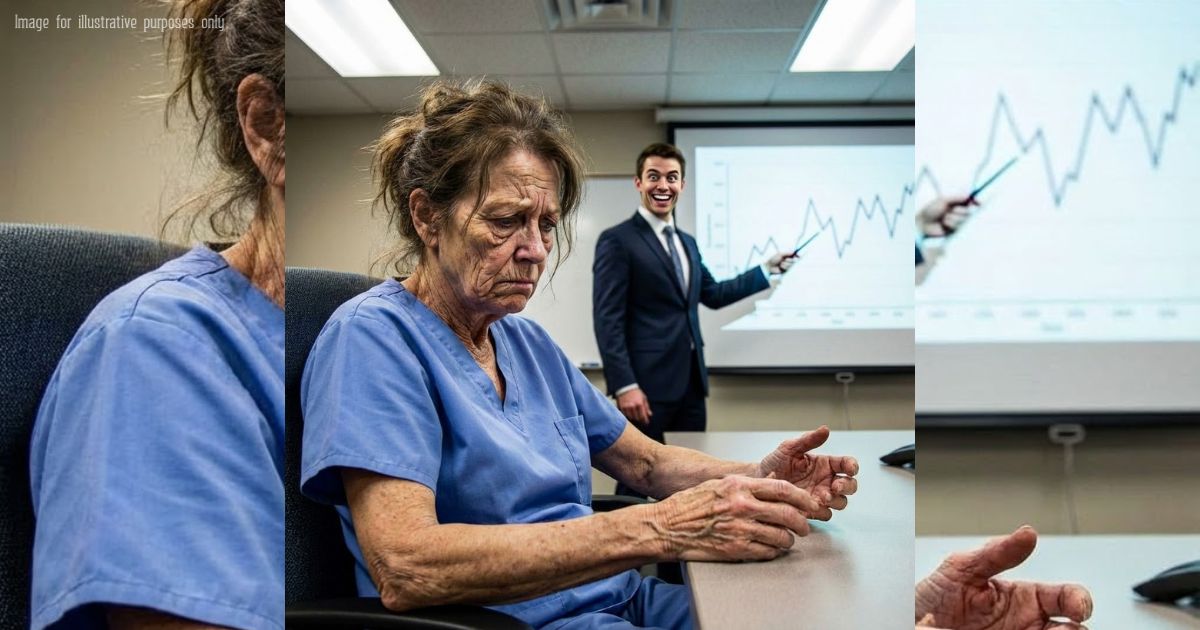
She stopped, ashamed of her own exhaustion.
Like being overwhelmed was a moral failure.
I hate that.
I hate what this country does to people—makes them apologize for needing help.
I squeezed her shoulder. “You’re not failing,” I said. “You’re carrying too much.”
Behind her, the little CareBuddy screen blinked cheerfully.
“I can provide resources for caregiver wellness,” it offered.
She stared at it like it had slapped her.
I watched her expression change—from confusion, to anger, to the kind of laugh that isn’t funny.
“What is that?” she demanded.
“Administration,” I said quietly.
Her eyes flashed. “So they can buy that, but they can’t approve his rehab?”
There it was.
The sentence that sparks comment sections into bonfires.
Because people will fight over it.
They always do.
Half of them will say, Healthcare is a business. That’s reality.
Half of them will say, No human being should be treated like a profit margin.
And the truth is, we’re all stuck inside that argument while real people bleed in real beds.
That night, the clip went online.
I didn’t post it.
Zoe didn’t post it.
Somebody in that conference room had filmed my speech—the part about “the algorithm handles the empathy”—and leaked it into the world where things don’t stay private.
By midnight, my phone was buzzing like an angry beehive.
Texts from nurses I hadn’t spoken to in years.
Messages from strangers.
Voicemails from unknown numbers.
And in the middle of it all, Zoe stood in the breakroom with her own phone shaking in her hands.
“Martha,” she whispered. “It’s… everywhere.”
She turned the screen toward me.
There I was.
Older, tired, hair frizzed from sweat, voice rough, eyes fierce.
A caption under the video screamed in giant letters:
“A NURSE JUST EXPOSED WHAT HOSPITALS REALLY ARE NOW.”
The comments were already a war.
SHE’S RIGHT.
NURSES ARE ANGELS.
DO YOUR JOB AND STOP COMPLAINING.
THIS IS WHY COSTS ARE OUT OF CONTROL.
IF YOU DON’T LIKE IT, QUIT.
THEY’RE REPLACING YOU WITH ROBOTS ANYWAY.
Zoe stared at the screen like it was a monster.
“Is this… good?” she asked.
“It’s loud,” I said. “That’s what it is.”
A loud truth is dangerous.
Not because it’s untrue.
Because it forces people to pick sides.
And sides are great for engagement.
Terrible for human beings.
At 6:05 AM, after another night of sprinting from room to room, after cleaning blood off my shoe with a paper towel that fell apart in my hands, I got another email.
SUBJECT: Mandatory Meeting — Human Resources
I didn’t have to open it to feel the weight.
I walked into HR at 8:30, still smelling like antiseptic.
A woman with perfect hair sat across from me, smiling the way people smile when they’re about to hurt you politely.
On the table was a printed screenshot of my face from the video.
A stranger’s version of me—cropped, captioned, turned into content.
“We’re concerned about your public statements,” she said gently. “They may violate organizational policy.”
“What policy?” I asked.
She slid a paper toward me.
NON-DISPARAGEMENT ACKNOWLEDGMENT
I looked at the signature line.
And suddenly, I understood the whole game.
They couldn’t stop the bleeding.
They couldn’t fix the staffing.
They couldn’t make Mr. Henderson’s rehab magically approved.
But they could control the narrative.
They could silence the people who actually see the truth.
“You want me to sign this,” I said, “so you can keep pretending nothing is wrong.”
She leaned forward, still smiling. “We want to move forward constructively.”
I laughed once—short and tired.
“Constructively,” I echoed. “Like a funeral brochure.”
Her smile flickered.
“Think carefully,” she warned, voice softer now. “This could impact your employment.”
Thirty-four years.
Tens of thousands of patients.
Countless hands held in the dark.
And here it was.
My career reduced to a signature on a piece of paper designed to protect the system, not the people inside it.
I picked up the pen.
Zoe’s face flashed in my mind—young, terrified, trying to become a nurse in a world that wants nurses to be quiet.
Mr. Henderson’s daughter flashed in my mind—furious, exhausted, asking why a gadget gets funding but her father doesn’t get care.
And the nineteen-year-old boy from the trauma bay flashed in my mind—the blood on my shoe, the mother I didn’t call back yet, the reality that never makes it into the graphs.
I set the pen down.
“No,” I said.
The HR woman’s smile vanished completely.
“Martha,” she said slowly, “do you understand what you’re doing?”
I stood up.
My knees popped again—loud in the quiet office.
“I understand exactly,” I said. “I’m doing what you all forgot how to do.”
I walked to the door.
Behind me, she spoke like a final warning.
“You can’t fight the future.”
I turned back, hand on the handle.
Her eyes were sharp now, not kind.
Not human.
I thought about the little rolling device with the cheerful face.
I thought about the phrase the algorithm handles the empathy.
And I felt something settle inside me—calm, heavy, certain.
“I’m not fighting the future,” I said. “I’m fighting for the part of us that still deserves to be in it.”
Then I opened the door.
And I went back to the floor.
Because someone, somewhere in that building, was scared.
And no screen in the world can hold a trembling hand the way a human can.
Not yet.
Not ever.
Thank you so much for reading this story!