At My Housewarming Party, My Sister Smiled And Handed My Son A Mocktail. “Drink Up, Billy. I Made It Just For You.” I Bent Down As If To Fix His Shoes And Quietly Swapped The Cup With Her Husband’s. Minutes Later…
Continues Reading Part 4
I told myself there were innocent explanations for the bottle.
Bitters. Flavoring. Some overpriced cocktail syrup Diane had bought from a boutique grocery store where everything cost twelve dollars more than it should. She was always bringing things like that around, little luxuries disguised as generosity.
But my body did not believe innocence anymore.
The kitchen was crowded enough to hide in plain sight. My aunt Linda was cutting limes at the counter. Two cousins argued about whether the barbecue needed more sauce. Someone had plugged a phone into the speaker, and old Motown floated under the noise of conversation. Outside, the kids shrieked as the dog barreled across the yard, nails scratching against the deck.
Diane stood at the drink station like she had been hired for the job.
Tall glasses. Plastic cups for the kids. Bowls of fruit. A pitcher of something pink and sparkling that caught the light prettily enough to look harmless. She was laughing with my cousin Heather, saying something about how men could build a fence but could not remember napkins, and everyone laughed because it was the kind of harmless insult people expect at family parties.
I laughed too.
That is what frightens me most when I replay it.
How normal my face must have looked.
Diane lifted the pitcher. Her bracelets clicked against the glass. The sound carried across the kitchen, delicate and bright.
“You want one?” she asked me.
“Driving later,” I said.
“You live here.”
“Still.”
She tilted her head, amused. “Suit yourself.”
Her purse sat on the counter beside the toaster. Tan leather. Gold clasp. A scarf tied around one handle. I knew that purse. Diane carried it like an extension of herself, polished, expensive, always zipped.
Now it was open.
I moved around the island with the platter of sliders, slow enough not to look purposeful. From that angle, I could see inside. Lipstick. Keys. A folded receipt. A small amber prescription bottle with the label turned inward.
My mouth went dry.
Diane noticed my eyes drop.
She closed the purse.
Not quickly. That would have betrayed her. She simply rested one hand on the clasp and pressed until it clicked.
“Owen,” she said softly. “You’ve done a beautiful job with this place.”
“Thanks.”
“Sarah would have loved the lights.”
I hated her for saying that. I hated that my first response was still grief, still the reflexive ache of Sarah’s name in the open air.
“Yeah,” I said. “She would have.”
Diane watched me. There was sympathy on her face, but it sat there like makeup, applied carefully.
“Don’t push yourself too hard tonight,” she said. “You always try to prove you’re fine.”
“I’m hosting a party, Diane. Not climbing Everest.”
Her smile tightened.
Then Billy ran through the kitchen with his cousin Emma chasing him, both of them breathless and red-faced. His inhaler clipped to his belt bounced against his hip. Diane’s eyes followed it.
That was the first clue I could not explain away.
Not Billy. Not his face. His inhaler.
A quick glance, down and back up, so fast anyone else would have missed it. But I was already watching her too closely.
“Slow down,” I called.
Billy skidded in his socks. “We’re spies.”
“Spies breathe quietly.”
He put one finger to his lips and tiptoed dramatically out of the kitchen.
Diane laughed.
It sounded real enough to fool the room.
At 7:34, I was on the back porch lifting another tray from the cooler when I heard her voice through the screen door. Lower than before. Not party voice. Private voice.
“Not enough,” she said.
The next words blurred under a burst of laughter from the yard, but then I heard the name.
Billy.
I froze with my hand on the tray.
The porch light buzzed above me. A moth knocked itself again and again against the glass. Somewhere behind the fence, a car door slammed. Ordinary sounds. Life continuing, stupidly, while my pulse beat hard in my ears.
I stepped inside.
Diane was crouched in the living room doorway, holding a pink drink with both hands. Billy stood in front of her, cheeks flushed from running, hair damp at the temples, eyes bright.
“Drink up, Billy,” she said. “I made it just for you.”
Her voice was sweet.
Her shoulders were not.
They were raised, tense, almost braced. Her eyes fixed on the cup as his fingers closed around it. That focus did not belong to an aunt giving a child a treat. It belonged to someone waiting for a mechanism to engage.
My first thought was impossible.
My second thought was move.
I set down the tray.
If I yelled, she could deny. If I knocked the cup away, everyone would turn, and I would have a shattered drink, a humiliated child, and no proof of anything except that grief had made me unstable. Diane would cry. Derek would murmur that she meant well. Somebody would mention how hard the year had been on me.
And if I was wrong, I would become the man who saw monsters in mocktails.
So I smiled.
“Hey, bud,” I said. “Shoe.”
The room smelled like pulled pork and furniture polish. The lights glowed amber against the windows. Somebody behind me was telling a story too loudly. Billy lifted his foot with exaggerated suffering.
I crouched.
His sneaker lace was damp from the yard. My fingers moved automatically, making loops, buying seconds. With my other hand, I lifted the cup.
Billy did not notice. Diane had already turned away, accepting a compliment from Aunt Linda about the drinks.
I set Billy’s cup on the side table beside Derek.
Derek sat in the armchair, shoulders curved inward, scrolling through his phone. His own identical drink sat untouched near his knee.
I took it.
For one terrible second, I held both versions of the night in my hands.
Then I handed Derek’s cup to my son.
“Go easy on the sugar,” I said.
Billy saluted me with the paper umbrella and ran off.
I stood slowly.
Diane’s back was to me, but I saw her reflection in the dark window. She was watching Billy in the glass.
Waiting.
I felt something inside me go quiet.
Not calm. Quiet.
The way a house goes quiet after you hear the foundation crack.
And then Derek lifted the other cup.
Part 5
Derek drank like a man doing something just to have something to do.
A distracted sip. Then another. He did not look at the cup. He did not taste whatever was in it and pause dramatically. He just swallowed while scrolling on his phone, thumb moving, eyes dull in the blue light.
I remember wanting to stop him.
That is the truth.
There was a moment, maybe two seconds, when I could have crossed the room and taken the cup from his hand. I could have said I mixed them up. I could have spilled it. I could have saved him from whatever Diane had intended for my son.
But I did not know. Not certainly. Not yet.
And Derek was not a stranger in a burning building. He was a grown man married to the woman I suspected of arranging my life like a trap. He was part of the room she moved through. Maybe he knew. Maybe he did not. Maybe the cup held nothing but syrup and seltzer and my fear.
So I watched.
I hate that sentence.
I watched.
The party went on around the edge of my vision. My uncle told a story about a neighbor’s stolen lawn mower. Someone dropped ice in the kitchen. The kids outside yelled about bases and rules and whether the dog counted as a player. Diane laughed at something Heather said, head tipped back, throat exposed, one hand touching her necklace.
Her eyes kept going to Billy.
Every thirty seconds. Maybe less.
He was by the patio door now, eating a cookie, the mocktail abandoned on a low bookshelf with the umbrella missing. He looked perfectly fine. Annoyed because Emma had declared the dog was on her team. Alive. Breathing.
Derek coughed at 7:51.
The first cough was small.
The second ripped through him.
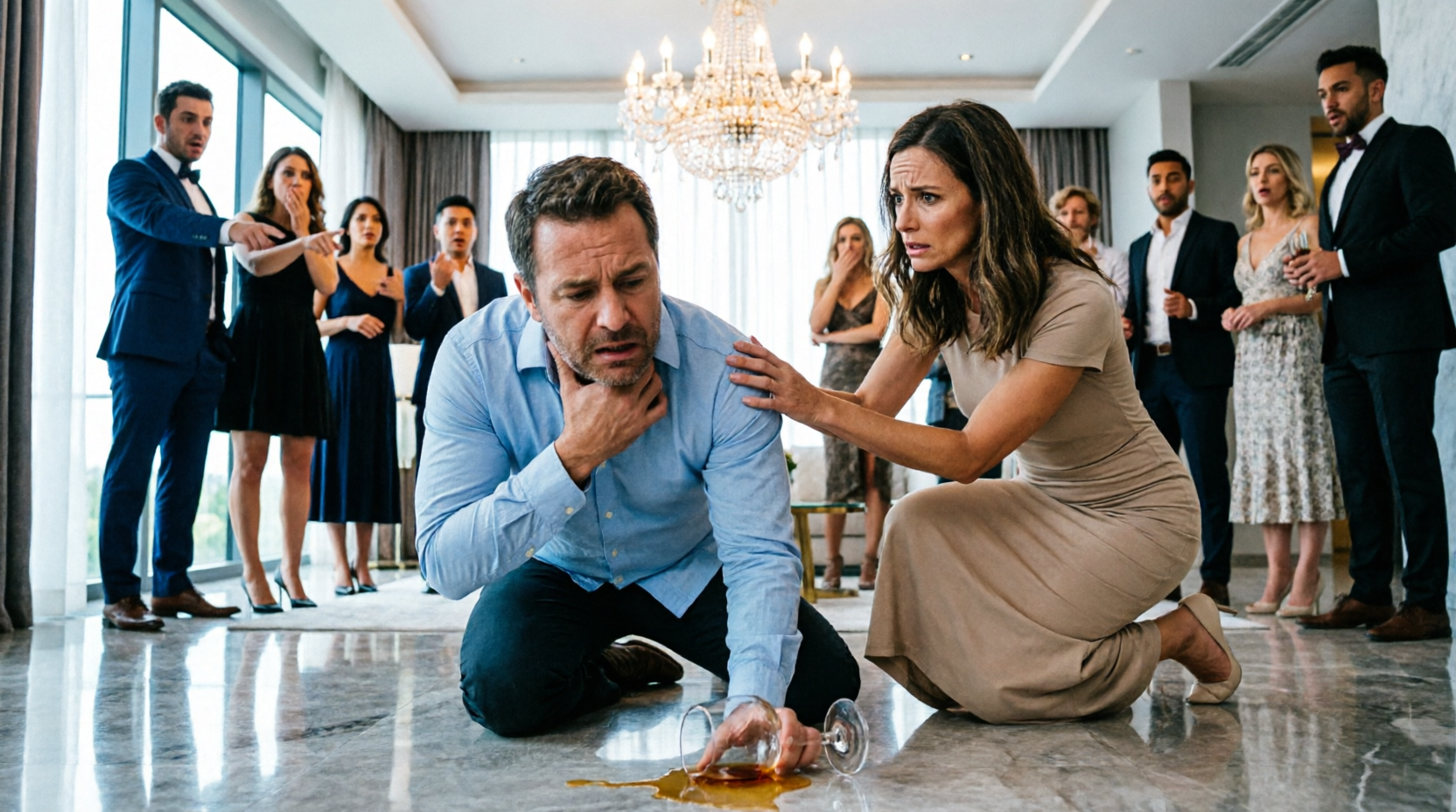
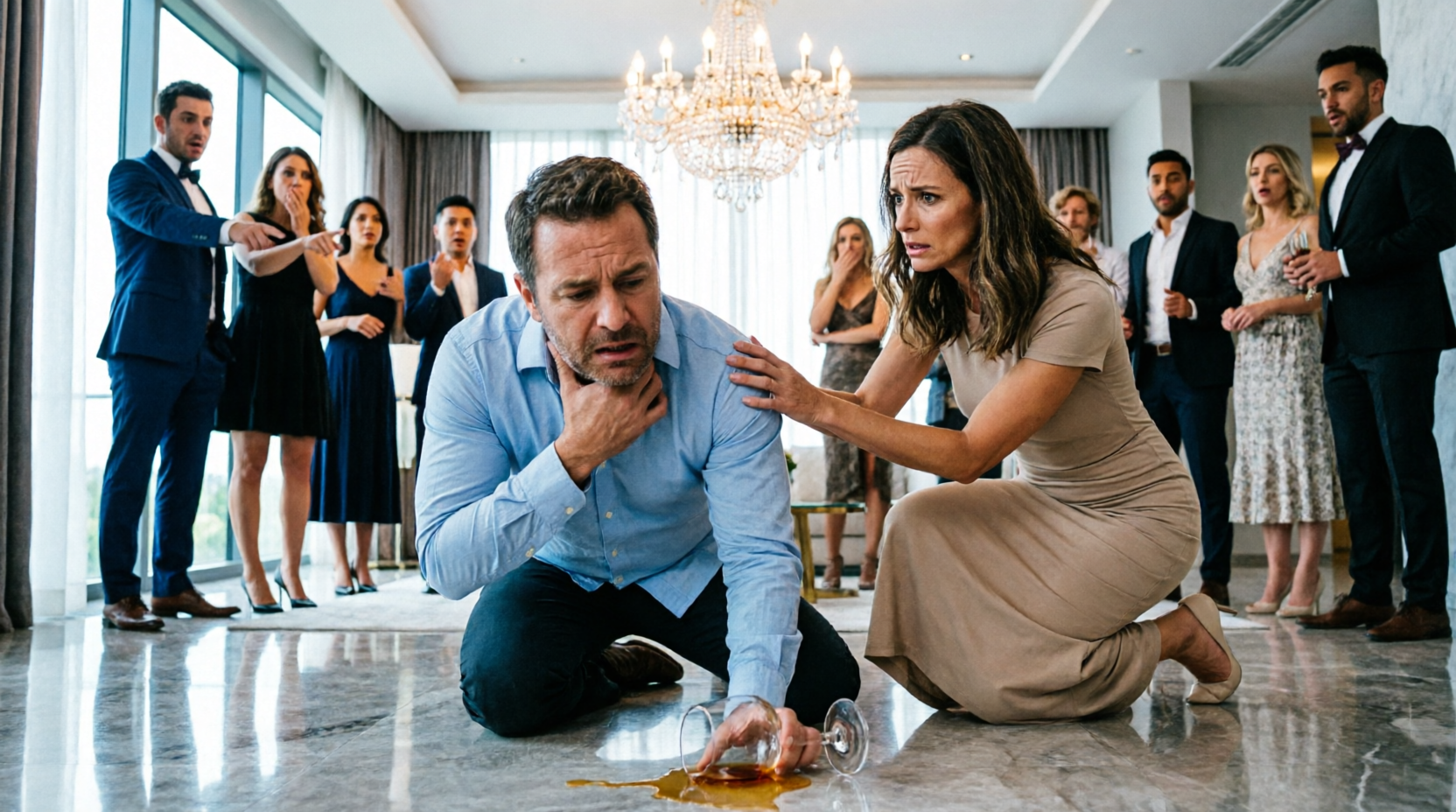
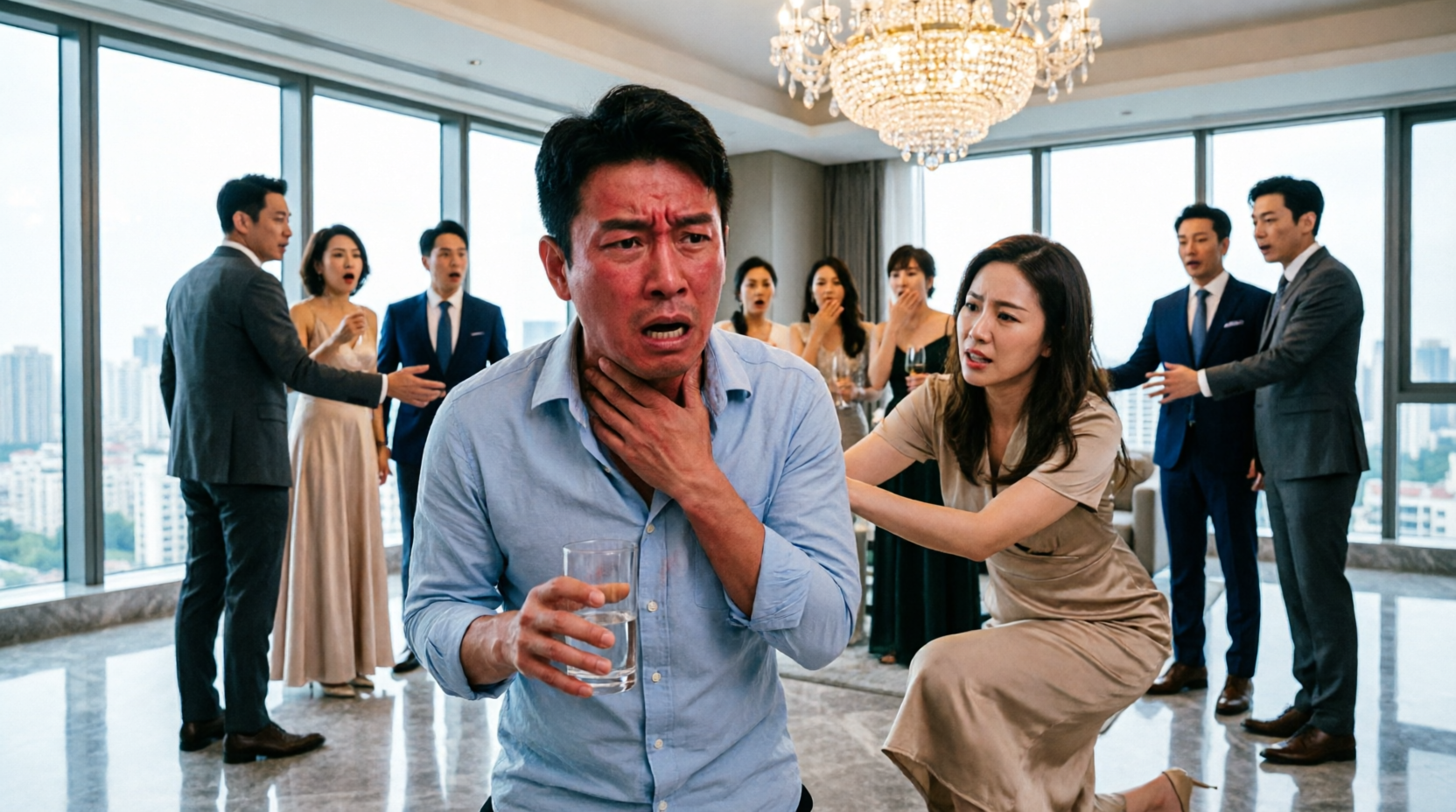
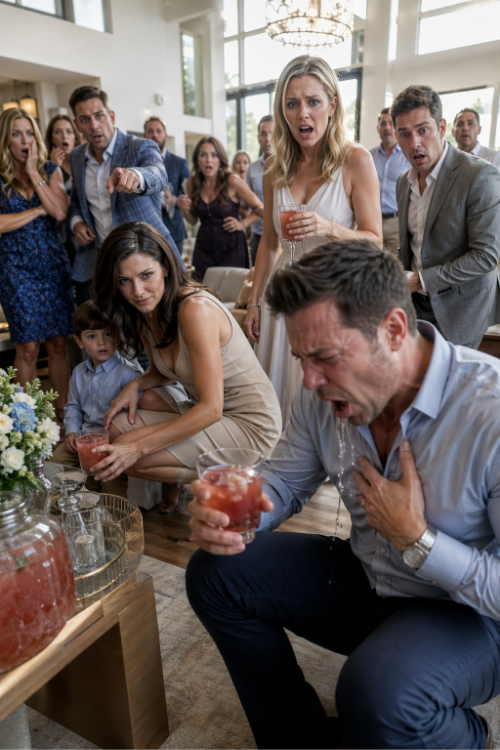
His body jerked forward. His phone slid from his hand and bounced on the rug. His face went red, then strangely gray around the mouth. He tried to stand and failed. The cup fell, hit the new hardwood, and cracked open, pink liquid spreading across the boards I had sanded myself.
“Derek?” someone said.
Then everything happened at once.
Chairs scraped. Linda screamed. My cousin Marcus dropped to his knees beside Derek and shouted for someone to call 911. Heather pulled the coffee table back. Somebody turned off the music, and the sudden absence of it made the room feel colder.
Derek’s hands clawed at the rug.
His eyes were open but unfocused. Saliva shone at the corner of his mouth. His breath came in ugly, uneven pulls.
Diane did not move for three seconds.
I counted them later in memory. One. Two. Three.
Then she looked at Billy.
Not at her husband.
At Billy.
He was standing four feet from the patio door, cookie halfway to his mouth, staring at Derek with wide eyes. No coughing. No wobbling. No flushed panic. No small body going limp on my living room floor.
Diane saw that.
Her face changed.
It was almost nothing. A tightening around the eyes. A tiny hollowing of the cheeks. Panic, but not the panic of a wife seeing her husband collapse.
Panic because the wrong person had.
Then the mask came down.
“Oh my God!” she cried, rushing forward. “Derek, baby, stay with me!”
She knelt beside him but did not touch his mouth, his chest, his pulse. Her hands fluttered uselessly over his shoulder. Performance hands. Loud hands. Hands meant for witnesses.
I moved then, but not toward Derek.
Marcus was already handling him. Marcus was a firefighter in Raleigh and knew what to do. He rolled Derek onto his side, checked his airway, barked instructions with enough authority that everyone obeyed.
I went to Billy.
“Come here,” I said.
His face crumpled. “Is Uncle Derek dying?”
“No.” I hoped it was true. “But I need you upstairs.”
“I didn’t do anything.”
“I know. Upstairs. Now.”
He started crying, not loud, just that silent shaking that always broke something in me. I guided him to my bedroom and sat him on the edge of the bed with the dog, who had followed us nervously.
“Stay here with Rocket,” I said. “Do not come downstairs unless I come get you.”
“What happened?”
“I don’t know yet.”
That was the last lie I told him that night.
Back downstairs, the living room was chaos. The pink liquid had spread under the side table. The broken plastic cup lay near Derek’s shoe. Diane was sobbing now, perfectly, breathless and dramatic, while checking over her shoulder toward the staircase.
The 911 operator’s voice came faintly from someone’s phone.
I went to the kitchen.
My hands were steady.
That steadiness frightened me later. In the moment, it felt useful. I opened the drawer beside the sink, took out a pair of disposable gloves from the first aid kit, then pulled a clean Mason jar from the cabinet.
Billy’s original cup was still on the side table.
Not broken. Not spilled. The pink drink inside had gone flat, bubbles clinging weakly to the plastic.
Derek had never touched that one after I moved it. I had watched enough to know.
I picked it up with the gloves on and carried it into the kitchen. I poured the remaining liquid into the Mason jar. It smelled sweet and tropical, pineapple and fake cherry, with something bitter underneath that might have been imagination.
I sealed the jar.
Then I labeled it with painter’s tape and a Sharpie.
Party drink. Billy’s original cup. 7:55 p.m.
The timestamp was approximate. The handwriting was not.
I put the jar in the back of the refrigerator behind a pan of lasagna.
When I turned around, Diane was standing in the kitchen doorway.
Her face was wet. Her eyes were not.
“What are you doing?” she asked.
I held up a stack of paper towels.
“Cleaning my floor.”
She stared at me.
Behind her, sirens approached, thin at first, then louder, filling the street with red light that flashed across the windows.
For the first time since I had known her, Diane looked unsure of where to put herself.
That was when I knew she had planned for grief, for confusion, for sympathy, for me to collapse under the weight of another disaster.
She had not planned for me to start collecting evidence.
Part 6
The EMTs arrived at 7:58.
They came in fast, smelling like cold air, rubber gloves, and rain. Their boots squeaked on my new floor. One of them asked sharp questions while another checked Derek’s pupils and blood pressure. Marcus gave a quick summary in the clipped voice people use when panic has to stand aside for training.
Male, forty-three. Sudden respiratory distress. Slurred speech. Loss of coordination. Unknown exposure.
Unknown exposure.
Diane flinched at the phrase.
I saw it because I was watching her again.
She rode in the ambulance with Derek, which gave me the first clean breath I had taken all night. Not because he was gone. Because she was. Her absence changed the air in the house. People still whispered. My aunt cried at the sink. The kids were quiet in the backyard. But without Diane’s attention moving from face to face, the rooms stopped feeling occupied by something hidden.
Family thinned out slowly.
Nobody wanted to leave too fast and seem uncaring. Nobody wanted to stay and admit they were curious. They hugged me awkwardly, told me to call if I needed anything, stepped around the pink stain on the floor.
I nodded. I thanked them. I watched every cup that went into the trash.
By ten o’clock, the house was nearly empty.
Billy had fallen asleep in my bed with Rocket curled against his legs. His cheeks were still damp. The paper umbrella lay on the nightstand beside him, bent at the stem.
I stood in the doorway longer than I needed to.
His breathing was even.
In. Out.
A sound so small it felt holy.
Downstairs, the house looked like a party had collided with an emergency. Plates abandoned. Napkins on the floor. A bowl of chips overturned near the couch. Red and blue light still seemed to flicker in my vision even though the ambulance was gone.
I took the Mason jar from the refrigerator and set it on the counter.
The pink liquid looked stupidly cheerful under the kitchen light.
I photographed it from three angles. Then I photographed the original cup. The side table. The spill on the floor. The amber droplets that had dried near the broken plastic. I took pictures of everything because details disappear and people lie.
At 8:30 the next morning, I called Meridian Analytical Services.
I got the number from a colleague who had once used them in a construction defect case involving contaminated soil. They did independent forensic testing for attorneys, insurers, and private clients with enough money and fear to pay quickly.
A woman named Dr. Patricia Osay called me back within twenty minutes.
Her voice was calm but not soft. I liked that immediately.
“Do not transfer the liquid again,” she said. “Keep it sealed. Keep it cold. Bring the container exactly as it is. If there’s any related material, cups, napkins, anything with residue, bring that too.”
“Is this legal?” I asked.
“What you’re asking for is private analysis. What anyone does with the results depends on law enforcement and your attorney. But if you believe a child may have been targeted, move carefully and document everything.”
A child may have been targeted.
She did not know Billy. She had never seen him sleep with his mouth slightly open, never heard him ask if heaven had pancakes because Sarah used to make pancakes on Sundays. Still, hearing someone else say child made the kitchen tilt.
I woke Billy at nine.
He did not remember falling asleep. He asked about Derek before he asked for breakfast.
“He’s at the hospital,” I said. “They’re helping him.”
“Did he drink something bad?”
I paused with my hand on the cereal box.
“I don’t know yet.”
Billy nodded like children do when adults give partial answers. They accept the words and store the silence for later.
At Meridian, Dr. Osay met me in a small reception area that smelled like copier toner and hand sanitizer. She was in her fifties, with silver-threaded hair pulled back tight and reading glasses hanging from a cord around her neck. She treated the Mason jar like it mattered, which made me trust her more.
She had me sign forms. Chain of custody. Date and time received. Condition of seal. Description of sample.
“You preserved this well,” she said.
“I watch crime shows.”
She did not smile. “Good. Keep watching them.”
Preliminary results came back forty-eight hours later.
I was at work, staring at a load calculation I had read six times without understanding, when my phone buzzed.
Dr. Osay did not waste words.
“The sample contains triazolam,” she said.
I stepped into the stairwell. The concrete walls smelled damp and metallic.
“What is that?”
“A benzodiazepine. Fast-acting. Sedative-hypnotic. Commonly prescribed for short-term insomnia in very controlled doses.”
“How much?”
She paused.
I gripped the railing.
“Based on the concentration in the remaining liquid and the estimated original volume, enough to cause severe sedation in an adult. In a child, especially a child with asthma or any respiratory vulnerability, the risk would be substantially higher.”
My throat closed.
“Are you saying it could have killed him?”
“I’m saying it was potentially fatal.”
The stairwell went silent except for the buzz of fluorescent lights overhead.
I sat down on the concrete step because my knees had stopped being reliable.
Potentially fatal.
Not suspicious. Not imagined. Not grief making monsters out of women with casseroles.
Poison.
In the drink Diane handed my son.
When I could speak again, I asked her to prepare a formal report.
Then I called Constance Park.
She answered on the second ring.
“Owen,” she said. “Is Billy all right?”
That was the kind of person she was. She heard my voice and started with the child.
“Yes,” I said. “Because I switched the cups.”
There was a silence.
Then Constance said, “Come to my office. Bring everything.”
Her office was downtown, third floor of a brick building with old windows and a lobby that smelled faintly of dust and expensive coffee. I brought the bank statements, the power of attorney, copies of my notes, photographs from the party, and Dr. Osay’s preliminary findings.
Constance read quietly.
She had short gray hair, red glasses, and the stillness of someone who had spent decades listening to people explain the worst moments of their lives. She did not interrupt. She did not gasp. She turned each page with care.
When she reached Clause 14b, her jaw tightened.
When she reached the bank transfers, she took off her glasses.
“This power of attorney is voidable,” she said. “Given the circumstances, I’d argue it was obtained through undue influence and fraud.”
“How fast can we kill it?”
“I’ll file today.”
“And the rest?”
“The money is recoverable. The toxicology report is criminal. The combination is…” She stopped, choosing the word. “Serious.”
“I need to prove Diane did it.”
Constance looked at me over the papers.
“Owen, you may already have more than you think.”
Then her phone buzzed.
She glanced at the screen and frowned.
“It’s your cousin Maggie,” she said. “She says she has something from the party.”
Maggie was twenty-three and dramatic in the harmless way of young people who believe secrecy makes romance more interesting. I remembered seeing her slip out of the kitchen more than once that night with her phone pressed to her chest, hiding from her mother and texting someone named Caleb or Connor or maybe Cameron.
Ten minutes later, she sent Constance a voice memo.
Fourteen seconds long.
Tinny. Muffled. Pantry door half-closed. Party noise in the background.
Then Diane’s voice, low and irritated.
“It’s not enough. We need him to drink all of it.”
A second voice answered, too faint to identify.
Then Diane again.
“Billy has to finish it.”
I listened once.
Then I sat back in Constance’s chair and covered my mouth with my hand.
Because there are moments when the truth does not arrive like a lightning strike.
It arrives like a door locking behind you.
Part 7
Constance told me not to confront Diane.
“Do not warn her,” she said. “Do not accuse her. Do not give her a chance to destroy anything. Let the evidence move first.”
I nodded like I agreed.
I did agree.
Then Diane came to my house eleven days after the party, and every reasonable part of me had to stand behind my teeth and hold on.
It was Thursday afternoon, the kind of mild October day that looks innocent. Leaves on the lawn. Thin blue sky. A school bus sighing at the corner. Billy was at a friend’s house for a supervised playdate I had arranged with the desperation of a man who needed his son somewhere safe for two hours.
Diane arrived carrying soup.
Of course she did.
Beige cardigan. Soft makeup. Hair a little looser than usual, as if she had dressed herself to seem more approachable. The container was glass with a blue lid. Steam fogged the inside.
“I made too much,” she said.
“No, you didn’t.”
The words came out before I could soften them.
Her smile paused.
Then recovered.
“You’ve always had a dry sense of humor.”
I stepped aside.
Letting her in felt wrong, but refusing would have told her I knew too much. Besides, by then the important documents were no longer only in my house. Copies sat in Constance’s office, in a safe deposit box, and with Detective Allison Varga, who had taken my statement two days earlier in a windowless interview room that smelled like coffee and old carpet.
Varga had listened to everything twice.
The second time, she asked fewer questions and took more notes.
“Why did you switch the cups?” she had asked.
“I had a feeling.”
“What kind of feeling?”
“The kind I should’ve trusted a year ago.”
She studied me for a moment, then wrote something down.
Now Diane stood in my hallway, looking around the new house like she was inspecting an investment. Her eyes moved over the staircase, the living room, the framed photo of Sarah and Billy at the beach. They lingered on that one.
“How is he?” she asked.
“Derek?”
“Billy.”
Of course.
“He’s fine.”
“That’s good.” She lowered her voice. “Children can be affected by witnessing medical emergencies. Even when they seem fine.”
“He has a therapist.”
“And you?”
“I have coffee.”
She gave me the sad little smile she used when pretending I had made her worry. “Owen.”
I hated that tone more than anger. Anger would have been honest.
She walked into the kitchen without being invited and set the soup on the counter.
The kitchen still had a faint stain near one floorboard where the pink drink had seeped too quickly before I cleaned it. I had scrubbed it three times. In certain light, I could still see the ghost of it.
Diane saw it too.
Her gaze dropped, then lifted.
“How is Derek?” I asked.
She touched her necklace. “Recovering. Doctors think it was some kind of reaction. Maybe something in the drink mix. These things happen.”
“These things?”
“You know what I mean.”
“I don’t think I do.”
The mask flickered again.
She turned toward the window above the sink. Outside, the backyard fence leaned slightly in the section I had built on the hottest day of August. Sarah would have teased me about it. Billy called it “the wobbly part” and insisted it gave the yard character.
“You seem like you’re carrying a lot,” Diane said. “With everything. The party. Derek being sick. Raising Billy alone. This house.”
There it was.
The opening move.
“I’ve been thinking,” she continued, “maybe you need more consistent support.”
“I have support.”
“Family support.”
“I have that too.”
She turned from the window. Her face was gentle. Her eyes were sharp.
“I mean someone who can step in legally if needed. Temporarily. Not because you’ve done anything wrong, Owen. But if you became overwhelmed. If a doctor thought rest was necessary. If Billy needed stability while you recovered.”
There was the door she had built.
There was the key turning.
For fourteen months, Diane had fed the idea that grief made me fragile. She had gathered examples like stones. Missed calls. Exhaustion. Billy’s asthma. My weight loss. The house renovation. Every ordinary struggle of a widower turned into possible evidence that I was failing.
I leaned against the counter.
“You mean Clause 14b.”
She went still.
The refrigerator hummed between us.
“I’m sorry?” she said.
“The guardianship clause. In the power of attorney you had me sign when I was too destroyed to read straight.”
A small flush rose along her throat.
“That document was for emergencies.”
“Like a poisoned drink at a housewarming party?”
Her face changed so quickly it almost made me step back.
The softness vanished.
Not all at once. Layer by layer. Concern first. Then hurt. Then patience. What remained underneath was colder than I expected.
“You should be very careful,” she said.
“I am now.”
“You’re grieving. People will understand that you’re confused.”
I almost laughed.
There it was again. The foundation of her whole plan. My grief as her shield.
“I have a toxicology report,” I said.
The color drained from her face.
I kept going.
“I have bank records. I have the power of attorney. I have photographs. I have the cup. And I have a voice recording from the pantry.”
She stared at me.
For once, Diane had no line ready.
“You can’t prove anything,” she whispered.
“I already did.”
The silence after that was not empty. It was crowded with every meal she had brought, every document she had slid in front of me, every time she had said Sarah would have wanted this.
Diane picked up her purse.
She left the soup.
At the door, she turned back.
For half a second, I saw something almost like hatred.
Not fear of prison. Not shame.
Hatred that I had ruined the version of the story where she won.
Then she stepped outside, and I locked the door behind her.
My phone buzzed before her car left the driveway.
A text from Constance.
Do not respond to Diane if she contacts you. Detective Varga is moving.
Part 8
Diane was arrested the following Tuesday at 8:45 in the morning.
I know the time because Constance texted me at 8:47.
Confirmed. She’s in custody.
I was at Billy’s baseball practice, sitting on the metal bleachers with coffee in a dented travel mug. The air smelled like cut grass and damp dirt. A line of boys in oversized helmets waited near the dugout, swinging bats too close to one another while their coach said, “Watch your space,” every thirty seconds.
Billy was at the plate.
His helmet sat crooked, one ear covered more than the other. His socks were pulled too high. His face had that fierce, serious look kids get when they are trying to be professional at something they barely understand.
The first pitch bounced before it reached him.
He swung anyway.
Parents made the soft sympathetic sounds adults make when children miss. Billy did not look over at me. He just adjusted his feet and lifted the bat again.
That small thing nearly undid me.
A month earlier, I would have worried about the swing. About his confidence. About whether grief had made him too sensitive to failure. Now I watched him stand there, alive, impatient, stubborn, and I thought: Diane tried to take this.
Not just his life, though that was bad enough.
She tried to take his ordinary mornings. His bad swings. His muddy cleats. His future arguments about vegetables. His chance to grow taller than me and pretend not to like hugs. She tried to turn him into a legal opportunity, a tragic child folded neatly into her custody.
The second pitch came in low.
Billy hit it.
Not far. Not clean. But the bat made contact with a sharp little crack, and he ran for first like the whole world depended on it.
I put my phone in my pocket and clapped until my palms hurt.
Later, I learned the arrest had happened at Diane and Derek’s house.
Detective Varga and two uniformed officers arrived with a warrant. Derek opened the door. According to Constance, he looked like a man who had not slept in days. Diane was in the kitchen. The same place women like her always seemed to be when life changed.
They seized her laptop, phone, purse, medication bottles, and a locked file box from the bedroom closet.
Inside the file box, they found copies of my power of attorney, Billy’s medical information, Sarah’s old insurance paperwork, and handwritten notes about dates when I had been out of town.
There were also printouts about triazolam.
The prosecution did not need that to arrest her, but it helped.
Diane was charged with attempted poisoning of a minor, attempted poisoning of an adult, financial exploitation, fraud in obtaining a legal document, and several related counts I do not remember because legal language has a way of making evil sound administrative.
Derek filed for divorce three weeks later.
He called me once.
I almost did not answer.
When I did, neither of us spoke for a few seconds.
“Owen,” he said finally. His voice sounded thinner than I remembered. “I didn’t know.”
I looked through the living room window at Billy riding his bike in the driveway. Round and round. Helmet tilted back. Rocket barking every time he passed like this was a shocking new event.
“I don’t know what to say to you,” I told Derek.
“I know.”
“Did you suspect anything?”
Another silence.
That silence told me more than denial would have.
“I suspected she hated you,” he said. “I didn’t know she would…”
He could not finish.
“Did you suspect she wanted Billy?”
“She talked about him like Sarah had left him to the wrong person.”
My hand tightened around the phone.
“She said that?”
“Not in those exact words.”
“But enough.”
“Enough that I should’ve pushed back.”
Outside, Billy braked too hard and nearly tipped over. He caught himself, laughed, and kept going.
“Yes,” I said. “You should have.”
Derek inhaled shakily.
“I’m sorry.”
I believed him.
That did not make him innocent in the way he wanted to be. There are people who commit harm and people who make room for it by staying comfortable beside it. Derek had lived for years in the second category, confusing silence with peace.
“I hope you tell the truth,” I said.
“I will.”
“Then start there.”
I hung up.
The preliminary hearing came six weeks after the party.
I wore the navy suit Sarah had always said made me look like I was going to apologize for being overdressed. Constance met me outside the courtroom with a paper cup of coffee and a folder tucked under one arm.
“You don’t have to look at her,” she said.
“I do.”
She studied me, then nodded.
The courtroom was smaller than I expected. Beige walls. Fluorescent lights. Wooden benches polished by decades of anxious hands. Diane sat at the defense table in a dark blazer, hair smooth, posture perfect.
She looked like she was attending a board meeting.
Then she saw me.
For one second, her composure cracked.
Not with regret.
With fury.
That was the moment any last confused part of me stopped searching for the woman Sarah had once tried to love.
Diane did not look sorry that she had nearly killed my son. She looked offended that I had survived her plan with proof.
The prosecutor presented enough for the judge to bind the charges over. Dr. Osay’s report. Financial records. The voice memo, enhanced by an audio forensic specialist who matched Diane’s voice with a high degree of confidence. Chain of custody on the sample. Evidence from Diane’s search history and medication access.
The defense tried to suggest confusion.
Cross-contamination.
Grief.
They used that word carefully, like a match near gasoline.
Grief can affect perception, Diane’s attorney said.
I almost stood up.
Constance put one hand on my sleeve.
The prosecutor played the voice memo.
“It’s not enough. We need him to drink all of it.”
The courtroom went still.
Even through the scratchy recording, Diane’s voice carried that unmistakable private edge. The one I had heard through the screen door. The one Sarah must have known all her life.
Diane looked straight ahead.
I watched her.
And I understood something that should have comforted me but did not.
She had never believed she was doing wrong.
She believed she was correcting an unfairness.
In her mind, Sarah had gotten the better life. The loving husband. The child. The insurance money. The house full of memory. Even dead, Sarah had occupied more space than Diane could bear.
So Diane had decided to inherit her.
Not mourn her.
Inherit her.
When the hearing ended, I walked outside into cold sunlight and breathed until my chest stopped hurting.
Constance stood beside me on the courthouse steps.
“She may try to negotiate,” she said.
“Let her.”
“If there’s an apology—”
“I don’t want it.”
Constance nodded once, approving.
Across the parking lot, reporters gathered near the entrance, hoping for someone to cry on camera.
I thought about Sarah. Not the morning she died, for once, but the way she used to stand barefoot in the kitchen, stirring pancake batter while Billy danced on a chair to music only he liked.
Diane had tried to turn that love into a claim.
She had failed.
And no apology in the world was going to purchase a place back in our lives.
Part 9
The civil case was less dramatic and somehow more insulting.
Criminal court had anger, fear, consequences. The civil case had spreadsheets.
Rows of transfers. Dates. Amounts. Descriptions Diane had typed herself, as if giving theft a tidy label made it respectable.
Household support.
Emergency groceries.
Family assistance.
Constance hired a forensic accountant named Paul Reedy, a small, cheerful man with wire glasses and the moral patience of a tax auditor. He found every dollar, every routing number, every attempt Diane had made to blur personal expenses into caregiving.
“She’s not as clever financially as she believes,” he told me.
“Is anyone?”
“Criminals rarely are. They mistake confidence for competence.”
I liked him immediately.
The $43,800 was recovered through judgment and settlement pressure. Constance called the process efficient, which I had learned was her highest compliment. The power of attorney was vacated. The guardianship clause was voided. Every document Diane had touched was reviewed, corrected, or burned from my life.
Not literally, though I considered it.
Instead, I sat at the kitchen table one Saturday morning with a shredder between my knees and fed pages into it while Billy ate cereal across from me.
“What are those?” he asked.
“Old paperwork.”
“Bad paperwork?”
I paused.
Since the party, I had told him pieces of the truth in careful layers. Diane had done something dangerous. The drink was not safe. Adults were handling it. He was not in trouble. None of it was his fault.
Children know when adults are building fences around the truth. Sometimes fences help. Sometimes they make the hidden thing scarier.
“Yeah,” I said. “Bad paperwork.”
He nodded seriously. “Shred it extra.”
So I did.
He watched the strips collect in the bin.
“Is Aunt Diane going to jail?”
The cereal had gone soggy in his bowl. Outside, morning light shone across the crooked part of the fence.
“I think so.”
“Good.”
I looked at him.
There was no cruelty in his face. Just clarity.
“Do I have to forgive her?” he asked.
I set the papers down.
This is one of those parenting moments nobody prepares you for. You can read every book, attend every conference, nod at every expert, and still find yourself across from your child on a Saturday morning trying to explain forgiveness after someone tried to poison him.
“No,” I said.
He blinked, surprised.
“No?”
“No. Some people may tell you forgiveness is required for you to be okay. I don’t believe that.”
“What do you believe?”
“I believe you don’t have to carry her every day. I believe you can let your life be bigger than what she did. But you do not have to forgive someone who hurt you just because they want to feel better.”
Billy considered this.
“So I can just not forgive her?”
“Yes.”
“Forever?”
“Yes.”
He picked up his spoon.
“Okay.”
Then he ate his cereal.
That conversation stayed with me through Diane’s plea hearing months later.
She did try to negotiate. Of course she did. People like Diane believe consequences are opening offers.
Her attorney floated explanations. Stress. Misunderstanding. A medication mix-up. Concern for Billy twisted by grief over Sarah. Diane, apparently, had also been grieving. Diane, apparently, had lost a sister.
I did not deny that.
Maybe she had grieved Sarah in some cracked, selfish way. Maybe part of her had loved Sarah and hated her at the same time. Families can hold contradictions for decades and call them loyalty.
But grief does not put triazolam in a child’s drink.
Grief does not steal $43,800.
Grief does not write yourself into guardianship over a motherless boy and wait for his father to look weak enough to remove.
At sentencing, I gave a victim impact statement.
I had rewritten it nine times. The first draft was all rage. The second was too controlled. The third sounded like a man trying to impress a judge with restraint. Finally, I wrote the truth.
I stood at the podium with my hands flat on the wood.
Diane sat several feet away in a county-issued uniform, her hair less perfect than usual but her chin still lifted.
I did not look at her at first.
I looked at the judge.
“My son was seven years old,” I said. “He trusted the adults in that room. He trusted family. Diane used that trust as access.”
My voice held.
I told the court about the housewarming. About the cup. About Billy’s asthma. About the months after Sarah’s death when I had accepted help because I was too broken to see the cost.
Then I looked at Diane.
“You used my wife’s death as an opportunity. You used my grief as cover. You used my son as a path to money, property, and control. You are not owed forgiveness from me, and you are not owed forgiveness from Billy. Whatever sentence the court gives you, understand this: you will never again be part of our family.”
Diane’s mouth tightened.
Still no tears.
Not real ones.
The judge sentenced her to prison. Not forever, but long enough that Billy would be much older when she came out. There were probation terms after that, no contact orders, restitution, restrictions. Legal walls where family boundaries had failed.
When it was over, Constance walked me to the hallway.
“You did well,” she said.
“I don’t feel well.”
“That’s different.”
Derek testified truthfully. I will give him that.
He admitted he had known Diane resented Sarah. He admitted she had discussed my supposed instability. He admitted he had heard her say more than once that Billy “needed a mother” and that Sarah would have wanted “someone competent” to step in.
Afterward, he approached me in the courthouse parking lot.
He looked older. Divorce had hollowed him out, but maybe it had also returned some shape to him.
“I meant what I said,” he told me. “I’m sorry.”
“I know.”
“If Billy ever—”
“No.”
He stopped.
“No,” I repeated, not cruelly, not loudly. “You don’t get access through apology.”
He nodded, swallowing.
“That’s fair.”
It was not about fair.
Fair had died with Sarah on the kitchen floor. Fair had not been present when Diane handed my son a poisoned drink under my own roof.
What remained was choice.
My choice.
Billy’s safety.
The life Sarah and I had built, and the life I was still building without her.
I got in my truck and drove home.
The house was quiet when I arrived. Billy was at school. Rocket slept on the couch despite knowing he was not allowed there. Sunlight came through the living room windows and caught the Edison bulbs, unlit but still warm-looking.
For the first time in months, the silence did not feel like a threat.
It felt like space.
Then my phone buzzed.
An unknown number.
One message.
Sarah never wanted you to keep him from us.
I stared at the words until my reflection darkened on the screen.
Diane was in custody.
Derek would not dare.
Which meant there was still someone else who believed my son belonged to them.
Part 10
The unknown number turned out to belong to Diane’s mother.
Margaret Vale.
Sarah’s mother too, though Sarah had rarely used the word mother without something careful around it. Margaret was seventy-one, sharp as a needle, and had perfected the art of sounding wounded before anyone touched her. She had not attended the hearing, claiming heart trouble. She had sent flowers after Sarah died with a card that read, We all lose what we love, as if grief were a competition she intended to win.
I should have known she would surface.
I called Detective Varga before I replied.
“Do not engage,” Varga said. “Send me screenshots. We’ll document it under the no-contact umbrella if it continues.”
So I sent the screenshots.
Then I blocked the number.
That evening, Margaret called from another one.
I blocked that too.
The next day, a letter arrived.
Cream envelope. Neat handwriting. No return address.
Inside were three pages of grief dressed as accusation. Margaret wrote that Diane had “made mistakes” but had only wanted to honor Sarah. She wrote that I had isolated Billy from “his maternal blood.” She wrote that men often remarried and forgot the families who shaped their children. She wrote that Sarah would be ashamed of my hardness.
At the bottom, in a slanted line that pressed deep into the paper, she wrote:
A boy without his mother’s family becomes half an orphan.
I read the letter once.
Then I put it in the same folder as the police reports.
Not because I was afraid of Margaret the way I had been afraid of Diane. Margaret was not building a legal trap. She was rattling the bars of one that had already closed.
But I had learned something.
You do not ignore termites because the wall is still standing.
Constance sent a cease-and-desist letter. Varga added the contact attempts to the case file. I changed school pickup permissions, updated Billy’s emergency contacts, and gave the front office a photo list of people not allowed near him. It felt extreme until it did not.
Billy noticed, of course.
Kids always notice the locked doors adults pretend are normal.
“Is Grandma Margaret mad?” he asked one night while we made grilled cheese.
I had started teaching him to cook because he had asked, and because refusing would have made fear the author of our kitchen forever. He stood on a stool at the stove, holding the spatula with both hands, concentrating like the sandwich might escape.
“Yes,” I said.
“At us?”
“At me mostly.”
“Because of Aunt Diane?”
“Because I won’t let people who hurt us decide what happens next.”
He flipped the sandwich too hard. It landed half-open, cheese sliding out.
“Dang it.”
“Language.”
“You say worse.”
“Quietly.”
He grinned, then looked serious again. “Mom liked Aunt Diane?”
I leaned against the counter.
The kitchen smelled like butter and toasted bread. Rain ticked softly against the window. For once, the coffee maker was off, and I was grateful.
“Your mom tried to love Diane,” I said. “There’s a difference.”
Billy thought about that.
“Did Diane love Mom?”
“I don’t know.”
That was true.
I had spent months wanting a clean explanation. Diane was evil. Diane was jealous. Diane wanted money. Diane wanted Billy. Diane wanted Sarah’s life.
All true, maybe.
But people are rarely one thing. Diane could have cried at Sarah’s funeral and still seen opportunity in the ashes. She could have missed her sister and still hated the shape of Sarah’s happiness. She could have believed she loved Billy while planning to drug him into a custody argument.
Complexity did not soften the crime.
It only made it uglier.
“What if she says sorry later?” Billy asked.
“Then you can decide whether you want to hear it. But sorry doesn’t open our door.”
He nodded.
“Good.”
We ate grilled cheese at the counter because the table was covered in school papers and my work drawings. Rocket sat hopefully between us, pretending he had never been fed.
Life did not become perfect after Diane went to prison.
That is not how endings work.
Billy still had nightmares sometimes. I still checked drinks at parties with a casualness that fooled nobody who knew me. I still woke some nights convinced I had heard Sarah calling from downstairs, only to find the kitchen dark and empty.
But fear became smaller.
Not gone. Smaller.
The house grew into itself. The crooked fence survived winter. The hardwood stain near the side table faded until only I could find it. The Edison lights stayed up because Billy liked them, and because I had stopped believing every reminder needed to be removed to prove healing.
In spring, I planted tomatoes in the backyard.
They did badly at first. Too much shade near the fence. Not enough patience from me. Billy watered them with the aggressive enthusiasm of a child putting out a fire. By June, we had five stubborn green tomatoes and one red one, lopsided but real.
“First harvest,” Billy announced.
“It’s one tomato.”
“Still counts.”
He wanted to make sauce from it, which was ridiculous, so we did. One tomato, half a can from the pantry, garlic, onion, too much basil because he insisted. The kitchen fogged at the windows. Music played from my phone. Billy stirred like a tiny chef with serious legal authority over the pot.
At one point, he looked up and said, “Dad?”
“Yeah?”
“I’m glad you switched the cups.”
My hand stopped on the cutting board.
He had never said it that directly before.
“Me too,” I said.
“Did you know?”
I looked at my son. His face had changed in the last year, losing some roundness, gaining angles that reminded me painfully of Sarah. He was old enough now to know adults could fail him. Still young enough to hope most would not.
“No,” I said. “Not for sure.”
“But you felt it?”
“Yes.”
He nodded slowly. “I get feelings sometimes.”
“About what?”
“People. Places. Stuff.”
“Listen to them,” I said. “But don’t let them be the only thing you use. Feelings tell you where to look. Truth needs proof.”
He stirred the sauce.
“Like clues.”
“Exactly like clues.”
The sauce tasted mostly like canned tomatoes and too much basil. We ate it anyway.
Months later, Diane sent a letter from prison.
It came through her attorney, because the no-contact order prevented direct communication. Constance called me before forwarding it.
“You do not have to read it,” she said.
“Does it contain anything legal?”
“No. It appears personal.”
“Then no.”
“You’re sure?”
“I’m sure.”
There was a time when I might have read it out of obligation. For Sarah. For family. For the version of myself trained to believe closure arrived through hearing every side.
But closure is not always a conversation.
Sometimes closure is refusing one.
“Send it back,” I said.
Constance did.
Diane’s mother tried twice more over the next year. A birthday card for Billy. A message through an old family friend. Each attempt met the same wall. No contact. No access. No softening because time had passed.
People sometimes confuse boundaries with bitterness. They think not forgiving means living with clenched fists.
They are wrong.
My life is not clenched.
My life is Saturday morning pancakes, even when I burn the first batch. It is Billy laughing in the yard while Rocket digs where he absolutely should not. It is baseball cards left in the laundry, asthma checkups, grocery lists, homework arguments, and quiet nights when I sit under the Edison lights and let myself miss Sarah without anyone using that missing against me.
I still think about the cup.
Pink fizz. Paper umbrella. Pineapple wedge.
A ridiculous little object that held the whole shape of Diane’s plan.
I think about how close evil can stand to ordinary life. How it can smile in your kitchen, use your dead wife’s name, and call itself help. I think about the version of that night where I dismissed my instinct one more time because I was afraid of seeming paranoid.
Then I think about Billy at the stove, stirring sauce from one lopsided tomato.
I did not forgive Diane.
I did not forgive Margaret.
I did not invite Derek back into our lives because he finally found regret after consequences arrived.
Late love, late loyalty, late apologies—they are weeds growing over a cracked foundation. They may look green from a distance, but they do not hold up a house.
I chose the house.
The crooked fence.
The boy with his mother’s laugh.
The life that was still mine.
And every time Billy reaches for a cup now, I do not live in fear of what might be inside it. I simply watch, trust what I have learned, and remember the night I bent down to tie a shoelace and saved my son’s life without saying a word.
THE END!