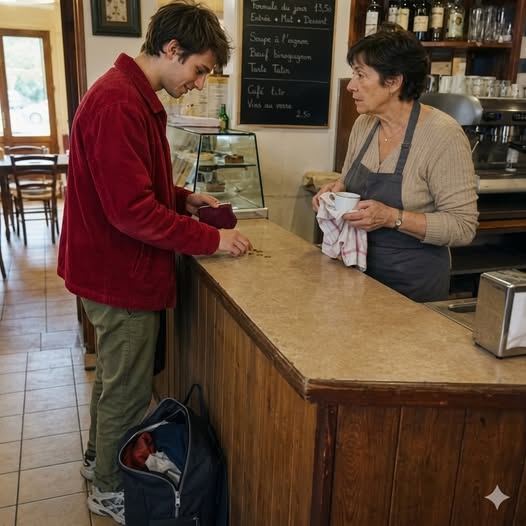
He placed 17 cents on my counter; five years later, his hands made me tremble.
I worked in a small roadside cafe, not far from a gas station.
A simple place.
Strong coffees, ham sandwiches, daily specials, hurried workers, tired drivers, regulars who hardly ever looked up from the newspaper.
That evening, I was alone behind the counter.
I had just finished washing up. My legs ached. My back too. I was already thinking about closing the till, going home, taking off my shoes and not talking to anyone anymore.
Then the door opened.
A boy came in.
He was perhaps eighteen years old. No more.
He was wearing an oversized jacket, damaged at the sleeves. His hair fell over his forehead. He was holding an old sports bag against his chest as if someone was about to take it from him.
He approached the counter without looking at me.
Then he placed some coins in front of me.
Small red coins.
“Is that enough for a coffee?” he asked.
I lowered my eyes.
17 cents.
I didn’t reply right away.
Not because I was making fun of him. On the contrary. I saw his shame. It was there, on his shoulders, in his fingers, in the way he kept his head down.
I told him gently:
“Sit over there. I’ll make you one.”
He immediately backed away.
“I don’t want to bother you.”
“You’re not bothering anyone.”
I served him a coffee.
Then I went into the kitchen. There was some soup left, some bread, two slices of cold roast and a slice of apple pie.
Nothing big.
But enough for someone who was hungry.
When I placed the plate in front of him, he turned pale.
“Madam, I cannot pay for that.”
“Nobody asked you to pay. Eat.”
He looked at me as if I had just said something impossible.
Then he ate.
At first, slowly.
Then, faster.
Not like someone who’s enjoying themselves. Like someone who hasn’t had the right to relax in a long time.
His name was Bastien.
He told me after a few minutes. His voice was low. He had left a foster home a few days earlier. He was an adult now. He said he wanted to fend for himself, find an apprenticeship, do something with his hands.
Plumbing, heating, building, anything.
“I don’t want to stay like this,” he told me. “I just want to be allowed to start somewhere.”
That sentence made my throat tighten.
I had a son almost the same age.
He had a room, a key, a washing machine, someone who would save him a plate when he came home late.
Bastien, on the other hand, had 17 cents and a sports bag.
I went back to the back room.
In my apron pocket, I had my tips for the week.
28.40 euros.
I was counting on it.
Not for my own enjoyment. To fill the fridge, put in some gas, and last until the end of the month.
I stood there for a few seconds with the money in my hand.
Then I prepared a small bag with what was left clean in the kitchen. Bread, soup in a can, the pie well wrapped.
I went back to him.
I gave him the bag.
Then I slipped the 28.40 euros into his palm.
He immediately withdrew his hand.
“No. You work too hard for that.”
I smiled, but my eyes were moist.
“Yes. But tonight, you need it more than I do.”
He didn’t speak anymore.
His lips trembled. He tried to say thank you, but no words came out.
So I wrote down the address of a small, inexpensive room, a fifteen-minute walk away. A clean place. Modest, but quiet.
Before he left, I told him:
“You don’t owe me anything. One day, if you can, you’ll do the same for someone else.”
He took me in his arms.
An awkward hug, too tight, full of fatigue.
Then he left with his bag, his meal and my 28.40 euros.
Years have passed.
The cafe has hardly changed.
Me, yes.
I had more wrinkles, less patience, knee pain, and still this habit of counting every coin at the end of service.
I rarely thought about Bastien.
Not out of indifference.
Life quickly brings back the bills, the impatient clients, the glasses to wash, and the days that start all over again.
And then, one Tuesday at noon, the door opened.
A man entered.
Clean work jacket. Safety shoes. Calm face. Strong, damaged hands with small marks around the fingers.
He sat down at the same table.
Exactly the same.
I approached with my notebook.
He looked up at me and smiled.
“A coffee, please. This time I have a little more than 17 cents.”
I felt my heart stop.
I looked at his face.
Then his hands.
They were the ones I recognized first.
“Bastien?”
He stood up.
I think I forgot about all the coffee for several minutes.
He told me.
The room he had taken that night.
The first night he had slept without being afraid of the next day.
The next morning, he went and knocked on the door of a small workshop. He asked for an internship. Then an apprenticeship contract.
He had learned slowly, but seriously.
Today, he worked in a small plumbing and heating installation company. He even trained young people with his boss.
Then he placed an envelope on the table.
Inside, there were 284 euros.
I pushed her away immediately.
“No, Bastien. That’s way too much.”
He shook his head.
“That’s ten times 28.40 euros. And even then, it’s not enough.”
I didn’t know what to say anymore.
He placed his hand on the envelope.
“That night, you didn’t just give me money. You gave me proof. Proof that I wasn’t completely invisible.”
My eyes filled with tears.
Then he told me what happened next.
In their workshop, they take on each year a young person who is leaving a foster home or who has no one behind them.
Not out of pity.
With rules. With patience. A proper lunch when necessary. A second chance when the first step is missed.
“I can’t help everyone,” Bastien told me. “But I can avoid looking away. I learned that here.”
I sat down opposite him.
And I cried.
Not for the money.
For the 17 cents.
For the bowl of soup.
For this boy who had almost disappeared into silence and who, now, was reaching out to others.
Sometimes we believe that a small gesture makes no difference.
But sometimes, a small gesture can become a door.
And behind that door, there is a whole life that was just waiting for someone to believe in it.
He came back with an envelope, but it wasn’t the money that was going to upset me.
I thought Bastien had come back to close an old chapter.
I was wrong.
He hadn’t come to settle a debt.
He had come to open a door that I hadn’t even seen.
The envelope was still between us, placed on the small table near the window.
284 euros.
Ten times my 28.40 euros.
I looked at her as if she was going to burn my fingers.
“Bastien, I cannot accept this.”
He smiled gently.
Not a smile of pride.
A calm, tired smile, almost an adult too soon.
“So don’t take it personally. Save it for the next person.”
I didn’t understand right away.
He looked around him.
The old counter.
The chairs are a bit wobbly.
The coffee machine that was always too noisy.
The window where the trucks passed by in reflection.
“There will be others,” he said. “People who will come in here with less than they should. Not always young people. Not always with a sports bag. But with the same shame.”
I lowered my eyes.
Because I knew he was right.
I often saw shame.
In the hands that count the change for too long.
In the glances that avoid the map.
Among people who just ask for a glass of water but have an empty stomach.
I told him:
“And what do you want me to do? Feed the entire nation?”
He laughed a little.
“No. Just don’t look away. Like you did for me.”
I didn’t reply.
Because sometimes, a simple sentence goes further than a long speech.
That day, I finally took the envelope.
Not for me.
I put it away in an old metal box, the one where I used to keep receipts and lost buttons.
On a small piece of paper, I wrote:
For someone who is starting out.
I didn’t yet know that these words would change the atmosphere of the cafe.
At first, I didn’t tell anyone.
When a driver didn’t have enough for his sandwich, I would simply say:
“That’s enough for today.”
When a tired mother asked for a coffee and shared a slice of pie with her daughter, I would put down two plates.
When an old man came just to warm his hands around a cup of tea, I didn’t look too long at his worn coat.
I was doing it discreetly.
Like putting a blanket over someone who is sleeping.
Then Bastien started to come back.
Not every day.
But once a month, sometimes twice.
He was passing by at midday, wearing his work jacket, with his marked hands and a calm demeanor.
He was having a coffee.
Always at the same table.
And before leaving, he would drop some bills into the box.
Never with ceremony.
Never so that we would see it.
He would just lift the lid, slide in the money, then throw it at me:
“For someone who is just starting out.”
One day, a regular customer noticed it.
A man who worked on construction sites, in his fifties, always in a hurry, always grumpy.
He asked me:
“What is this box?”
I hesitated.
Then I replied:
“A box for people who are hungry but don’t have enough money.”
He made a face.
I was prepared for a harsh remark.
But he just took two euros out of his jacket.
“Put that in there. I’ve been through that too.”
After him, others followed.
Not all of them.
Some pretended not to see.
Others gave twenty cents, fifty cents, an unused drink ticket.
One morning, a woman left a package of biscuits still sealed.
A retiree paid for three coffees in advance.
A bus driver told me:
“If anyone needs a hot meal, serve it. I’ll come by to pay next week.”
I never put up a large poster.
I never wanted to turn it into a show.
Just a small piece of paper near the cash register:
Here, if you’re going through a tough time, just say: “a simple coffee”. We’ll understand.
It was discreet.
Worthy.
No one needed to explain their life in front of everyone.
Bastien had insisted on that.
“Shame is more tiring than hunger,” he once told me.
And he knew what he was talking about.
Months have passed.
The box never stayed full for long.
But it was never completely empty either.
It was strange.
Before, I used to count every coin with fear.
Now, I was also counting what people were capable of leaving behind.
And that warmed me up a little.
One November evening, as I was putting away the chairs, the door opened gently.
A boy came in.
Nineteen years old, maybe.
Skinny.
Hollow cheeks.
A hood over his head.
He was holding an almost empty supermarket bag.
He approached the counter and whispered:
“Just a simple coffee, please.”
I stopped.
I felt my heart tighten.
Because I saw Bastien again.
Not his face.
His silence.
This way of asking without really daring to ask.
I served him a coffee.
Then some soup.
Then some bread.
He wanted to protest, like Bastien once did.
I told him:
“Here, when you order a simple coffee, you have the right to sit down.”
He nodded.
He said almost nothing.
But he ate.
Slowly.
While keeping one hand on her bag.
Before leaving, he asked me:
“How much do I owe?”
I replied:
“Nothing today. One day, if you can, you’ll do the same for someone else.”
I had already said those words.
But this time, they weren’t just mine anymore.
They belonged to Bastien too.
A few days later, I told Bastien the story when he came by.
He remained silent.
Then he looked at the box.
“You see?” he said. “The door is still holding.”
I didn’t understand.
He smiled.
“The door you opened that night. It hasn’t closed.”
I had to turn away to wipe the counter.
Not because it was dirty.
Because my eyes were stinging.
What Bastien didn’t know yet was that I too would soon need a door to remain open.
The following spring, the cafe owner announced that he wanted to sell.
Not because of a tragedy.
Not because of a great story.
Just age.
Fatigue.
The years behind the counter.
He told me that one morning, between two coffees.
“I can no longer continue as before.”
I understand.
But I felt the ground move beneath my feet.
That coffee wasn’t mine.
Yet, I had left twenty years of my life there.
My mornings are too early.
My service ended too late.
My knee pain.
My silences.
My smiles when I didn’t feel like it.
And now, everything could disappear.
The counter.
The box.
Bastien’s table.
Simple cafes.
I didn’t tell anyone for several days.
Not even to Bastien.
I served the customers as usual.
But every time I passed by the box, I felt like I was looking at a small light before it was turned off.
Bastien came in on a Tuesday at lunchtime.
He looked at me for five seconds and asked:
“What’s wrong?”
I wanted to lie.
I didn’t succeed.
I told him everything.
The boss.
The sale.
The fear that the place will become something else.
A cleaner, colder, more expensive place.
A place where a boy with 17 cents wouldn’t even dare push open the door.
Bastien didn’t speak right away.
He placed his hands on the table.
Those hands that I recognized before her face.
Then he said:
“So we have to keep the spirit of the café, even if the walls change.”
I shrugged.
“Nice words are easy. Me, I don’t know how to do much besides serve, clean, and stand up.”
He looked at me with a gentleness that almost offended me.
“You still don’t realize, do you?”
” What ? “
“You know how to welcome people when they are ashamed of existing. That’s no small thing.”
I didn’t reply.
Because I had never thought about my work like that.
For me, I was serving coffee.
I was cutting bread.
I was wiping down tables.
I was giving the change.
Bastien, however, saw something else.
Two weeks later, he returned with his boss.
A simple man, grey hair, a firm handshake.
No grand speeches.
No brilliant promises.
Just a suggestion.
In their workshop, they had a small unused room near the entrance.
A corner with an old table, two hot plates, a sink, a window.
They wanted to make it a space for apprentices.
A place to eat a hot lunch.
Where to get a coffee.
Where to talk a little when the day starts badly.
Bastien looked at me.
“We need someone to keep it going. Not like a canteen. Like here.”
I thought he was joking.
Me, in a workshop?
With young people in safety shoes, pipes, tools, and construction noises?
He added:
“It won’t be your average cafe. But there will be a table. A coffee maker. People starting out.”
I felt my throat tighten.
People who are just starting out.
Those words again.
The cafe closed two months later.
Not brutally.
Not sadly either.
On the last day, more regulars than usual came.
Some pretended to be joking.
Others stayed too long in front of their cups.
Bastien arrived in the late afternoon.
He brought a small wooden sign.
On it, he had engraved:
For someone who is starting out.
I touched it with my fingertips.
The wood was soft.
The letters are a little irregular.
You could see that it had been done by hand.
I took it with me in the metal box.
The following week, I started at the workshop.
At first, I felt like I was in the way.
I didn’t know the technical terms.
I couldn’t distinguish between all the tools.
I would jump whenever a drill started up.
The young people were looking at me with curiosity.
A woman my age, clean apron, hair tied back, preparing soup in a small room at the back of a workshop.
But they understood very quickly.
I wasn’t there to supervise them.
I was there so they would have a place to put down their fatigue.
The first one to come regularly was called Noah.
Seventeen and a half years old.
Too thin.
Too proud.
Always saying:
“It’s okay, I’m not hungry.”
But sometimes his stomach would respond before he did.
I pretended not to hear.
I was just putting a plate down for him.
“At least try it. If it’s not good, you’ll complain later.”
The first time, he ate without looking up.
During the third week, he helped me carry a crate of bottles.
In the second month, he asked me how to make a simple apple pie.
“For whom?” I asked.
He blushed.
“For me. To know.”
I smiled.
Bastien saw it too.
I think it upset him more than he wanted to show.
One lunchtime, I caught him standing in front of the small wooden sign.
He watched him in silence.
I asked him:
“What are you thinking about?”
He replied:
“The evening I walked into your café, I wonder what would have happened if you had said no.”
I didn’t like that sentence.
It was too cold.
So I replied to him:
“I didn’t say yes to your entire future, Bastien. I just gave you a bowl of soup. The rest is up to you.”
He shook his head.
“Maybe. But someone had to make me believe it was worth starting.”
That day, Noah heard us.
He said nothing.
But he looked at Bastien differently.
Not like a deputy boss.
Not like an adult giving orders.
Like someone who had been through something.
At the end of his apprenticeship, Noah came to see me with an envelope.
I almost laughed.
“Oh no. Not another envelope.”
He smiled, embarrassed.
There was no money inside.
There was a photo.
He, in clean clothes, in front of his first completed construction site.
On the back, he had written:
Thank you for the meals when I said I wasn’t hungry.
I cried.
Again.
I think I cry more easily with age.
Or perhaps I’m better at recognizing important moments.
Bastien framed the photo and placed it near the sign.
Then more photos came.
Not many.
Just enough.
Young people with a degree.
A first contract.
A first bedroom of their own.
A shared meal.
Dirty hands, but proud.
The metal box is still there.
She has a few bumps now.
The lid doesn’t close properly.
But nobody wants to replace her.
She’s coming from the cafe.
It comes from the evening of the 17 cents.
Sometimes I think back to the end of my shift when I was exhausted.
I just wanted to go home.
Stop talking.
Stop giving.
No longer being the one who still holds on when everyone else is leaning on her.
Then a boy came in with 17 cents.
And without knowing it, he gave me back something I had almost lost.
The feeling that my little life could have a slightly positive impact.
Today, Bastien trains young people.
Noah, in turn, helps others.
And I’m still making coffee.
Not behind the same counter.
Not with the same brand.
But with the same phrase in my head:
You can’t always save someone with grand actions.
Sometimes, we save him by leaving him a chair.
Hot soup.
An open hand.
Proof that he is not invisible.
And when this evidence passes from one person to another, it becomes greater than us.
It becomes a chain.
A gentle chain.
Solid.
Human.
So yes, Bastien refunded my 28.40 euros.
But what he gave me back is worth much more than that.
He restored my certainty that no good deed ever truly disappears.
He’s waiting somewhere.
In a pocket.
In a dented box.
In the hands of a man who once had only 17 cents.
And one day, without warning, he returns.
Not to say thank you.
But to continue.